Anti-blacklist demo targets Olympic site

NO TRUCK Anti-blacklist protesters stopped traffic entering the Olympics site, in a protest against the dismissal of whistleblower Frank Morris.

Anti-blacklist protesters caused chaos outside London’s Olympic Park this week when they stopped deliveries getting onto the site for more than an hour.

Traffic ground to a halt in Pudding Mill Lane on 1 March as the demonstrators from the Blacklist Support Group crossed continually a zebra crossing near the site gates. Traffic disruption is a common and very effective union protest tactic in the US, but is new to the UK.

The protesters were supporting an RMT member who was recently removed from the job. Enfield-based electrician Frank Morris was shifted from his job at the prestigious media centre at the Olympic site after blowing the whistle on the use of an illegal blacklist on the construction project.

His dismissal by subcontractor Daletech Services followed weeks of intimidation and threats of violence by members of senior management after he had raised concerns about the dismissal of a co-worker.

The co-worker was dismissed from the Olympic Media Centre being built by Skanska and Carillion after his name appeared on a blacklist of trade union members, many of whom were targeted for their health and safety activities. After Morris raised concerns about this illegal practice, he says he was victimised, bullied and threatened with violence by senior management to the point that he had to call the police for his own protection before finally being dismissed.

RMT is backing his unfair dismissal claim to an industrial tribunal. RMT union official Steve Hedley commented: “In over 25 years representing workers I have never seen such a blatant stitch up, victimisation and even threats of violence to a union activist whose only ‘crime’ was to expose an illegal blacklist operating on the Olympic site.”

Site worker Paul Tattersfield has become the latest worker to win a blacklisting tribunal. It found Balfour Beatty Engineering Services Ltd has refused him employment because he was on The Consulting Association blacklist. The company is known to have been a major support of the covert blacklisting operation.

The tribunal awarded him just under £24,000 including loss of earnings, injury to feelings and aggravated damages.

Construction firm guilty of blacklisting

A major engineering construction contractor has been found guilty by an employment tribunal of blacklisting a prominent trade unionist.

Ashford Employment Tribunal ruled that Unite member Phil Willis had been unlawfully refused employment by CB&I because he is a member of a trade union and a prominent activist. He was awarded £18,375 in damages. The case is directly linked to the seizure in 2009 by the Information Commissioner’s Office (ICO) of a blacklist run by the Consulting Association. CB&I were subscribers to TCA and used the services of TCA extensively.

Mr Willis submitted an application to CB&I for work as a steel erector on the Isle of Grain project in 2007. Although his application was acknowledged, he was not contacted again. Following the raid by the ICO Mr Willis obtained a copy of his blacklist file which contained information about his trade union activity. He brought his case under section 137 of the Trade Union and Labour Relations (Consolidation) Act 1992.

Speaking after the verdict Mr Willis said: “We are beside ourselves with delight. The judgment was absolutely damning against CB&I, so much so that it reduced us to tears. It was such a great victory for us and for all those who will eventually follow in our footsteps.”

Unite’s national officer for construction Tom Hardacre said: “It is the first successful case against a major construction company but it will not be the last. The union is currently providing legal support to a number of workers who believe they have been blacklisted.”

He added: “Unite intends to use the full force of the law to hold firms to account for systematically ruining people’s livelihoods just because a few brave men were prepared to stand up for the rights of their fellow work colleagues.”

Unite assistant general secretary Les Bayliss said: “Unite will be campaigning to strengthen the law on blacklisting to ensure employers do not even contemplate blacklisting trade union members.”

The Blacklist Support Group welcomed the landmark ruling. It added that the inclusion of £2,000 in the payout for “aggravated damages”, specifically related to the company’s involvement with The Consulting Association blacklist, was a major coup, “as aggravated damages are very rarely awarded.”

Blacklisting campaign gets national recognition

BSG awardMembers of the Blacklist Support Group collected an ‘Alan’ award at July’s National Hazards Conference in Manchester. They nabbed the biggest prize in safety activism following a highly successful campaign to expose the major construction employers who have operated blacklists targeting union safety activists.

Blacklisting case heads to full tribunal

An electrician blacklisted from the construction industry won the right to take his case to a full tribunal. Steve Kelly, one of over 3,000 workers whose data was found on an illegal blacklist run by disgraced firm The Consulting Association, believes he was targeted because of his trade union health and safety activity.

At a preliminary tribunal last week in east London Mr Kelly won the right to bring a case to full tribunal against electrical sub-contractors ECS. He was employed by the firm in 2007 but was sacked within days, allegedly for poor work.

However after obtaining his file from the Information Commissioner’s Office he discovered documentation which he believes shows that either the firm, which was a sub-contractor for Sir Robert McAlpine, or McAlpine’s itself dismissed him due to his trade union activities.  Both firms have denied the allegation, although McAlpine’s is known to have subscribed to The Consulting Association’s blacklist and was one of the most enthusiastic users of the service.

Mr Kelly also believes that his being blacklisted cost him a number of other jobs in the industry. He told the Morning Star: “My only aim was to earn a living and improve health and safety conditions for myself and my workmates but I’ve been treated like a criminal. I’ve been robbed of the trade I decided to go into as a 16-year-old.”

He added he “was more fortunate than some, I’ve heard of people who lost their homes, their families, marriages split up. I know of five former workmates who have committed suicide since, primarily because they couldn’t get work.”

The tribunal is scheduled for April 2011.

Blacklist bosses to be named and shamed

Construction bosses who personally sanctioned the use of blacklists in the industry are set to be named and shamed.

The move means managers at construction giants like Balfour Beatty, Kier and Sir Robert McAlpine could be publicly outed for their role in the blacklist scandal, reports the online trade publication Construction Enquirer.

The decision follows a 12 month legal fight by anti-blacklist campaigners to have made public all the documentation unearthed in the Information Commissioner’s investigation last year. Employment details of thousands of workers were held illegally by The Consulting Association, used by construction firms to vet prospective employees.

A legal ruling means the Information Commissioner’s Office (ICO) must now reveal full details of a number of test cases. Other victims of the blacklist are expected to follow suit and bring claims for full disclosure following the ruling by Manchester Employment Tribunal. The test cases that established the full disclosure precedent involve prominent campaigners against the blacklist including Phil Willis and Steve Acheson.

A spokesperson for the Blacklist Support Group said the precedent was “brilliant”, adding: “This is a major victory for blacklisting campaigners in the courts. Most of the multinational companies involved in The Consulting Association conspiracy have frustrated all attempts to gain further documentation in this case – now the evidence will be out in the public domain for all to see.”

Documentation, invoices, correspondence and business and organisational relationships between The Consulting Association and construction firms must be released under the terms of the ruling.

Site firms scoop blacklisting awards

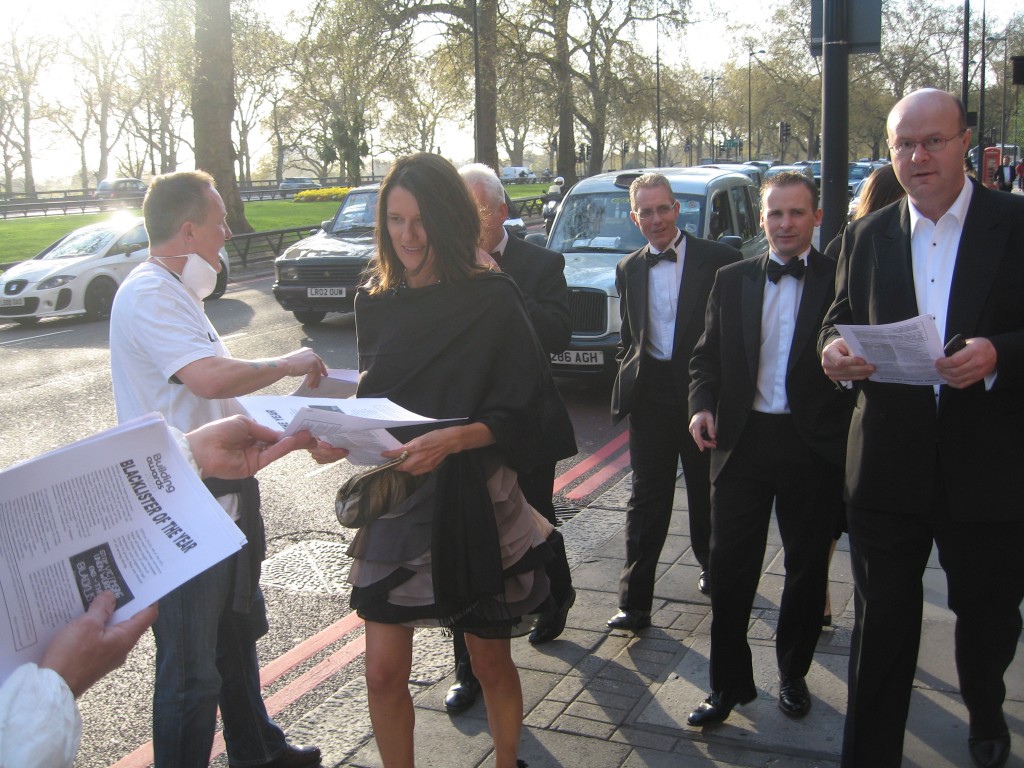
BAD TASTE Blacklisted construction workers reminded construction industry black tie revellers at the UK National Building Awards 2010 of their distasteful habits.

Campaigners from the Blacklist Support Group provided some extra entertainment at the swish National Building Awards 2010 dinner at London’s Grosvenor House Hotel.

The campaign presented its own alternative Blacklister of the Year Awards as the construction industry revellers assembled for the 22 April black tie event.

Balfour Beatty won the category for “Most Enforcement Notices Issued by the Information Commissioner,” with a soaraway 14 notices.

Skanska headed the “Largest Blacklisting Invoice” category, with £28,123 in one year, pipping Sir Robert McAlpine’s £26,842 in payments to covert blacklisting group The Consulting Association.

The former head of the association, Ian Kerr, bagged the “Lifetime Achievement Award.”

A special category, the “Hear No Evil See No Evil Speak No Evil Award”, went to Skanska for its three month internal blacklisting investigation that found no-one in management did anything to merit even a verbal warning.

Safety watchdog the Health and Safety Executive (HSE) received an honourable mention in this category.

Law professor Keith Ewing of Kings College London welcomed the awards.

He said: “Blacklister of the Year is an important initiative to remind those attending the National Building Awards of the scandal that hangs over their industry. 

“While the fat cats purr with delight at their lavish black tie banquet in the Grosvenor House Hotel, they need to be confronted – in what is an era of austerity for everyone else – about their role in ruining the lives of thousands of British construction workers.”

Whistleblowing ETs could attract regulators

PHONE HSE? Things could be looking up for whistleblowers under new employment tribunal (ET) rules.
PHONE HSE? ETs could finger safety offenders.

Employers that choose to dismiss or pay off workplace whistleblowers could face further investigation from 6 April, when the current bar on employment tribunals (ETs) revealing any details of whistleblowing allegations outside of the tribunal process is lifted.

Under the new system, tribunals will be able to refer claims to the relevant regulatory authority, such as the Serious Fraud Office or Health and Safety Executive, for further investigation, reports human resources magazine Personnel Today.

It quotes Mark Hammerton, partner at international law firm Eversheds. “To date, even where allegations heard by an employment tribunal involved potentially serious fraud, health and safety breaches or financial irregularities, employment tribunals have been unable to pass them on,” he said.

“I would urge all employers to now review their current procedures and practices for dealing with whistleblowing claims and to ensure any such allegations are addressed as early as possible. Failure to do so could otherwise mean that employers learn of their alleged wrongdoings only once they have escalated to a formal external investigation.”

A report last week by the charity Public Concern at Work revealed that work safety is a top whistleblower concern and one of the most common reasons for whistleblower employment tribunals.

Work safety is a top whistleblower concern

The number of employees claiming to have been sacked, mistreated or bullied for exposing corrupt practices at work has increased tenfold over the last decade, according to official figures – and raising health and safety issues remains one of the top concerns.

Whistleblowing charity Public Concern at Work (PCAW) has called on the government and employers to do more to encourage people to speak up about malpractice or wrongdoing by publicising existing support and legal protection for workplace whistleblowers.

Commenting on the release of ‘Where’s whistleblowing now – 10 years of legal protection for whistleblowers’, its report into ten years of the Public Interest Disclosure Act (PIDA), the legislation intended to protect from reprisal workers who raise a matter of public concern, PCAW director Catherine Wolthuizen said: “Workers in the UK are increasingly prepared to speak up about wrongdoing in the workplace, but the ever-rising number of Employment Tribunal claims for victimisation demonstrates employers need to do more to protect their staff from retribution.”

Employment tribunal statistics show that the total number of people using the PIDA whistleblowing legislation, which aims to protect workers from victimisation if they have exposed wrongdoing, increased from 157 cases in 1999 to 1,791 ten years later.

Workplace safety is the second most common reason individuals contact the PCAW helpline, accounting for 17 per cent of all calls, topped only by financial malpractice at 26 per cent. A PCAW breakdown of “types of wrongdoing in PIDA judgments” says 12 per cent of these tribunal decisions relate to work safety, behind only financial malpractice (19 per cent) and “consumer/competition and regulation” (13 per cent).

Labour leaves blacklisted high and dry

Construction workers like blacklisted bricklayer turned union full-timer Mick Dooley – whose human rights have been traduced by a practice revealed by their files to have been going on since the 1970s – have been left empty-handed, denied any compensation for the losses they have suffered at the hands of the construction companies, according to labour law expert Professor Keith Ewing.

Writing in The Guardian, Prof Ewing noted: “In the absence of a right not to be blacklisted, Dooley argued that he had been the victim of anti-union discrimination. A London employment tribunal has held against him, on the ground that he does not qualify under the legislation. Even if he did, like other workers in the same position the problems of proof would not be easy to overcome (for obvious reasons).”

The Kings College London academic indicates that part of the problem arises because Labour has only just introduced anti-blacklisting regulations. “But they are woefully inadequate. Not only do they fail to make blacklisting an offence, but they also fail to make blacklisting unlawful.”

He adds: “The biggest failure of the regulations, however, is the government’s failure to take steps to compensate the victims of blacklisting, who will now have to pursue a claim to the European court of human rights…”

He contrasts Labour’s inaction and weak laws on union victimisation with the action by Margaret Thatcher when she came to power. Anti-union laws curbed the power of unions  and a retroactive scheme was introduced to compensate workers dismissed because of union non-membership.

“If the Tories can compensate at public expense workers who suffered loss because of their non-membership of a trade union, then surely a Labour government could have done the same on behalf of workers whose lives have been blighted because of their membership of a trade union, and participation in its activities. Next stop Strasbourg, it seems.”

Campaigners condemn lack of blacklisting protection

Campaigners have condemned the lack of protection given by UK employment law to trade unionists falling victim of employer blacklists. They were speaking out after an 8 March written judgement from the first full-merits blacklisting Employment Tribunal, Dooley v Balfour Beatty, found in favour of the company.

Balfour Beatty did not deny using an illegally compiled blacklist to target bricklayer and union activist Mick Dooley. Instead it used documents it had made available to disgraced and now shutdown blacklisting organisation The Consulting Association in its tribunal submission.

While the judge, Mr BT Charlton, described blacklisting as “ghastly”, he found in favour of the construction giant because while Balfour Beatty has sought Mick Dooley’s dismissal, it wasn’t his actual employer – and the law only covers employees.

According to campaign group the Blacklist Support Group: “In an industry where sub-contracting and agency labour is widespread, this effectively allows the major multi-nationals such as Balfour Beatty, Sir Robert Mc Alpine, Skanska and Costain to blacklist workers who complain about safety or unpaid wages with impunity (as almost all labour is sub-contracted out).”

A spokesperson for the group said: “The Dooley decision and the new Blacklisting Regulations are basically a get out of jail free card for the major contractors. The blacklisters can hide behind the fact that they sub-contract most of the labour on major projects to escape any kind of legal responsibility.

“The new regulations will not make an ounce of difference to the likelihood of success for any blacklisted building worker seeking legal redress. If the new Regulations fail to make any difference for workers who can prove they have been blacklisted, what is their purpose?”

The Consulting Association “conspiracy” is a clear breach of Article 11 of the European Convention on Human Rights, he added. “The Blacklist Support Group send out an unambiguous message today: if our human rights cannot be upheld in the UK courts or from UK Regulations, then we will be taking our claims to the European Court of Human Rights. We have suffered for many years: we are prepared to fight all the way.”