|
TOILET BREAKS: CASE
HISTORIES
Britain: Unite survey highlights women's workplace toilet struggle
A Unite survey of 12,000 women has revealed female workers are still struggling for access to clean toilets. The survey found 14 per cent face sporadic or no access to workplace toilets, while 17 per cent encounter unhygienic facilities. Industries like transport report nearly half of bus workers affected. Respondents shared accounts, from health issues to embarrassment over necessary breaks. Unite General Secretary Sharon Graham said: "Access to clean, dignified toilets is a fundamental right, not a privilege. Yet, our survey starkly exposes the ongoing neglect many women face in the workplace."
Unite News
Hazards news,
27 November 2023
Britain: Toilets for drivers a ‘basic human right’
Toilets for taxi and private hire drivers, courier and road transport workers are a ‘basic human right’, GMB’s congress has heard. Mike Tinnion, GMB London region delegate said: “This is a health and safety issue for professional drivers,” adding: “If you risk not using a proper facility you can face prosecution and can lose your job.”
GMB news release.
Hazards news,
7 June 2023
Britain: Director penalised over unusable open air toilet
Construction company ID8 Design and Build Ltd and its director Adeel Bhatti have been fined for failing to provide suitable welfare facilities at a North London construction site, with and HSE investigation finding the was no rest facilities and the toilet provided was not flushable and was in a room without a door or window coverings. There was no sink, no hot water, no soap and no towels – cold water was only available from a pipe in the room next to the toilet.
HSE news release. Construction Enquirer.
Hazards news.
22 February 2023,
Britain: Train driver tragedy prompts safety recommendations
An official investigation after the death of a train driver who it is believed may have got out of his cab to urinate and was hit by another train has called for safety improvements on the network. The train drivers' union Aslef, which described the report a ‘wake up call’ for the industry, had previously raised concerns that the model of train he was driving has no toilet and the West Worthing timetable did not allow drivers time to use a toilet between services.
RAIB news release and report. BBC News Online. Sussex Express. The Argus.
Hazards news,
22 February 2023
Global: Decent sanitation ‘a vital right’ for workers
Across the world, millions of transport workers - and women transport workers in particular - face the indignity of workplaces where it is nearly impossible to do something as simple as go to the toilet, ITF has said. The global transport union said in workplaces in every corner of the globe, transport unions and ITF-affiliates are leading the struggle for the right to decent sanitation facilities, with the help of the ITF Sanitation Toolkit.
ITF news release and case history. Sanitation rights are human rights: public transport worker voices , ITF, November 2022.
Hazards news,
23 November 2022
Britain: Government fails to spend a penny on driver toilets
The government’s much heralded multi-million pound budget to improve toilet facilities for lorry drivers has been entirely unspent after a year, research by Unite has found. Following a freedom of information request made by Unite, DfT – which is responsible for administering the funding – has admitted that a year after Sunak made the funding commitment: “No companies have as yet received funding from the £32.5 million match funding scheme.”
Unite news release, FOI findings and Toilet Dignity campaign.
Hazards news,
23 November 2022
Britain: Lack of toilets makes lorry drivers sick
Lorry drivers are leaving the job and even becoming ill because of a shameful lack of toilet facilities they can use during work, according to new research by Unite. One in 10 of the 1,700 drivers surveyed by the union said a lack of toilets on the roads resulted in them developing a medical condition.
Unite news release. Morning Star.
Hazards news,
23 November 2022
Britain: Unite protest at MoD toilet shame
Members of Unite marked the UN-recognised World Toilet Day on Saturday 19 November with a protest outside RAF Cranwell in Lincolnshire, to highlight the Ministry of Defence’s failure to provide decent toilets for workers. The problem initially arose when the first female civilian firefighters were recruited to the base in 2014, where ageing facilities were not fit for purpose or suitable for unisex use.
Unite news release. World Toilet Day.
Hazards news,
23 November 2022
Britain: Toilet facilities ‘essential’ on railways
Staff and passengers working and travelling on Britain’s railways deserve decent toilet facilities, ASLEF has said. Marking World Toilet Day on 19 November, the train drivers’ union said it would “again lobby the government, train companies and industry groups on the need for access to clean, safe, and appropriate toilets.”
ASLEF news release.
Hazards news,
23 November 2022
Britain: Train drivers shouldn’t be dying for a toilet
A train driver was killed after getting out of his cab to urinate at the track side because there were no toilets on board, drivers’ union ASLEF has said. The union is waiting for the Department for Transport’s Rail Accident Investigation Branch to produce its report into the tragedy - but it is calling on all rail operators to remedy the lack of facilities for train crew where no toilet is provided on board.
Morning Star.
Hazards news,
28 October 2022
Britain: Train drivers forced to use incontinence products
The UK government and rail firms are using the pandemic ‘health emergency’ as an excuse to force through changes that mean the safety and dignity of train drivers is being disregarded. In 13 June evidence to MPs, rail union ASLEF said some train drivers were so short of breaks they had to rely on incontinence products.
Transport Select Committee hearing on rail strikes, 13 July 2022. The Guardian. Risks 1052.
Hazards news,
19 July 2022
Global: ITF launches sanitation rights toolkit
A new toolkit containing resources for transport workers to win sanitation rights has been launched by the sector’s global union ITF. The toolkit includes key information about health risks related to a lack of access to toilet and welfare facilities, checklists for negotiators and model contract language.
ITF news release, Sanitation Toolkit and Sanitation Charter. Risks 1035.
Hazards magazine
9 March 2022
Britain: Train drivers need to stop at the loo
Accessing suitable toilet and hygiene facilities across the UK rail network is a ‘real problem’ for train drivers, their union ASLEF has said. Commenting on World Toilet Day, the 19 November United Nations annual event intended to inspire action to tackle the global sanitation crisis, the union said the problem affects drivers on lots of difference services.
ASLEF news release. Morning Star article and Mick Whelan commentary.
Health implications of not having access to toilets at work, ASLEF, November 2021 – publication alert and online resource list and full report.
ITF news release and campaign for clean, safe, accessible toilets for transport workers. Risks 1023.
Hazards news,
23 November 2021
Britain: Delivery drivers need to go to the toilet
Distribution and retail trade union Usdaw is calling for all drivers to be provided with safe and easy access to toilets and other welfare facilities. The union said drivers have faced a lack of appropriate facilities for many years, both at the roadside and when making deliveries
Usdaw news release. Morning Star. More on health and safety and toilet breaks. Risks 1023.
Hazards news,
23 November 2021
Britain: Health and access to toilets at work
A new report from the train drivers’ union ASLEF, ‘Health implications of not having access to toilets at work’, says a lack of access during the working day is a human rights issue, an occupational health and safety issue, an equality issue, and a public health issue. It says workers must be provided safe, clean and appropriate toilet facilities and the opportunities to use them. The report includes an extensive resources list.
Health implications of not having access to toilets at work, ASLEF, November 2021 – publication alert and online resource list and full report.
Hazards resources on toilet breaks at work. Risks 1022.
Hazards news,
17 November 2021
Australia: Women’s amenities should be mandatory
Women’s amenities to be mandatory on worksites across Australia to boost the number of women in male dominated industries, a union has said. The Electrical Trades Union (ETU) is launching a ‘Nowhere To Go’ campaign after its report outlined the ‘significant obstacles’ women face within the industry and makes recommendations on how to increase female participation.
Mirage News. Risks 1012.
Hazards news,
2 September 2021
Australia: Costly bid to block women’s toilet
Australia’s federal building industry watchdog has defended its decision to spend more than half a million dollars unsuccessfully pursuing a union through the courts after organisers demanded a women’s toilet on a Melbourne worksite. The action by the Australian Building and Construction Commission (ABCC) came after a CFMEU official said there should be a union enterprise agreement covering a project, with the union also noting a woman working on the site had previously been forced to use the men’s toilet.
ACTU news release. Sydney Morning Herald. ABC News. Risks 1010.
Hazards news,
19 August 2021
USA: Amazon grovels after pee-in-vans denial
Amazon has apologised to a US politician for falsely denying its drivers have been forced to urinate in plastic bottles. Mark Pocan, a Democrat from Wisconsin, referenced Amazon making “workers urinate in water bottles” in a tweet; the official Amazon Twitter account then replied: “If that were true, nobody would work for us,” but then apologised after evidence emerged of drivers having to urinate in bottles.
Amazon statement and Amazon twitter exchange with Rep. Pocan. BBC News Online. Risks 992.
Hazards news,
14 April 2021
USA: Proof Amazon knows drivers forced to pee in bottles
A denial by Amazon that its delivery workers have been forced to pee in bottles or poop in bags was shot down last week when a leaked internal memo revealed the company has been aware of the problem for at least several months. Documents provided by employees at Amazon to the Intercept showed that an email sent in May 2020 admonished workers for urinating in bottles and defaecating in bags while on the job.
The Intercept. The Guardian. Risks 991
Hazards news,
31 March 2021
Britain: Working drivers denied access to toilets
Professional drivers are routinely and illegally denied access to toilets during working hours, a union survey of thousands of professional drivers has found. The research by the Unite involved over 6,000 of its driver members and found that during their normal working day, 70 per cent do not have adequate access to toilets and washing facilities.
Unite news release. Risks 974.
Hazards news, 19 November 2020.
Britain: McDonald's apologises for stopping couriers using loos
Fast food chain McDonald's has apologised to food delivery drivers after they were denied access to its toilets. “We are sorry to hear that on some occasions this guidance has not been implemented, and we will be reminding our restaurant teams about the policy,” the company said.
BBC News Online. Drivers’ welfare at delivery and collection sites during the coronavirus (COVID-19) pandemic, HSE. Joint DfT/HSE open letter on access to hygiene facilities for drivers. Risks 974.
Hazards news, 19 November 2020.
Britain: Midwives missing out on breaks, report reveals
Overworked midwives are missing meals and loo breaks while at work as they do not have enough time to take them, union research has revealed. Midwives are also working additional unpaid hours, on top of long shifts, according to a survey of 980 professionals in England carried out by the Royal College of Midwives (RCM).
RCM news release. Morning Star. Risks 962.
Hazards news,
29 August 2020
Britain: Fast food chains accused of ‘taking the pee’
Unite has demanded that takeaways and major fast food chains stop breaking the law and allow fast food couriers to use their toilets. The union said it has been contacted by several self-employed couriers who work via platforms such as Deliveroo and Uber Eats, who are concerned that Covid-19 is being used as a excuse to bar them from using a toilet when collecting food from takeaways.
Unite news release. Risks 952.
Hazards news,
20 June 2020
Britain: Government cuts created coronavirus ‘hygiene nightmare’
Government cuts have heightened public hygiene problems with the closure of more than a fifth of public toilets in Britain during the past decade, according to UNISON figures. People across the country are being urged to wash their hands frequently and thoroughly in a government information campaign aimed at containing the spread of Covid-19, or coronavirus, but new freedom of information (FoI) figures gathered by UNISON show there has been a 22 per cent drop in the number of public toilets maintained by councils since 2010, with the closure of 979.
UNISON news release. Risks 937.
Hazards news,
7 March 2020
Britain: Dover congestion plans ignore lorry drivers’ welfare
The government’s latest plan for introducing a new system for dealing with potential Brexit-related disruption at Dover once again ignores the health and welfare of lorry drivers, the professional drivers’ union Unite has said. The union, which represents over 50,000 lorry drivers, has been seeking answers for over a year to drivers’ concerns about the lack of welfare provisions if there is major disruption on the roads towards Dover, either as a result of the introduction of customs checks or industrial action.
Unite news release. DfT news release. BBC News Online. Risks 935.
Hazards news,
22 February 2020.
Britain: ‘Dismal’ poultry firm awarded ‘worst toilet’ trophy
Unite has bestowed its ‘Golden Toilet’ award on a Two Sisters poultry factory in Deeside, Wales, as workers at the site step up their campaign to make the ‘dismal’ toilet facilities fit for purpose. The union said hundreds of workers employed at what is one of the UK’s biggest food companies, supplying KFC and Sainsbury’s, are up in arms, claiming an atrocious standard of toilet facilities at the food factory in Deeside, where hygiene is critical.
Unite news release. US NIOSH bathroom breaks blog. More on toilet breaks. Risks 926.
Hazards news,
7 December 2019
Britain: RMT highlights lack of toilet facilities for transport staff
Research by the transport union RMT has exposed ‘shocking’ lack of toilet facilities in workplaces, with women and disabled people particularly badly affected. An online survey by the union found more than 1-in-8 workers (13 per cent) do not have access to a toilet at work and almost half (45 per cent) are not given adequate time during working hours for toilet breaks.
RMT news release. Risks 925.
Hazards news,
30 November 2019
Britain: UK transport workers denied toilet dignity
Workers in the UK transport sector are being routinely denied access to toilets, creating health issues and in some cases forcing workers to leave their jobs, Unite has warned. Unite’s Diana Holland said: “The lack of access to toilets is simply intolerable and can and does result in our members developing severe health problems and in some cases being forced to quit their jobs due to medical conditions. horrendous conditions or even putting themselves at risk when facilities are not available.”
Unite news release and toilet dignity campaign. ITF news release. Workplace toilet breaks health and safety news. RMTU New Zealand news release.
ILO news release. WHO news release. Health, Safety and Dignity of Sanitation Workers: An Initial Assessment, International Labour Organisation (ILO), World Bank, World Health Organisation and WaterAid, November 2019. World Toilet Day. Risks 924.
Hazards news,
23 November 2019
Britain: Report highlights toilet dignity deficit at work
Unite has welcomed the findings of a report from public health experts that warns a lack of public toilets is affecting the health of workers and the public at large. The Royal Society for Public Health (RSPH) report found that 74 per cent of adults believe that there are not enough public toilets in their area and it highlights outdoor workers among those ‘disproportionately’ affected.
RSPH news release, publication alert and full report, Taking the p***: The decline of the great British public toilet, May 2019. Unite news release and toilet dignity campaign. Risks 899.
Hazards news,
1 June 2019
Britain: Bristol toilet closures flush working conditions down the pan
A decision by Bristol council to close the vast majority of public conveniences in the city, is denying workers access to toilets and has forced some to quit their jobs, the union Unite has warned. In place of public toilets, the Bristol council scheme asks private businesses including pubs, cafes and shops to provide non-customers access to their toilets - however, Unite has found that this scheme is not effective for key workers who keep the city operating such as bus drivers, street cleaners and refuse collectors.
Unite news release and toilet dignity campaign. Risks 894.
Hazards news,
27 April 2019
Britain: Buy it Direct ‘denying drivers toilet dignity’
Transport union Unite has ‘named and shamed’ online retailer Buy it Direct for denying drivers ‘toilet dignity’ and for flouting welfare regulations. Unite members undertaking deliveries to Buy it Direct’s warehouse in Elland, Leeds, report being denied the use of the warehouse’s standard toilets and instead having to use a portaloo, with no washing facilities.
Unite news release and Toilet dignity campaign. Risks 884
Hazards news
9 February 2019
USA: Nappy-wearing protesters win bathroom breaks
When campaigners showed up outside a Texas poultry plant in October 2018 their attire, at least for most adults, was unusual. The group protesting outside the Sanderson Farms poultry processing plant in Bryan were all wearing adult diapers [nappies] over their trousers – and the tactic to force the plant to introduce improvements worked.
The Pump Handle blog. Risks 881.
Hazards news,
19 January 2019
Britain: Peed off call centre staff slam toilet break limit
Workers at a Scottish call centre are refusing to sign a new contract that limits toilet breaks to as little as two minutes a day. CWU members at the Virgin Media site in Bellshill, Lanarkshire, have been told their “personal time” should take up no more than one per cent of their shift.
Daily Record. Risks 881.
Hazards news,
19 January 2019
USA: Poultry industry workers living in fear
The poultry industry “has created a culture to keep people living in fear,” a union official has warned. Brandon Hopkins of the United Food and Commercial Workers Union (UFCW), the union that represents workers at US poultry giants including Sanderson Farms, JBS and Pilgrim’s Pride, says in his 10 years as a union representative in Texas and Louisiana, he has “had employees go to the bathroom on themselves because they are so scared of getting in trouble that they don’t leave the line.”
The Guardian. Risks 877.
Hazards news,
1 December 2018
Britain: UK workers routinely denied toilet access
Tens of thousands of people do not have access to basic toilet facilities in their workplace, according to Unite. The sectors where Unite has identified problems are wide-ranging, including banking, bus driving, construction, finance, lorry driving, warehousing and agriculture.
Unite news release. The Guardian. iNews. BBC News Online. Construction Enquirer. More on health and safety and toilet breaks. Risks 876.
Hazards news,
24 November 2018
Australia: Warehouse workers suffering in Amazon ‘hellscape’
Workers at two Amazon warehouses are being subjected to ‘horrific’ pressure to meet daily targets and are afraid to use the bathroom outside of specified times, a media investigation has found. Fairfax Media found that casual employees aren't hired by Amazon, but by a third-party labour hire firm Adecco.
NUW news release. Sydney Morning Herald. Daily Mail Australia. Risks 866.
Hazards news,
15 September 2018
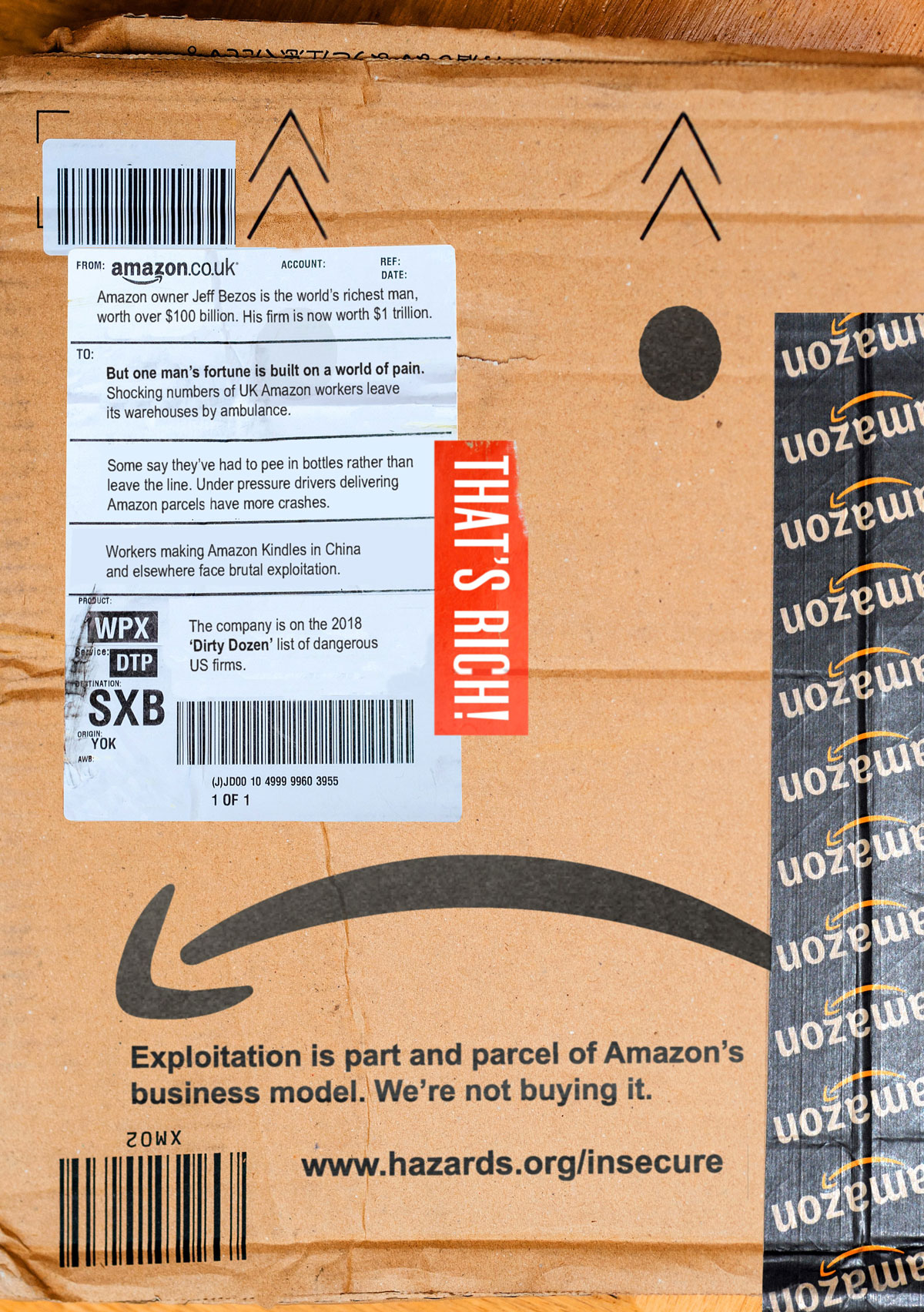
Britain: Exploitation is part and parcel of Amazon’s business model
Amazon’s Jeff Bezos this year become the world’s first 100 Billion Dollar Man - but one man’s fortune is built on a world of pain, the union GMB has warned. In a new feature in Hazards magazine, GMB director of safety Dan Shears notes: “On the back of labour exploitation, unhealthy workplaces and cost-shifting to the public purse, his global firm was valued in September 2018 at $1 trillion.”
Dan Shears. Rich pickings? Exploitation is part and parcel of the Amazon business model, Hazards, number 143, September 2018 and accompanying That’s rich! poster. GMB news release. Daily Express. Birmingham Mail. Morning Star. Risks 866
Hazards news,
15 September 2018
Britain: Nurses 'going whole shifts without a glass of water'
The majority of nurses regularly go through entire shifts without drinking water or taking breaks, a survey has found. Threequarters of nurses do not have time to take a break during one or two shifts every week, according to the poll of 2,000 nurses by journal Nursing Standard.
Nursing Standard. Morning Star. Risks 849.
Hazards news,
19 May 2018
Britain: Female posties more likely to lose out on loos
A lack of toilet facilities for postal delivery workers disproportionately affects women, the Communications Workers’ Union (CWU) conference has heard. The Morning Star reports that delegates at the annual gathering in Bournemouth unanimously passed a motion calling for a compulsory list of toilet facilities on every delivery route.
Morning Star. Risks 847.
Hazards news,
5 May 2018
Britain: Midwife fired after lack of loo breaks made her sick wins job back
A midwife sacked from Wakefield’s Pinderfields Hospital has won an appeal against her dismissal after more than 40,000 people signed an online petition calling for her to be reinstated. UNISON member Jane Greaves said she was last off work with a kidney infection she believed she contracted at Pinderfields Hospital’s birth centre - which doesn’t have a staff toilet.
Yorkshire Evening Post. The Independent. Risks 845
Hazards news,
21 April 2018
Britain: One in five sites force men and women to share toilets
A union survey has found many construction workers are enduring ‘entirely inadequate’ toilets and washing facilities. The survey of over 3,500 Unite members working in the sector found that on nearly one in five sites (17 per cent) of men and women were forced to share toilet as there were no separate facilities for women workers.
Unite news release. Construction Enquirer. Risks 835.
Hazards news,
3 February 2018
Britain: Stop passing the buck on truck stops, says Unite
A lack of adequate truck stops is resulting in lorry drivers being forced to take a break in industrial estates, lay-bys and even in residential roads, drivers’ union Unite has said. The union is calling for lorry drivers to be treated with dignity.
Unite news release. Risks 828.
Hazards news, 2 December 2017
Britain: Commercial drivers win the right to spend a penny
Transport union Unite has won a long–running campaign giving delivery drivers the right to use the toilets at a business where they are making deliveries. Thanks to the union-secured deal, employers in control of non-domestic premises are now obliged to allow people who are not their employees but use their premises to access toilets and washing facilities.
Unite news release and Better loos 4U campaign. More on toilet breaks. Risks 825.
Hazard news,
11 November 2017
Britain: Too few school toilets add up to sickness
A lack of staff toilets is leading to bowel problems and urinary infections in school staff, teaching union ATL has said. The union’s conference heard that at some schools, teachers were having to share facilities with pupils. Others were being forced to trek to distant buildings and stand in loo queues during breaks.
Morning Star. Risks 796
Hazards news,
22 April 2017
Britain: Lorry drivers need better loos
Lorry drivers are not being provided with adequate toilet facilities, their union Unite has said. The union is calling on the government to introduce a legally-binding code of practice so that hundreds of thousands of lorry drivers have adequate parking and eating facilities, decent showers and toilets when they are travelling across the UK for up to five-days-at-a-time.
Unite news release. Transport minister John Hayes’ written statement, 20 December 2017. Risks 782.
Hazards news,
7 January 2017
Britain: Amazon drivers forced to use vans as toilets
Amazon delivery drivers regularly work illegal hours, with time pressures so extreme some are forced speed and to urinate and defecate in their vans, a BBC investigation has claimed. Drivers for agencies contracted by the e-commerce giant told an undercover reporter they were expected to deliver up to 200 Amazon parcels a day.
BBC Inside Out special. BBC News Online. The Independent. Risks 777
Hazards news,
19 November 2016
Britain: Call for independent inquiry into Crossrail ‘abuses’
Construction union UCATT is calling for an urgent independent inquiry into ‘safety and workplace abuses’ on the Crossrail tunnelling contract being undertaken by contractor ATC, a consortium involving Alstom, TSO and Costain. The union says its members working on the Crossrail tunnelling contract say ATC management are employing ‘intimidatory’ working practices.
UCATT news release. Risks 772
Hazards news,
15 October 2016
Britain: MPs to investigate Asos working conditions
Fashion retailer Asos is to face a parliamentary probe after an approach from the union GMB. The decision came in the wake of an investigative report that revealed Asos has subjected 4,000 workers to a brutal management regime at its huge Yorkshire warehouse.
GMB news release. Buzzfeed news update and report, The real cost of Asos’s fast fashion. BBC News Online. Morning Star. Risks 771
Hazards news, 8 October 2016
Britain: Crossrail builders face two-mile trek to the toilet
Crossrail workers have criticised site welfare conditions after having to walk two miles to use a toilet. Union members protested outside the Crossrail site over a range of concerns, including ‘appalling’ welfare facilities and a misfiring fingerprint recognition system.
UCATT news release. Construction Enquirer. Morning Star. Risks 770
Hazards news,
1 October 2016.
Britain: Rail workers stand up for toilet breaks
Rail workers took ‘rock solid’ strike action on two London Underground lines in September over ‘timed’ toilet breaks. RMT members on the Hammersmith & City and Circle lines walked out for 24 hours after what their union described as a ‘flagrant disregard for agreed policies and procedures’.
RMT news release. Morning Star. London Evening Standard. More on toilet breaks. Risks 679.
Hazards news,
24 September 2016.
USA: Toilet breaks blocked by chicken firms
Workers in America’s poultry plants are being routinely denied bathroom breaks, research by Oxfam America has found. Its report, ‘No relief’, is based on months of research and exposes how poultry workers are forced “to urinate and defecate while standing on the line; they wear diapers [nappies] to work; they restrict intake of liquids and fluids to dangerous degrees; they endure pain and discomfort while they worry about their health and job security.”
Oxfam America news release and report, No relief: Denial of bathroom breaks in the poultry industry, May 2015. Washington Post. Bloomberg. Fox News. Risks 751.
Hazards news,
21 May 2016
Britain: Bus drivers strike over unsafe timetables
Over 200 Arriva bus drivers in Kent have taken two days of strike action over the introduction of unachievable, fatigue-inducing and unsafe timetables. Their union Unite has said drivers are being kept at the wheel for five and a half hours at a time with as little as four minutes ‘recovery’ time and limited access to toilet facilities.
Unite news release. Kent Messenger. Risks 732.
Hazards news,
12 December 2015
Britain: Stretched ASOS workers forced to pee in water stations
Breakneck work rates required at the Barnsley distribution depot of the online retailer ASOS are so hard to achieve that employees are sometimes forced to urinate in nearby water stations rather than make the trip to the loo, their union has said. GMB said pressure to maintain ‘pick rates’ meant some staff did not have the time to make the 15 minute return walk to the toilets.
GMB news release. Risks 720.
Hazards news,
19 September 2015
Britain: Unite calls for respect for toilet breaks
Too many workers are facing difficulty getting a toilet break at work, research by Unite has found. The union has published a 10-point action checklist for Unite safety reps, with recommendations including that toilet and washing facilities form part of regular safety inspections, members be encouraged to report problems and ensuring that agreements and health and safety policies provide for paid rest breaks, toilet breaks, provision of suitable welfare facilities and easy access to them during the working day.
Unite toilet breaks campaign. Hazards toilet breaks webpages. Risks 716
Hazards news,
22 August 2015
USA: Chicken processor strained wrists and bladders
A chicken processing firm in the US enforced limb-crippling line speeds and didn’t like its workers leaving the line, even to go to the toilet. The Allen Harim Foods plant in Harbeson, Delaware, was cited by the Labor Department’s safety regulator OSHA for nine violations, with the proposed penalties totalling $38,000.
OSHA news release. The Pump Handle. Center for Progressive Reform blog. Risks 709
Hazards news,
4 July 2015
Thailand: Nappy-wearing bus conductors fight for rights
Stuck for hours each day in snarling traffic, bus conductors in Thailand’s sprawling capital have found a radical solution to a lack of toilet breaks - adult nappies. A recent survey found that 28 per cent of female bus conductors in Bangkok had worn nappies on a job that requires them to work up to 16 hours a day.
Gulf News • Risks 657
Hazards news,
7 June 2014
Britain: Workers left with no place to go
Council cuts to public conveniences are leaving workers with no place to go, the public sector union UNISON has warned. It says workers suffering from too few loos include paramedics, transport workers, police community support officers, postal workers and bin men who spend their working day out and about.
UNISON news release • IOSH news report • Risks 619
Hazards news,
24 August 2013
Britain: Site walkout wins better welfare facilities
Construction workers at Runcorn thermal power station have secured improved toilet and welfare facilities on site after a week long snap strike. The 800 plus workers had walked out in protest at what they considered inadequate toilet and canteen facilities. Unite news release • Morning Star • Risks 590
Hazards news,
26 January 2013
Britain: Window firm failed welfare test
A London window manufacturer has been prosecuted for ignoring two improvement notices requiring the firm to bring employee welfare facilities up to a clean and hygienic standard. City of London Magistrates' Court heard that on 20 May 2010, at a routine inspection of the TLC Glazing Ltd factory, the Health and Safety Executive (HSE) found the toilets were very dirty, with no supply of hot water, no soap for hand washing and no means of hand drying.
HSE news release • Risks 490
Hazards news,
22 January 2011
Britain: Union condemns use of no toilet trains
“Greedy money-grabbing” bosses on Southern Railways have been branded a “disgrace” by the rail union RMT after it emerged some of its expanded fleet will have no toilets on board. RMT general secretary Bob Crow said: “It doesn't take a genius to work out that, if you close on-train toilets, some people will take matters into their own hands turning the carriages into stinking cattle trucks and creating appalling conditions for both passengers and staff.”
BBC News Online • Morning Star • The Telegraph • Risks 475
Hazards news,
25 September 2010
Britain: Workers caught short on toilet breaks
Many of us are being short-changed by our employers when it comes to the call of nature. A study by the Labour Research Department (LRD) has found many British workers are suffering because of inadequate toilet facilities and restrictive toilet break rules.
LRD news release • BBC News Online • Risks 462
Hazards news,
26 June 2010
Britain: Contractor fined for failing to provide toilets
A Bridlington building firm boss has been fined for not providing adequate toilet and washing facilities for staff on a construction site. The Health and Safety Executive (HSE) prosecuted Bryan Ellis Brown, a partner in Bryan Brown & Son, of Flamborough, Bridlington, after finding problems on the site on 23 July 2009 which the firm then failed to remedy.
HSE news release • Risks 447
Hazards news,
13 March 2010
Britain: Hands up for toilet breaks at work
Employers should not be able to penalise staff for using the toilet in work time and should provide decent, clean lavatories, the TUC has said. The union body is calling for a change in the law to bring workplace loos into the 21st century.
TUC news release • Risks 447
Hazards news,
13 March 2010
Britain: Meat firm docks wages for loo breaks
Workers at a Lancashire meat firm are outraged at their employer’s toilet break policy which stops their pay every time they visit the loo. Unite, which represents workers at the Dunbia a meat processing plant, says workers are being forced to take unpaid toilet breaks during work time.
Unite news release • Risks 432
Hazards news, 14 November 2009
Australia: Union dumps toilet diaries
A requirement on staff at an Australian government call centre to observe a three-minute time limit when using the toilet and to keep diary entries of how long they spent in the bathroom has been dumped after union pressure. Managers at the Medicare Australia call centre were even following staff into bathrooms to hurry them along, workers said.
CPSU news release • News.com.au • Risks 428
Hazards news,
17 October 2009
Britain: Train drivers forced to pee in a bottle
Staff toilet facilities are so poor on some parts of the rail network, train drivers are forced to urinate in plastic bottles. Inability to go to the loo for long periods is linked to a range of chronic health problems.
ASLEF online article • Risks 411
Hazards news,
20 June 2009
Britain: London cabbies protest at toilet rip-off
London taxi drivers picketed Westminster City Council for an hour on Wednesday 20 May over “rip-off” parking charges which are forcing them to spend up to £3 just to use the toilet.
RMT news release • Hazards toilet breaks webpages • Risks 407
Hazards news,
23 May 2009
Britain: Golden
toilet bid to flush out breaks pay
An MP is backing a union campaign for paid toilet breaks at a Scottish
meat firm supplying the supermarket chain Tesco. Workers at Brown Brothers
in Kirkconnel are forced to take unpaid lavatory breaks - a policy that
has been condemned by Labour MP Russell Brown and the union Unite as unacceptable.
Guidance on toilet
breaks • Risks
363
Hazards news, 5 July 2008
Britain: Workers
make a stink over loo breaks
A meat company supplying Tesco has been accused of “Dickensian employment
practices” by making workers clock off when they go the toilet.
The union Unite is now calling on Tesco to intervene to stamp out the
practise at Dumfriesshire-based Brown Brothers.
BBC
News Online • Hazards
magazine toilet breaks webpages • Risks
362
Hazards news, 28 June 2008
Britain: Bus
drivers relieved at more toilets
Bus drivers are relieved authorities have agreed to speed-up the introduction
of toilets along London's bus routes. Unite organiser, Peter Kavanagh,
said “significant extra resource” had been agreed to combat
what was “a very serious problem.”
This
is local London • TUC/Hazards
toilet breaks campaign
Hazards news, 1 September 2007
Britain: Company films
toilets on the job
The union UNITE has told a firm it must remove CCTV cameras after they
were discovered filming workers in the factory's toilet blocks. ThyssenKrupp
Automotive (TKA) Tallent Chassis, in Newton Aycliffe, County Durham, was
accused of a “horrendous breach of employee privacy.”
Northern
Echo • Hazards workplace
privacy webpages and toilet
breaks webpages
Hazards news, 25 August 2007
Britain: Bus workers
demand respect and toilets
London’s bus workers took to the streets of the capital on 23 August
to demand proper toilet facilities on bus routes and at their workplaces
– and immediately won support from the mayor of London. The workers,
members of Unite, are threatening a full strike ballot if Transport for
London (TfL) and London’s local authorities don’t unblock
planning obstacles and speed up action to provide facilities.
Unite
news release • BBC
News Online
Britain: Give us
toilets or prepare for a sitdown strike!
London's bus workers are to stage a series of protests at key London transport
and local government offices on Thursday 23 August to protest at the lack
of toilet facilities. The campaign has taken a new turn with the capital's
bus workers, all members of the TGWU section of Unite, threatening a full
strike ballot if Transport for London (TfL) and London's local authorities
don't act.
Unite
news release • TUC/Hazards
toilet breaks campaign
Hazards news, 4 August 2007
Britain:
Free-to-pee win in women's toilet campaign
Women truck drivers who use the port of Folkestone are celebrating a breakthrough
this week in their worldwide ‘Free to Pee’ campaign. Following
pressure from transport union TGWU, the harbour master at the cross channel
port has announced the opening of a women's toilet.
Risks 244, 18 February 2006
Britain:
AA wrong on pee and tea breaks
Call centre workers employed by the car recovery giant AA say the firm
must come clean on toilet and other breaks. Paul Maloney, GMB senior organiser
said: Adults in the AA call centres have to put up their hands like schoolchildren
to get time to get a drink of water or to visit the toilet.”
Risks 232, 12 November 2005
USA:
Ford in “incredibly stupid” toilet crackdown
You know things are tense at work when management starts timing rest room
breaks. But Ford Motor Co is doing just that.
Risks 231, 5 November 2005
Britain:
No pee for parking attendant
A parking attendant has been suspended for going to the toilet. The GMB
member, employed by APCOA and who works in Kensington and Chelsea, has
been barred from work since 29 July and is facing disciplinary action.
Risks 220, 20 August 2005
Australia:
Union outrage at Pee&O breaks ban
A UK-registered company which forced Australian call centre workers to
carry a "pee pole" to signify they're going to the toilet has
responded to staff protests by banning all breaks.
Risks 184, 27 November 2004
Britain
Bus driver fights for toilet breaks
An ex-bus driver whose health was ruined by the lack of toilets on bus
routes, is taking his former employer to the European Court of Human Rights.
Arthur Martin, who worked for First Bus, had to have surgery to remove
half his prostate, a problem doctors say had been caused by being denied
loo breaks for long periods.
Risks
149, 27 March 2004
Britain
Workers "forced to pay for toilet breaks"
Factory workers at TTems in Blyth have been told by bosses they will have
to pay back wages for the time they spend on visits to the toilet and
cigarette breaks.
Risks
147, 13 March 2004
USA
Fired if you pee, fired if you don't
Workers suffering from paruresis or shy bladder syndrome are being fired
as a result. Drug test happy US employers a treating failure to provide
a urine sample as a refusal to submit to a drug test.
Risks
143, 14 February 2004
Australia
Bursting bus drivers told to wait and wee
Bus drivers in Australia are piddling in bottles, buckets
or at the road side because of a chronic lack of toilets.
Drivers in New South Wales say this is an industry
wide problem and that operators and the government are failing to address
a serious health issue.
Former bus driver and Transport Workers Union organiser
Mick Pieri said: "The drivers have to hang on for hours on end. A
lot of time when you need to go to the loo you have to go through passengers
just to get to the toilet. The passengers can be irate because the bus
is running late."
Pieri says the issue is about more than just toilets.
"We need facilities with hot and cold running water, proper meal
rooms, proper amenities."
He suspects that being forced to hold off going to
the toilet on a regular basis could be linked to a high incidence of prostate
problems among bus drivers.
TUC launched its own "gotta go!" campaign
last year after Hazards magazine revealed UK workers were routinely being
denied loo breaks and were at risk of a range of health problems as a
result.
Risks
138, 10 January 2004
AUSTRALIA: Call centre stink
over time off in loo
Employees at a company owned by Australia's second biggest telecoms company
say their bosses have ordered them to record as "personal time" the amount
of time they spend in the toilet. More than 60 workers at an RSL COM call
centre are being forced to time themselves going to the toilet and make
up the time at the end of the day or risk losing pay.
Members of the union CEPU have now started a "low key" campaign to end
what they describe as harassment, excessive surveillance and monitoring
over toilet breaks.
"We are disgusted by this over-the-top behaviour by management," said
Alice Salomon, CEPU branch organiser.
"It is demeaning for grown adults to be treated like school kids and
have to account for the time taken to go to the toilet…Managers are spending
more time on monitoring toilet breaks than it actually takes to use the
bathroom." She added the policy could force workers to forgo loo breaks,
which could lead to serious health problems.
Workers
Online • Risks
120, 23 August 2003
Supermarket cashiers
can’t check out for loo breaks
Supermarket cashiers in Argentina are being forced to wear nappies (diapers)
because they can’t take toilet breaks at work, a union official said.
Female cashiers in western Mendoza province must wear adult nappies in
case 'cold, nerves, pressure or stress' provoke incontinence, union official
Jorge Cordova told local news agency Diarios y Noticias.
Cordova refused to name the supermarket, but he did say the chain is
backed by foreign capital, said Sandra Varela, Mendoza's labour subsecretary.
"The truth is, it's difficult to imagine a line of 20 adult cashiers wearing
diapers for eight hours," said Varela, who is investigating the matter.
"In 17 years as a labour lawyer, I've never heard anything like this before."
TUC has highlighted widespread loo breaks abuse in the UK, and is calling
for a legal right for workers to take a toilet break. Earlier this year
GMB member Gavin Ruddick won an employment tribunal after his employer
said the security guard could not take any breaks during a 12-hour shift.
Risks
118, 9 August 2003
Jaguar attacks toilet breaks
Luxury car-maker Jaguar has come under fire from workers after slamming
the lid on toilet breaks. Paint shop workers have told by personnel chiefs
at the Castle Bromwich plant they should not go to the toilet during working
time.
The loo breaks embargo started with a written briefing from the company’s
Employee Relations Department, whose "bell-to-bell" edict says workers
must seek permission from their supervisor if they need to leave the track
for any reason.
The briefing warns that anyone failing to comply could end up facing
disciplinary action. It says: "All employees should endeavour to deal
with issues during their break times. This includes leaving to go to the
toilet. Due to the continuing high absence trend, it is likely that there
will be times when delays in releasing people to go to the toilet cannot
be avoided."
One worker said: "We can’t believe this. People can’t go to the toilet
by schedule and they are threatening disciplinary action if people need
to go outside of break times."
Risks
115, 19 July 2003
BRITAIN
Guard secures workplace toilet breaks
A Tyneside security guard has won a "groundbreaking" victory after claiming
his employer would not let him go to the toilet at work. GMB member Gavin
Ruddick said Reliance Security Services Ltd told him he could not take
any breaks during a 12-hour shift at an office block.
A Newcastle employment tribunal ruled that the security industry is not
exempt from Working Time Regulations and while it is not subject to the
law that requires workers to have a 20 minute rest break every six hours,
it must do "the next best thing," such as allow a number of shorter rest
periods or one longer period. It stated that if any company were to be
as ridiculous as to prevent a security guard from going to the toilet,
then it might be guilty of degrading and inhuman treatment under the Human
Rights Act.
GMB’s Joan Hoggins said: "This is a great result for our members and
this will now send a clear message that the security industry does not
fall outside the Working Time Directive and they must treat their workers
fairly or pay the price. I could not believe that when Gavin approached
me, informing me that he was to do a 12 hour shift, he was denied the
right of any form of rest breaks." A further hearing will decide compensation.
Risks
110, 14 June 2003
AUSTRALIA
The ultimate piss off
Wollongong workers on poverty-level wages are losing up to $5,000 (£2,000)
for taking toilet breaks, according to the union representing staff at
a Stellar call centre. Other employees claim they have lost their bonuses,
worth up to $5000 a year, for using sick leave entitlements.
The bonuses are significant to workers earning only $25,000 ($10,000)
a year thanks to non-negotiable contracts that have slashed base earnings
from the $35,000 (£14,000) paid to Telstra employees before their jobs
were outsourced.
Stellar is Australia's largest contract call centre operation, employing
more than 2000 people around the country.
The workers' union, CPSU, has launched inspections of Stellar call centres
at Wollongong, Hornsby, Adelaide and Robina into suspected breaches of
the Workplace Relations Act, and says the workers have been conned into
accepting the new contracts.
"We have information that his choice has not been provided," CPSU official
Larissa Andelman says. "That these people have not even been told that
they have a right to choose."
Andelman says the reported use of bonuses to dissuade people from using
their sick leave is a major concern to members. Stellar call centres are
understood to have an unusually high number of employees absent on stress
leave. Andelman says that annual staff turnover rates are as high as 40
per cent in some of the company's call centres.
Workers
Onliine, 2 May 2003
BRITAIN
This time it’s personnel
Personnel professionals are backing the union campaign for sensible toilet
breaks at work.
Chartered Institute of Personnel and Development adviser Diane Sinclair
commented: "It is inappropriate for people to have to request to go to
the bathroom, unless the nature of the work is that a production line
stops or there has to be cover for that person."
She added that employers could be opening themselves up to legal action
if they prevent someone from using the toilet when they need to. "Allowing
someone to go to the bathroom is a reasonable adjustment under the Disability
Discrimination Act," she said, adding if a pregnant woman is only given
restricted access, she could also take her employer to court on a discrimination
claim.
TUC’s Owen Tudor commented that some employers go to greater lengths
to monitor toilet trips than it can possibly be worth. "One person told
me that in his workplace they had a man who sat by the toilet door with
a stopwatch and timed people," he said. "He also used to hand out regulation
amounts of toilet paper. That cannot conceivably have been economically
worthwhile."
Risks
99, 29 March 2003
USA
Ship workers say no, no, no to a bottle of pee
Shipyard workers rushing to complete a US aircraft carrier by 28 March
are raising a stink about a shortage of toilets. Union officials representing
members working on the Ronald Reagan say some yard workers have resorted
to urinating in the corners on the brand-new ship, or in cups, drink bottles
and plastic bags.
The US Navy moved 2,500 sailors onto the ship in the autumn, slowing down
the last-minute yard work and placing most of the restrooms off-limits
to shipyard workers. "You're not going to pee in your pants, you're going
to find some place to go to the bathroom," said Jim Scull, chair of the
health and safety committee for the United Steelworkers of America's (USWA)
Local 8888.
Arnold Outlaw, president of USWA Local 8888, said although the company
may be meeting the letter of the law by having the bathrooms off the ship,
it is sometimes difficult for workers - especially some older workers
who need to take diuretics and those with other medical problems - to
get off the ship in time: 'If you're working six decks down, it can take
more than 10 minutes just to get off the ship,' Outlaw said. 'You don't
always know when you're going to get the urge.'
The company, Northrop Grumman, refused to provide additional portable
facilities, he said.
Risks
97, 15 March 2003
BRITAIN
Investigation uncovers dirty business on site
Contractors on a Leyton building site are breaking health and safety
laws by not providing proper washroom facilities, an investigation by
the Waltham Forest Guardian has shown. It says its special investigation
into the site has revealed that no hot water is being provided to builders
by the Inner London Group and the two loos are rarely useable, a breach
of the Construction (Health, Safety and Welfare) Regulations 1996.
A tip-off to the newspaper from concerned staff led to the investigation,
which found just two portable toilets for around 35 to 40 workers. One
worker commented: "The portaloos are serviced once a week and they are
OK for about two days before they become full and unusable."
Larry Fenttiman, of the Inner London Group, denied the company was in
the wrong. However, a spokesperson for the HSE confirmed it had received
a complaint and the company had been contacted, adding: "We are not satisfied
with what we've been told so it is being contacted again. It will be told
what it is legally expected to do. We will take it further if necessary
and if it fails to comply with the inspectors it is a prosecutable offence."
Risks
96, 8 March 2003
USA
Union no go on no go policy
The union at bourbon maker Jim Beam has won a reversal of its policy
of limiting bathroom breaks for workers at a Kentucky distillery (Risks
69).
The rules – and disciplinary measures used to enforce them - outraged
workers, some of whom said they’d had to pee themselves or face disciplinary
action - and drew a citation from the Labor Cabinet, the official enforcement
agency, which called the policy illegal.
"I am really glad to hear that they've come to their senses,"
Jo Anne Kelley of the UFCW union said. Krystal Ditto, who was one violation
away from being fired, expressed relief.
"Nobody should have to go to work with that kind of fear,"
she said.
Rich Reese, top boss at the company, said: "We've listened to the
concerns of our employees and have changed our policy." He added:
“We will work with the local union to find a mutually acceptable
solution for managing breaks on the bottling-line."
WNBC
News
AUSTRALIA
Pregnant worker fired over toilet breaks
The Community and Public Sector Union (CPSU) said workers employed by
TeleTech, US-owned and one of the world's largest call centre companies,
were owed thousands of dollars in unpaid wages and had also been bullied
and dismissed for taking sick leave.
A pregnant woman had been dismissed for taking too many toilet breaks,
while another was sacked because she was in hospital with pneumonia, says
the union.
Risks
71, 14 September 2002
ACTU's
Call Central campaign - the site includes safety guidance
BRITAIN
Firm docks workers wages for toilet breaks
Mean meat factory bosses are docking £1,000 a week from their workers'
wages for the time they spend in the loo.
Almost 200 staff at the Brown Brothers' factory in Kirkconnell, Scotland
have been issued with smart cards which deduct their pay for the time
they're away from the factory floor.
One worker, who feared the sack if he gave his name,
said: "We have to go through a turnstile and up a flight of stairs to
the toilet in the canteen. One week they took an hour off me, which is
£5.28. There are 190 workers here so the company is saving £1,000 a week
in wages. The motto among the staff here is: 'Have a break - have a quick
crap'."
George Hodge, regional organiser with the Transport
and General Workers' Union (TGWU), said: "We have been campaigning constantly
to persuade the company to abolish this practice but they have so far
refused to budge. Brown Brothers are the only company I have heard of
to operate such a policy."
Not getting to the loo when you need to can lead
to serious health problems, research has shown.
Risks
88, 11 January 2003
BRITAIN
Pee is for organising
Advertising staff at Bristol United Press used to
have to ask permission to use the toilet at work - until their union started
a protest leafleting campaign.
GPMU South West branch organiser Gavin Brooks said:
"We received a fantastic response to the leaflet and management have backed
down over the issue."
He told GPMU Direct magazine the toilet breaks
campaign was just the beginning of an organising drive at the company.
And he has told newspaper staff: "If it is possible
for the union to solve a problem just by giving you a leaflet, imagine
what you could do if you got your union recognised."
Pee is for organising, Hazards 80, October-December
2002, page 13. Hazards
80 full contents
BRITAIN
Safety watchdog sniffs out bad washrooms

Decent washing facilities are vital in preventing occupational dermatitis
and are an absolute legal duty. Would you use these? |

This sink is unusable and illustrates a basic lack of regard for the
health and welfare of the construction workers on site |
Above, welfare
facilities uncovered in a 2002 UK construction sites safety blitz
conducted by the
Health and Safety Executive. |
|