

Features
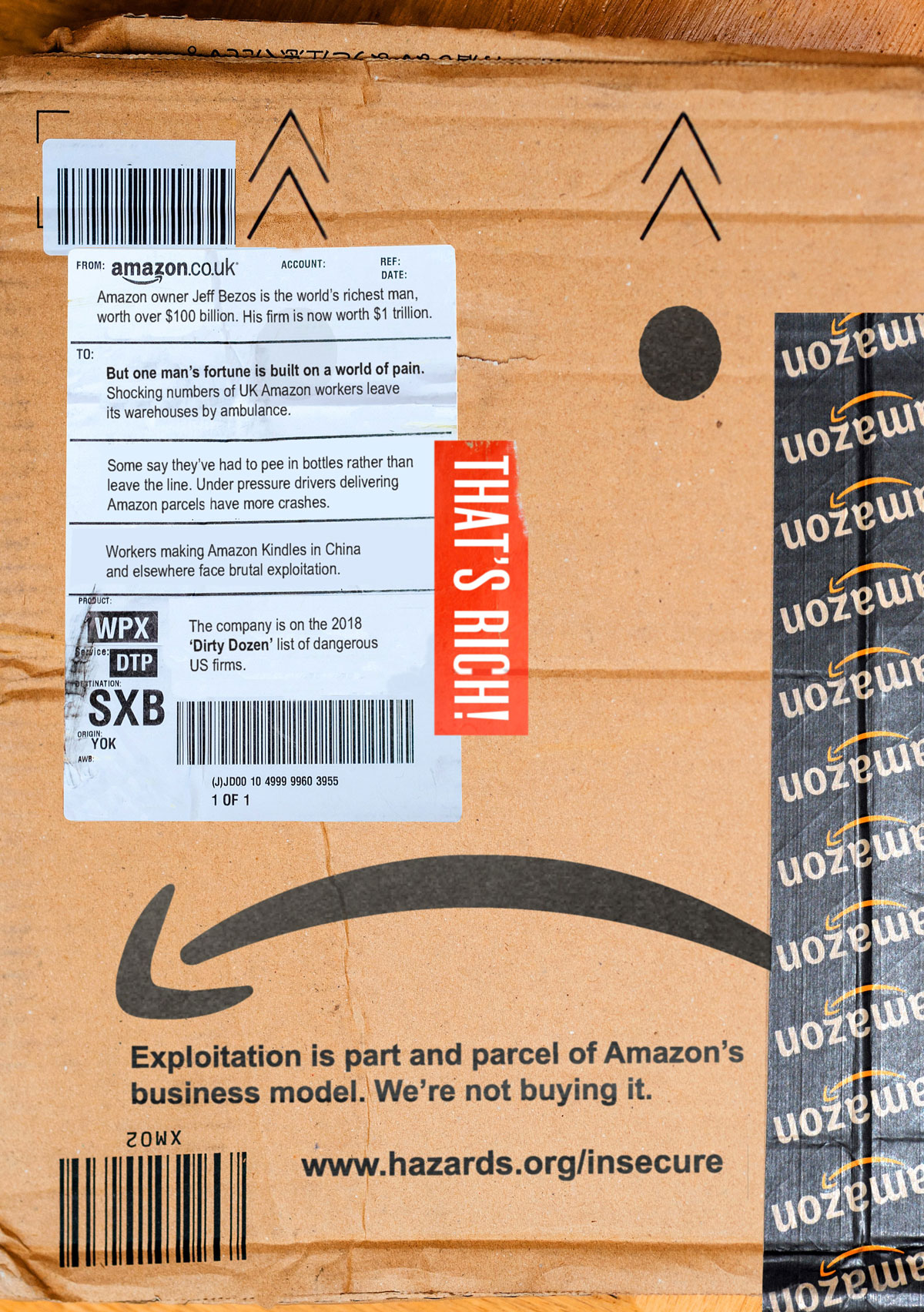
Rich pickings Amazon’s Jeff Bezos is the world’s richest man. His company is worth $1 trilion. But Amazon’s success is built on world of pain, says GMB’s Dan Shears, who says his union is intent on delivering it workers good jobs and union protection. Hazards, number 143, 2018
McBurned On the heels of a successful organising campaign at fast food giant McDonald’s, the union BFAWU is now targeting safety problems at the burger chain. It says burns should never be ‘part and parcel’ of the job. Hazards, number 143, 2018
Bad job A government-commissioned review of insecurity at work has failed to recognise the game-changing improvements required tov solve abusive employment practices. It also ignored almost entirely the cost to health of poor, poorly paid work, saying only the government and rogue businesses stand to benefit. Hazards, number 139, 2017
Make or break Workers should not be disposable. And work should not be a spirit-sapping, body-breaking grind. Hazards editor Rory O’Neill warns bad jobs are driving us over the edge and says it is time to turn and fight for basic decency, security and rights at work. Hazards 138, June 2017
Face it Whether it is a gaping gulf in pay, job insecurity or job discrimination based on your class, gender or rac e, a divided workplace is bad for your health. Sharan Burrow, general secretary of the global union body ITUC, reveals how inequality is a real pain in the workplace – and outlines how unions can make things better. Hazards 137, April 2017.
Suicidal work Your job can drive you to kill yourself, but don’t expect your suicide to be counted in official work fatality statistics or for the boss to end up in court. Leeds University researcher Sarah Waters highlights how the UK is turning a ‘blind eye’ to a major workplace killer. Hazards 137, January-March 2017
Trashed! In a recession-ravaged world, even if you’ve got a permanent job, you feel insecure. If you’ve got a temporary job, you are permanently insecure. Hazards examines the lasting health damage caused to an increasingly disposable workforce. Hazards 119, July-September 2012
HSE is broke The official safety watchdog is broke, can’t do its job and is haemorrhaging staff. Hazards predicts over-stretched and under-protected workers will soon get sick of being fed the government’s healthy lifestyle and “work is good for you” line. Hazards 96, October-December 2006
Drop dead It is the thoroughly modern way to die at work. Major occupational diseases of the 21st century will be heart attacks, suicide and strokes. Hazards looks at why so many of us are being worked into the ground.
Hazards 83, July-September 2003
Not what we bargained for
The economy is buoyant, but we work harder for less pay. We know more about hazards and their control, but work-related stress, strains, depression and violence are soaring. We have never been more productive, and we are rewarded with temporary contracts, long hours and back breaking workloads. What on earth is going on? Hazards 69, January-March 2000
News
Britain: Tory legacy is long-term sickness and bad jobs
The legacy of the Conservative’s lengthy term in office is low pay, ill health and more insecure jobs, the TUC has said. The union body was responding to latest ONS labour market figures, which show real wages still below their level in 2008, more than a million people on zero-hours contracts, and 2.8 million people not working due to long-term sickness.
TUC news release. 13 February 2024
USA: Tiny fine for death of Amazon worker
Caes Gruesbeck, a 20-year-old Amazon warehouse worker, tragically lost his life in Fort Wayne, Indiana, due to a machinery accident. Despite safety violations found in the investigation, the $7,000 fine imposed by Indiana falls dismally short for a company of Amazon's financial size, sparking concerns about workplace safety enforcement and the value placed on an employee's life..
The Street. Washington Post. 26 November 2023
USA: Minnesota acts to protect warehouse workers
Minnesota lawmakers have passed a bill that would provide more protection for warehouse workers who have to meet productivity quotas, a move aimed at helping employees at companies like Amazon. The bill prohibits companies from firing or taking any adverse actions against an employee for failing to meet a quota that has not been disclosed to them and says companies can’t implement productivity quotas that prevent workers from taking breaks, and allows the state to open an investigation if a company has an injury rate 30 per cent or higher compared to its peers.
ABC News. 24 May 2023
Britain: Working people ‘pushed to breaking point’
Working people are being “pushed to breaking point”, the TUC has said, as latest ONS labour market figures show that real weekly wages are down £19 per week over the past year. The number of people on zero hours contracts is up to 1.13 million, from 1.02 million this time last year.
TUC news release. ONS labour market figures. More on the hazards of low pay and insecure work. 17 May 2023
Global: Amazon must sign up to safety
The Make Amazon Pay coalition is calling on Amazon to sign the International Accord for health and safety in the apparel and textile industry. “Amazon’s failure to sign the Accord is a failure to respect the workers producing goods in its supply chains, said Christy Hoffman, general secretary of the global union UNI. Over 200 brands have signed the International Accord since its launch, securing safer jobs for over two million garment and textile workers in Bangladesh. The Accord established an independent body to inspect factories and set timelines for correcting occupational hazards. Lauded as “the most effective campaign of the globalised era,” UNI said it ‘revolutionised’ safety in the Bangladeshi garment industry and has now expanded to Pakistan. Amazon is the largest retailer of clothing in the US.
UNI news release. 26 April 2023
Britain: MPs speak out Amazon's 'climate of distrust'
A committee of MPs has warned that workplace surveillance by global retailer Amazon is stressing out its workers. The cross-party House of Commons' BEIS Committee's report on UK labour markets warns that Amazon's “surveillance practices (for whatever intention they are deployed) are leading to distrust, micromanagement and, in some cases, disciplinary action against its workers.”
Post-pandemic economic growth: UK labour markets, BEIS committee tenth report, 21 April 2023. 26 April 2023
USA: Amazon injury rates twice that of competitors
Amazon warehouses have an injury rate more than twice that of their competitors, according to an analysis by a coalition of unions. The report, which was compiled by the Strategic Organizing Center (SOC), examines data Amazon submitted to the Occupational Safety and Health Administration (OSHA) and found the company's injury rate was 6.9 per cent in 2022, down on the 7.9 per cent the year before but up on the 2020 rate of 6.6 per cent – compared to 3.2 serious injuries for every 100 workers at its competitors.
CBS News. 19 April 2023
Britain: Lifeboat falls off low wage P&O ferry
Maritime union RMT has written to the Maritime and Coastguard Agency (MCA) after a lifeboat fell off the new P&O superferry P&O Pioneer while moored off the coast of the Isle of Wight. The union said accidents involving lifeboats are one of the most common causes of injuries and fatalities amongst seafarers in the shipping industry.
RMT news release. ITV News. 5 April 2023
Germany: Labour standards return to the meat industry
Two years after the German government banned subcontracting in the meat sector, research by the food union NGG has found widespread improvements in safety and working conditions. Since the Protection Control Law for the Meat Industry was passed 35,000 subcontracted workers have been hired directly by meat companies, collective bargaining has secured a substantial pay increase and occupational health and safety has ‘dramatically improved’, the union says, with union membership increasing.
IUF news release. 15 March 2023
Britain: Zero hours contracts hit record high
The union GMB has accused Rishi Sunak of presiding over a ‘tidal wave’ of insecure work after zero hours employment hit its highest rate in history. New official figures show that 1,133,441 people were employed on a zero hours contract in October to December 2022, an increase of 8.5 per cent on the previous three months.
GMB news release. 22 February 2023
USA: Amazon safety citations at three warehouses
Retail giant Amazon has been cited for failing to keep workers safe and has been issued hazard alert letters after inspections at three warehouse facilities – in Deltona, Florida; Waukegan, Illinois; and New Windsor, New York. Federal safety regulator OSHA found workers had been exposed to ergonomic hazards.
OSHA news release. Strategic Organizing Center news release. US Department of Justice news release. 26 January 2023
Britain: Amazon treats robots better than workers
Amazon workers have accused the firm of imposing “severe” conditions and low pay. Staging their the first-ever UK strike against the online giant on 25 January, the GMB members said they are constantly monitored and upbraided for “idle time” lasting just a few minutes, with staff treated worse than the company’s robots.
GMB news release. BBC News Online. Morning Star. 26 January 2023
Europe: Progress on platform workers’ rights
The European Parliament has fought off platform industry attempts to weaken a proposed law giving their workers decent rights. The December 2022 vote in favour of keeping a strong presumption of employment in the Platform Work Directive by the European Parliament’s Employment and Social Affairs Committee was whole-heartedly welcomed by the International Transport Workers’ Federation (ITF).
ITF news release. 10 January 2023
Britain: Soaring levels of zero hours contracts in over-50s
Zero hours contracts among the over-50s have reached their highest level since records began, according to new analysis of official government statistics. There are nearly 300,000 people aged 50 and older with zero hours contracts, the highest number for this age group since records began in 2013 and almost double the number 10 years ago, from 149,000 in October to December 2013 to 296,000 in July to September 2022.
Rest Less news release. The Guardian. More on the hazards of insecure work.10 January 2023
Britain: Precarious employment hurts mental health
Insecure work can deprive people of the financial benefits of secure employment and the social benefits of regular routine, valued social status and positive social interactions, new research has found. The authors from Kings College London reviewed evidence from 32 studies of the impact of precarious work in western economies and found that several reported experiences of stress, exhaustion, anxiety, depression and other emotions such as frustration, guilt and low self-esteem.
KCL news release. Annie Irvine and Nikolas Rose. How Does Precarious Employment Affect Mental Health? A Scoping Review and Thematic Synthesis of Qualitative Evidence from Western Economies, Work, Health and Society, Online First, 6 December 2022. Work Foundation blog. More on the hazards of insecure work. 21 December 2022
Britain: Amazon slammed over worker monitoring
Online retail giant Amazon has been criticised for 'misleading' MPs over worker monitoring. Giving evidence to a Business Select Committee on 15 November, Brian Palmer, an Amazon policy chief, repeatedly said surveillance of workers was not the ‘primary focus’ of their monitoring systems but when pressed admitted the company tracks productivity of your workers in its warehouses.
Business Select Committee news release, Inquiry: Post-pandemic economic growth: UK labour markets and 15 November 2022 hearings. GMB news release. 18 November 2022
Global: Make Black Friday ‘Make Amazon Pay day’
The Make Amazon Pay campaign has announced a global day of action with strikes and protests in around 30 countries on 25 November, the shopping day known as Black Friday. The campaign accuses Amazon of “squeezing every last drop it can” from “workers, communities and the planet” in the face of the cost of living scandal, global debt crisis and climate emergency.
UNI news release. Find out about and join the Make Amazon Pay campaign events on 25 November. 10 November 2022
Britain: Labour leader says Amazon should recognise union
Amazon it should recognise a union in its workplaces, Keir Starmer has said. At the TUC’s annual Congress on 20 October the Labour leader stated: “I would be very clear... to Amazon. They should recognise the GMB,” which has long campaigned for Amazon to recognise the union in order to help improve the company’s record on health and safety issues.
GMB news release. 26 October 2022
USA: Amazon sues regulator after safety action
Amazon, the world’s biggest retailer, is suing a workplace safety regulator in Washington state, after it was penalised for a series of safety violations. In its 3 October 2022 court filings, Amazon argued the measures required by the regulator to mitigate risks would be ‘tremendously disruptive’ and require a ‘costly study’.
Seattle Times. Lincoln Star Journal. Confined Space. Risks 1062. 6 October 2022
Australia: Dossier exposes Qantas outsourcing dangers
Australian transport union TWU is calling on authorities to investigate Qantas’ supply chain. The move comes with publication of the union’s explosive dossier of serious safety breaches at Swissport, the ground handling labour provider carrying out the bulk of Qantas’ ‘illegally outsourced’ work.
TWU news release and dossier of Swissport safety incidents. Risks 1059. 15 September 2022
USA: Insecure income is harmful to workers
The insecure income associated with ‘gig work’ has a negative impact on the overall health and wellbeing of US workers, according to University of Texas (UT) research. It found that insecure income from gig work contributed to poor health outcomes, including a sicker workforce, higher unreimbursed healthcare costs, and greater costs to the consumer, with insecure income earners reporting a 50 per cent increase in poor overall health and psychological distress compared to salary earners.
Robert D Thomas, John W Davis, Paula M Cuccaro, Gretchen L Gemeinhardt. Assessing associations between insecure income and US workers’ health: An IPUMS-MEPS analysis, Social Science & Medicine, volume 309, September 2022: 115240.
University of Texas news release. Science Daily. 7 September 2022
Firms like P&O must face serious consequences
The government must strengthen laws so firms like P&O face serious consequences when they illegally fire workers, the TUC has said. Commenting on the announcement by The Insolvency Service that it will not commence criminal proceedings with P&O Ferries, TUC general secretary Frances O’Grady said: “Our laws should protect working people from companies that brazenly flout the rules and treat staff like disposable labour.”
The Insolvency Service news release. TUC news release. RMT news release. 23 August 2022
Australia: Health scientists back call for sick pay for casuals
The Australian government is facing growing calls from epidemiologists, unions and others for sick leave to be extended to casual employees. Michele O’Neil, president of the national union federation ACTU, said: “Nearly one million ‘casual’ workers are effectively working permanent full-time hours,” adding: “These workers should have the right to be permanent with paid leave including sick leave provisions.”
The Guardian. More on health and safety and insecure work. Risks 1054. 3 August 2022
USA: Amazon warehouses under fed investigation
Federal prosecutors in New York and the government’s safety regulator OSHA are inspecting Amazon warehouses around the US as part of a civil investigation into unsafe workplace conditions. A statement from US Attorney's Office for the Southern District of New York (SDNY) Nicholas Biase said “the United States Department of Labor's Occupational Safety and Health Administration entered Amazon warehouses outside New York City, Chicago and Orlando to conduct workplace safety inspections in response to referrals received from the United States Attorney's Office for the Southern District of New York concerning potential workplace hazards related, among other things, to Amazon's required pace of work for its warehouse employees.”
ABC News. Bloomberg Law. 26 July 2022
USA: Amazon’s warehouse ‘disciplines’ out of control
Internal Amazon documents reveal how routinely the company measured workers’ performance in minute detail and admonished those who fell even slightly short of expectations – sometimes before their shift ended. In the year ending April 2020, the company issued more than 13,000 ‘disciplines’ at its Staten Island warehouse, a lawyer for Amazon admitted in court papers, adding management for a warehouse in Robbinsville, NJ, with an average of about 4,200 workers as of December 2020, gave employees more than 15,000 disciplines in the year leading to April 2020, and a North Haven, Conn., warehouse, with an average 4,800 workers as of December 2020, issued more than 5,000 such notices in the year ending in April 2020.
New York Post. Risks 1052. 19 July 2022
USA: Amazon ‘injury machine’ twice as dangerous as rivals
A sharp rise in injuries among Amazon’s warehouse workers in the last year has come as the e-commerce giant's profits have soared. A new report from the Strategic Organizing Center (SOC), ‘The Injury Machine: How Amazon's Production System Hurts Workers’, reveals a 20 per cent rise in serious injuries in a year, and an overall rate now twice that of Amazon’s rivals.
The Injury Machine: How Amazon's Production System Hurts Workers, Strategic Organizing Center (SOC), 2022. SOC news release. Common Dreams. CNBC News. Seattle Times. Risks 1041. 20 April 2022
USA: Unsafe Amazon cited for ‘wilful serious violation’
E-commerce giant Amazon has been cited for a ‘wilful’ serious violation and told to pay a $60,000 fine for knowingly putting workers at risk of injury at a US fulfilment centre. A Washington State Department of Labor & Industries (L&I) inspection at the facility in Kent, Washington State, found 10 of the 12 processes L&I evaluated create a serious hazard for work-related back, shoulder, wrist and knee injuries, and because it has cited Amazon for similar violations at three Washington locations, “the most recent violation is classified as a wilful violation and comes with a significantly higher penalty than those issued as a result of earlier inspections.”
Washington State Department of Labor and Industries news release. Risks 1037. 24 March 2022
Britain: Act now to end the scandal of insecure work
The government must act now to stop ‘rogue employers’ treating workers like disposable labour, unions have said. The joint union letter demands that the business secretary Kwasi Kwarteng names a date for the government’s long-overdue employment bill in the wake of “the callous, illegal and pre-meditated firing of 800 workers by P&O Ferries”.
TUC news release and update. More on insecure work. BALPA news release. Bectu news release. GMB news release. ITF news release. Nautilus news release. Prospect news release. RMT news release. STUC news release. TSSA news release. UNISON blog. Unite news release. CIPD news release. Risks 1037. 24 March 2022
Britain: Unions raise alarm over safety of P&O ships
Seafarers’ unions RMT and Nautilus International have written to the Maritime and Coastguard Agency (MCA) to express serious safety concerns about the sacking of P&O Ferries crew and their replacement with agency staff with no experience of the ships. The unions say the replacement staff are only receiving a few days familiarisation and will be put under intense pressure from the company, which “will have the effect of importing a far higher level of safety risk to passengers and workers meaning that lives will be put in jeopardy.”
RMT news release. Risks 1037. 24 March 2022
Britain: Racism hurts in the jobs market
Ministers must end the racism in the UK jobs market, the TUC has said. The union body was commenting on the government’s 16 March 2022 acceptance of the recommendations of the Commission on Race and Ethnic Disparities, published in March 2021 in the Sewell report, which the TUC described as ‘complacent’.
TUC news release. The Guardian. Risks 1037. 24 March 2022
Britain: ‘Structural racism’ reflected in insecure work
Insecure work is “tightening the grip” of structural racism on the labour market and deepening gender inequalities, a new analysis from the TUC has concluded. TUC general secretary Frances O’Grady said “the time for excuses is over,” adding: “The government must publish its long overdue employment bill and ban exploitative practices like zero hours contracts.”
TUC news release. Morning Star. More on the hazards of insecure work. Risks 1035. 9 March 2022
Australia: State says insecure work is a health hazard
In an Australian first, Western Australia (WA) has formally recognised that job insecurity can harm both a worker’s physical and mental health. The recognition comes in a new code of practice on psychosocial hazards in the workplace introduced by the state safety watchdog and which provides practical guidance on how all workplaces across the state can comply with their duties under its Occupational Safety and Health Act.
Code of practice - Psychosocial hazards in the workplace, Western Australia Worksafe 2022. The Conversation. Risks 1034. 2 March 2022
Europe: Gig economy workers set to get employee rights
Gig economy companies operating in the European Union, such as Uber and Deliveroo, must ensure workers get the minimum wage, access to sick pay, holidays and other employment rights under plans for new laws to crack down on fake self-employment. Publishing long-awaited draft legislation on 9 December, the European Commission said the burden of proof on employment status would shift to companies, rather than the individuals that work for them.
Draft EU directive on improving working conditions in platform work and related 9 December speech by Commissioner Schmit. The Guardian.
RESOURCES. When AI is the boss: An introduction for union reps, TUC, December 2021.
Seven ways platform workers are fighting back, TUC, 2021. Risks 1026. 15 December 2021
Australia: Uber slammed for work deaths ‘cover-up’
Australian transport union TWU has slammed a ‘cover-up culture’ at Uber after it was revealed the rideshare giant failed to report over 500 reportable incidents in New South Wales. The TWU is calling on the federal government to create an independent body with the power “to tackle the root causes of safety breaches in exploitative businesses like Uber,” arguing that post-breach audits and low penalties will not prevent people being maimed or killed.
TWU news release. Risks 1012. 2 September 2021
Britain: GMB and Uber pledge to ‘end exploitation’
GMB and Uber have made a joint commitment to end the exploitation of more than 200,000 drivers who use ride hailing apps. The 26 August statement marked the first meeting between GMB general secretary Gary Smith and Uber’s Jamie Heywood, following a groundbreaking trade union recognition deal.
GMB news release. Risks 1011. 26 August 2021
Britain: Industry backlash against longer lorry driver hours
A temporary extension of lorry drivers' working hours introduced by the UK government has been met with a backlash from unions and the industry, who say the government is applying a "sticking plaster" to driver shortage problems. HGV drivers can now increase their daily driving limits from nine to 10 hours or change weekly rest patterns.
RHA news release. Logistics UK news release. DfT/DVSA guidance, updated 7 July 2021. BBC News Online. The Guardian. Risks 1005. 14 July 2021
Extending lorry drivers’ hours could kill
Unions have said the government decision to extend the hours lorry drivers can work is a dangerous mistake. Unite national officer for road transport, Adrian Jones, said: “Asking an already exhausted workforce to work even longer is likely to make an already difficult situation worse.” The Unite officer said: “Unite will be advising its members to not place themselves in danger and that if they are too tired to drive safely they have a legal right to refuse to do so.”
Unite news release and manifesto for change. RMT news release. Usdaw news release. Risks 1005. 14 July 2021
Britain: Yodel faces ‘complete standstill’ over unworkable schedules
Delivery giant Yodel faces a summer of strikes that could bring its entire network to a standstill, the GMB has warned. The company has imposed “unworkable” driver schedules and “robbed” drivers of annual leave by reneging on long-standing agreements, the union said
GMB news release. Morning Star. Risks 1005. 14 July 2021
Australia: Mine fire report fingers contract work hazards
An inquiry into a “terrifying” accident last year in which five mineworkers sustained serious burns has found that labour hire and contract work is “entrenched” in the Queensland coal mining industry and has recommended that employers and labour suppliers bear joint responsibility for safety compliance. The Queensland Coal Mining Board of Inquiry's final report into an incident at Anglo American's Grosvenor coal mine in May last year concludes that “there is a perception among coal mine workers that a labour hire worker or contractor who raises safety concerns at a mine might jeopardise their ongoing employment.”
Report Part 2, Queensland Coal Mining Board of Inquiry, Terry Martin SC and Andrew Clough, May 2021. Workplace Express. National Resources Review. Mirage News. Risks 1002. 23 June 2021
Global: IUF focus on safety in fast food
Global food union IUF has said it is sharpening its focus on the fight on health and safety in the fast food sector. IUF said since the beginning of the pandemic, fast food workers, many of whom are paid as little as US$7.25 per hour, have reported serious workplace hazards around Covid-19.
IUF news release. Risks 999. 2 June 2021
Britain: Uber union recognition deal will protect safety and rights
GMB and ride hailing firm Uber have announced a groundbreaking trade union recognition deal which the union says will mean Uber drivers are safer and have greater employer protection. Under the landmark agreement, GMB and Uber will work together on key topics including pay and employment conditions and health, safety and wellbeing.
GMB news release, news tweet and news release on the membership increase. TUC news release. ITF news release. The Guardian. Risks 999. 2 June 2021
Britain: Another gig employer told to treat workers right
Private hire firm Addison Lee is the latest gig economy firm to have the courts reject its ‘bogus’ self-employment model, the union GMB has said. The Court of Appeal ruled the company will not be able to fight Employment Tribunal rulings that drivers are entitled to workers’ rights.
GMB news release. Risks 994. 28 April 2021
Britain: Short notice shifts are unsafe
The failure of many businesses to provide adequate notice of shift patterns is damaging workers’ health and destroying family lives, Unite has warned. The union was commenting after a survey by the Living Wage Foundation found where workers operated on variable hours or shifts, more than three-fifths (62 per cent) were only given notice of a week or less about when they would be working.
Unite news release. Living Wage Foundation news release. Risks 993. 22 April 2021
Britain: Food delivery firms must address rider safety concerns
Food delivery companies such as Deliveroo should be forced to investigate accidents and address risks facing their Scottish couriers, according to campaigners. The call comes as the Workers’ Observatory – an Edinburgh project supporting fast food couriers – prepares to launch a manifesto in response to rider safety concerns such as traffic hazards.
The Ferret. The Workers’ Observatory. Risks 993. 22 April 2021
Britain: ‘Stark’ Covid death rates skewed towards insecure jobs
Covid-19 mortality rates during the pandemic are twice as high in insecure jobs than in other professions, a TUC analysis of official figures has found. The analysis shows the Covid-19 male mortality rate in insecure occupations was 51 per 100,000 people aged 20-64, compared to 24 per 100,000 people in less insecure occupations; the female mortality rate in insecure occupations was 25 per 100,000 people, compared to 13 per 100,000 in less insecure occupations.
TUC news release. Risks 993. 22 April 2021
Britain: Uber ‘finally does the right thing’ says GMB
It took losing four court battles but Uber has finally done the right thing, the union GMB has said, and given its drivers employment rights. The union was commenting after the ride hailing company announced that from 17 March all 70,000 drivers would be paid holiday time, automatically enrolled into a pension plan and would earn at least the minimum wage.
GMB news release. Leigh Day news release. ITF news release. Risks 990. 23 March 2021
Britain: Historic workers' rights win for Uber drivers
GMB has scored an ‘historic’ win at the Supreme Court in a worker’s rights case against car hailing platform Uber. The country’s highest court ruled in GMB's favour, determining that Uber drivers are not self-employed, but are workers entitled to workers’ rights including holiday pay, a guaranteed minimum wage and an entitlement to breaks.
Supreme Court press summary and full decision. GMB news release. Leigh Day news release. BBC News Online. Risks 986. 24 February 2021
Britain: Unions welcome Uber ruling and call for action
Unions have welcomed the Supreme Court ruling against Uber on the employment status of its drivers and called for government action to improve employment rights across the economy. TUC general secretary Frances O’Grady said: “Unions will continue to expose nasty schemes that try and cheat workers out of the minimum wage and holiday pay.”
STUC news release. ITF news release. The Guardian. Morning Star. Risks 986. 24 February 2021
Germany: New law ends subcontracting of meat jobs
After years of campaigning, the Germany food union NGG has succeeded in winning a new federal law ending subcontracting and curtailing temporary work in the meat sector. The global union for the sector, IUF, said this is an “important win” that comes after rights abuses as well as the low pay and poor work conditions suffered by migrant workers were exposed through the Covid-19 pandemic.
IUF news release. Risks 981. 20 January 2021
Australia: Gig worker deaths highlights need for rights
The recent deaths of three fast food delivery drivers illustrates the urgent need to provide these workers legal protection, the national secretary of Australia’s Transport Workers’ Union (TWU) has said. Michael Kaine, writing in the Sydney Morning Herald, said the dead workers had “hustled for one-off jobs from digital platforms, where pay is dictated by opaque algorithms.”
Sydney Morning Herald and related story on risking injury rates. The Guardian. More on health and safety and insecure work. Risks 974. 19 November 2020.
Australia: Insecure work could lead to virus third wave
As restaurants and pubs around Australia reopen their doors, workers are coming out in force to demand permanent and secure jobs amid concerns casual work could increase coronavirus risks. Tim Kennedy, secretary of the United Workers Union, said insecure work “does a lot of damage to a lot of people” and added a lack of sick leave in the hospitality industry could increase the risk of a third coronavirus wave, because workers won’t ask for time off to get tested if they feel sick.
United Workers Union news release. The New Daily. More on the hazards of insecure work.
Lan F, Suharlim C, Kales SN and others. Association between SARS-CoV-2 infection, exposure risk and mental health among a cohort of essential retail workers in the USA, Occupational and Environmental Medicine, Published Online First, 30 October 2020. doi: 10.1136/oemed-2020-106774 Risks 972. 7 November 2020
Ireland: ‘Bogus’ work practices blighting meat plants
The meat processing industry contains “unrivalled vectors for the transmission of Covid-19,” with around 90 per cent of workers in the industry not receiving sick pay, the union Siptu has said. Siptu divisional organiser Greg Ennis revealed the extent of the crisis in evidence to the government Oireachtas Covid-19 committee.
Irish Times. Irish Independent and related article. RTE news. AgriLand. Risks 961. 22 August 2020
Germany: Meat union demands strict regulation and enforcement
New coronavirus hotspots in Germany's meat processing plants have highlighted the massive abuse of subcontracted migrant labour on which the industry depends, unions have said. Draft legislation published in May 2020 and due to take effect on 1 January 2021 would require the meat companies to directly employ their workforce, impose new oversight of working hours and payment and enforce strict liability for violations.
IUF news release. Risks 854. 4 July 2020
Britain: Women and insecure workers in coronavirus frontline
The impact on health and wealth of the coronavirus pandemic is hitting certain groups much harder, new research has found. A study by the Resolution Foundation found key workers are disproportionately likely to be female, low paid and insecure.
Resolution Foundation news release and briefing note, Risky business: Economic impacts of the coronavirus crisis on different groups of workers, 28 April 2020. Risks 945. 2 May 2020
Britain: Government must protect the self-employed, says TUC
The TUC has called on the government to provide urgent aid to Britain’s five million self-employed workers. A report from the union body published on 23 March warns the current measures in place for self-employed workers are “inadequate” with many facing severe hardship over the coming months.
TUC news release. Fixing the safety net: What next on supporting working people’s incomes?, TUC, 23 March 2020. Chancellor Rishi Sunak’s 20 March 2020 announcement, business support news release and TUC commentary. Updated government guidance for employees.
GMB news release. Usdaw news release. Aslef news release. Prospect news release. NUJ news release. Musicians’ Union news release. Community news release. BECTU news release. Unite news release.
The Health Protection (Coronavirus, Business Closure) (England) Regulations 2020 and related government news release. BBC News Online. Prime minister’s 23 October speech announcing the lockdown and related BBC News Online story. Morning Star. Risk 940. 28 March 2020
Britain: Sick pay reality for gig worker couriers
The ‘paltry’ sick pay for delivery couriers affected by coronavirus could push them to keep working to stay financially afloat rather than self-isolate, critics have warned. Mick Rix, national officer at the GMB, said: “Paltry statutory sick pay for those who have to self-isolate is a financial punishment simply for doing the right thing, flies in the face of advice to employers, and exposes people to harm and hardship.”
The Guardian. Business and Human Rights resource centre. Risks 939. 21 March 2020
Britain: Casualisation damage worries top universities
The casual contracts having a detrimental effect on the physical and mental health of university staff is also causing ‘reputational damage’ to the institutions themselves, according to a secret report from the Russell Group. Leaked minutes of a virtual meeting of the high status Russell Group universities said the group needed to 'show leadership' to 'avoid further reputational damage'.
UCU news release and leaked minutes of the Russell Group meeting. Risks 938. 14 March 2020
Britain: Hermes pledges £1 million to help couriers self isolate
GMB has praised courier company Hermes for pledging £1 million to support self-employed drivers if they need to self-isolate as a result of the coronavirus. The company said it will help find someone to deliver on behalf of affected workers and guarantee that their rounds will be kept open for them for when they return.
GMB news release. The Guardian. Yahoo Finance. Risks 938. 14 March 2020
Britain: Young black and minority workers stuck in bad jobs
Millennials from black, Asian and minority ethnic (BAME) backgrounds are 47 per cent more likely to be on a zero hours contract, and have 10 per cent greater odds of working a second job, compared to their white peers, according to a new report from the UCL Centre for Longitudinal Studies, Carnegie UK Trust, and Operation Black Vote. BAME millennials are also 5 per cent more likely to be doing shiftwork, and are 4 per cent less likely to have a permanent contract than white workers.
Carnegie Trust UK news release and report, Race inequality in the workplace, March 2020. BBC News Online. Risks 937. 7 March 2020
Britain: GMB wins full pay for ISS staff if self isolated
The union GMB has scored a big win for thousands of workers after private outsourcing company ISS promised full pay for all its health worker employees if they are forced to self-isolate due to coronavirus. The union said it has pressured NHS outsourcing companies – and the government - to ensure all workers are given full pay from day one if forced to self-isolate.
GMB news release and briefing on Coronavirus risks at work; GMB news release on the Channel 4 focus group findings. Risks 937. 7 March 2020
Britain: Patchy sick pay cover undermines coronavirus prevention
Leaving large sections of the workforce without sick pay is undermining the government’s plans to head off a possible coronavirus epidemic, unions have warned. They say the government needs to introduce emergency legislation to ensure that the millions of workers not entitled to statutory sick pay receive it from day one if they can’t work because of coronavirus.
Unite news release. Prospect news release. GMB news release and related news release. UNISON news release. Morning Star. The Guardian. Risks 937. 7 March 2020
Britain: Health crisis exposes sick pay and zero hours peril
Hundreds of student workers on precarious contracts at Sheffield Students' Union are calling on management to address urgently shortcomings in its sick pay policy and the use of zero hours contracts. Health warnings linked to coronavirus have prompted their union Unite to step up its call to management to introduce sick pay entitlements for casual staff in line with full time staff, and to end “poor employment practices”.
Unite news release. Risks 937. 7 March 2020
Britain: Government must ban zero hours contracts, says TUC
The TUC has renewed its call for a ban on zero hours contracts, after new official figures showed the numbers affected had reached a record high. The Office for National Statistics (ONS) figures reveal 974,000 people are now employed on a “zero hour contract” in their main job, representing a record 3.0 per cent of all people in employment.
TUC news release, blog and ban zero hours contracts petition. Employment in the UK: February 2020, ONS.
More on the work-related hazards of low pay and insecure work. Risks 936. 29 February 2020
Britain: Defunct firm convicted after temporary worker death
A defunct London skip hire company has been fined £240,000 for criminal failures that led to a temporary worker being crushed to death. Stelian Florin Gavriliuc died while employed by Ace Waste Haulage in August 2017; the 24-year-old, who had only been with the firm for two weeks, was killed as he walked from his work station through the only exit open to employees and was crushed by a shovel loader vehicle that didn't see him.
Metropolitan Police news release. Kilburn Times. Risks 934. 15 February 2020
Britain: Warning on deadly pressures on gig economy couriers
RoSPA has launched new guidance aimed at helping self-employed gig economy workers, such as couriers and taxi drivers, stay safe on the road. The safety charity’s new guide stresses the importance of maintaining bicycles and motor vehicles, how to avoid experiencing fatigue while on the road, and how to drive and ride safely in the dark.
RoSPA news release and Driving and riding for work in the gig economy factsheet. Risks 931. 25 January 2020
Britain: Casualised university staff are ‘second-class citizens’
Staff on casualised contracts in UK universities are vulnerable and invisible ‘second-class academics’, a new study has found. The report says universities’ statements about how much they value their staff ring hollow when put against how thousands of staff without secure contracts staff are treated.
UCU news release. Second class academic citizens, report for UCU, Nick Megoran and Olivia Mason, Newcastle University, January 2020. Risks 931. 25 January 2020
Britain: Union and business say end zero hours
Leading figures from unions, business and community organisations have called for new rights for workers to end exploitation through zero hours contracts. A Zero in on Zero Hours event, held at the TUC’s Congress House HQ on 13 January, considered how unions, good employers and voluntary sector organisations can campaign together in 2020 to put an end to the injustice of zero hours contracts.
TUC news release and research on zero hours contracts. Thompsons Solicitors news release. Risks 931. 25 January 2020
Britain: Delivery drivers ‘less valuable than the food they carry'
Jeremy Corbyn has joined delivery drivers in demanding an end to the gig economy after a moped rider was stabbed to death in London. The Labour leader Jeremy Corbyn visited the scene of the knife attack in Finsbury Park where a 30-year-old man named locally as Taki Dine was killed on the evening of 3 January, noting delivery drivers are “often on zero hours contracts, yet the food they are carrying is insured… So the delivery driver is less valuable than the food they are carrying.”
Evening Standard. Daily Mail. Morning Star. BBC News Online. ITV News. Risks 930. 18 January 2019
Britain: Record employment based on poor quality jobs
Record high UK employment is based on an explosion in the numbers working in poor quality jobs, researchers from LSE’s Centre for Economic Performance (CEP) have found. While the UK has experienced record high employment rates since January 2015, wage growth over the past 11 years has been lower than in any other developed country except Greece, their study found
CEP news release and full report, The Labour Market - CEP Election Analysis. More on the hazards of low pay and insecure work. Risks 925. 30 November 2019
Britain: ‘Scandal’ of 30,000 NHS zero hours contracts
At least 30,000 NHS workers in the UK are employed on zero hours contracts, a new GMB analysis of official figures has revealed. The union says the worsening situation has created a “pressured, demoralised and casualised workforce”.
GMB news release.
Sign the petition calling on the government to ban zero hours contracts. Risks 925. 30 November 2019
Britain: Unions welcome London’s ban on ‘unfit’ Uber
Uber will not be granted a new licence to operate in London after repeated safety failures, Transport for London (TfL) has said. In a decision welcomed by unions, the regulator said the taxi app was not “fit and proper” to be a licence holder, despite having made a number of positive changes to its operations.
TfL news release. Unite news release. GMB news release. BBC News Online. Risks 925. 30 November 2019
Australia: Deliveroo workers demand safety after deaths
Food delivery riders in Australia have sent letters to Deliveroo demanding that the company comply with workplace health and safety laws. The union members believe this would help address the dangers they face, including collisions with cars, lethal falls from their bikes and heat stress.
TWU news release. Delivery Riders Alliance. Risks 922. 9 November 2019
Britain: Insecure workers exhausted and lack ‘time, control and trust’
A report published from the Scottish Trades Union Council (STUC) has found that people in insecure work, such as zero- and short-hours contracts, are exhausted and concerned by a loss of control over their time. ‘Time, control, trust: Collectivising in precarious work’ is based on research conducted by the STUC and academics from the Universities of Glasgow and Strathclyde.
Time, Control, Trust: Collectivising in Precarious Work, STUC and the Universities of Strathclyde and Glasgow, October 2019. Better Than Zero website. Morning Star. Risks 921. 2 November 2019
USA: Report exposes Amazon warehouse ‘pressure and pain’
A study has exposed unhealthy workplace practices at a major Amazon warehouse in New York. The New York Committee for Occupational Safety and Health (NYCOSH) research report, ‘Time off task: Pressure, pain, and productivity at Amazon’, reveals that 80 per cent of workers at the year-old Staten Island facility were pressured to work harder or faster at their facility, 66 per cent expressed experiencing physical pain while performing work duties, and 42 per cent continued to experience pain even when they weren't at work.
NYCOSH news release and report, Time off task: Pressure, pain, and productivity at Amazon, NYCOSH, October 2019. The Guardian.
Amazon in the UK: GMB ‘Amazon workers are not robots’ campaign and petition. More on Amazon UK’s safety record and related That’s rich! poster. Risks 920. 26 October 2019
Australia: Union exposes dangers to Deliveroo riders
Deliveroo Australia has set up a ride safety panel after a union revealed how the gig company’s under-pressure cyclists, who have no guaranteed income, were routinely 'doored' and injured on the job. The safety advisory panel was established after Deliveroo drivers complained to the Transport Workers Union (TWU) about poor road safety - a union survey of 160 Deliveroo, Uber Eats and Foodora riders found 46.5 per cent of these gig economy workers had been injured at work or knew someone who had.
Daily Mail. TWU on-demand delivery worker webpages. This is Money.
More on health and safety and insecure work and low pay. Risks 920. 26 October 2019
Canada: Ontario premier’s office occupied over temp deaths
Community and labour leaders began an occupation of the office of Ontario premier Doug Ford’s constituency office on 16 October, demanding his signature on a law aimed at preventing further deaths in the province’s workplaces. Several protesters were subsequently arrested. Enacting section 83(4) of the Workplace Safety and Insurance Act (WSIA) would ensure that companies using temp agency workers are held financially responsible for workplace deaths and injuries.
OFL news release. Rank and File Canada. Rabble podcast. Risks 920. 26 October 2019
Britain: Tell the government to ban zero hours contracts!
The TUC is calling for an outright ban on zero hours contracts – and it wants your support. It says too many workers are being denied job security and can miss out on sick pay. Urging supporters to sign an online petition, the TUC says if ministers are serious about building a country that works for everyone, they must act now to ensure every worker gets fair pay, decent rights and a voice at work.
Sign the petition calling on the government to ban zero hours contracts. Risks 919. 19 October 2019
Britain: Agency worker seriously injured at port
A dock company has been sentenced for criminal safety offences after an agency worker was struck by a load falling from two forklift trucks (FLTs) at the Port of Liverpool. The Mersey Docks and Harbour Company Limited pleaded guilty to a criminal safety offence and was fined £300,000 and ordered to pay costs of £7,593.55.
HSE news release. Risks 917. 5 October 2019.
Britain: Uber 'has had more chances than game of monopoly'
Ride hailing firm Uber has had ‘more chances than a game of monopoly’, the union GMB has said, warning a failure to regulate its activities is leaving drivers and the public at risk. The union was commenting after Transport for London (TfL) announced on 24 September that the company had been awarded a temporary licence extension.
GMB news release. TfL news release. The Guardian. BBC News Online. Risks 917. 5 October 2019.
USA: California sets safer standard for ‘gig’ workers
The global transport unions’ federation ITF is calling for a landmark law in California to be the inspiration for global rules that protect ‘gig’ workers from exploitation and abuse. California’s ‘AB 5’ law makes it hard for employers to misclassify workers as independent contractors.
ITF news release. Vox. NPR report. New York Times. BBC News Online. The Guardian Risks 915. 21 September 2019.
Britain: Report spurs union push for secure university jobs
Action is needed to reduce the use of stress-inducing fixed-term contracts for university researchers, the education union UCU has said. The union, responding to a new Researcher Development Concordat, said the ‘huge levels of casualisation’ in universities was bad for staff and bad for students.
Vitae news release and Researcher Development Concordat. UCU news release. More on the hazards of insecure work. Risks 915. 21 September 2019
Britain: Report spurs union push for secure university jobs
Action is needed to reduce the use of stress-inducing fixed-term contracts for university researchers, the education union UCU has said. The union, responding to a new Researcher Development Concordat, said the ‘huge levels of casualisation’ in universities was bad for staff and bad for students.
Vitae news release and Researcher Development Concordat. UCU news release. More on the hazards of insecure work. Risks 915. 21 September 2019
UNISON moves to protect gig economy workers
Porters, care workers, security staff and parking wardens are at greater risk of physical and verbal attack, injury or illness, because they work alone for long periods, the public service union UNISON has warned. Launching a new gig economy safety guide, it said that staff cuts, the growth of zero-hours contracts and an increase in the number of home care workers has led to the creation of a vulnerable and isolated workforce.
UNISON news release. Risks 915. 21 September 2019
Britain: Danger of 19th century working conditions, TUC warns
Britain risks slipping back to 19th century working conditions, the TUC has warned. A new report from the union body says there are 3.7 million people in insecure work, nearly two million (1.85m) self-employed people earning less than the minimum wage and workers still facing the longest pay squeeze for 200 years. It says that unless the balance of power is reset in the workplace, economic inequality and insecure work will continue to get worse.
TUC news release and report, A stronger voice for workers: how collective bargaining can deliver a better deal at work, TUC, September 2019. The Guardian.
Wage war: Delivering workplace justice through union collective bargaining, Hazards magazine, number 142, 2018. Risks 914. 14 September 2019
Australia: Casualisation and ‘production first’ hurts mine safety
Declining job security in coal mining is a major mine safety risk factor, a new union survey of miners in the Australian state of Queensland has found. Nearly nine in ten of the 1,000 plus coal miners surveyed said that casualisation of jobs at their work site has affected safety, mining union CFMEU has found.
CFMEU news release and survey results. Risks 909. 10 August 2019
Australia: Union warns of outsourcing dangers after port incident
A maritime union has said outsourced maintenance work on the docks was behind a potentially ‘catastrophic’ incident where wire ropes slipped on a crane used to load and unload shipping containers at DP World’s Port Botany terminal. The MUA said it was pure luck that no one was injured in the “major safety incident.”
MUA news release. Risks 908. 3 August 2019
Britain: Workers need stronger rights now, not a no-deal Brexit
The new prime minister must get on with enhancing workers’ rights now and should abandon his threat of a no-deal Brexit, the TUC has said. The call to Boris Johnson comes as new TUC analysis shows that 1 in 9 workers – 3.7 million of the workforce – are in precarious jobs.
TUC news release and report, Insecure work: Why the new PM must put decent work at the top of his to-do list, TUC, 29 July 2019.
STUC news release. TSSA news release. Unite news release. Cabinet Office news release. Boris Johnson’s first speech as prime minister. The Guardian. The Independent.
More on the work-related health effects of insecure work and low pay. Risks 908. 3 August 2019
Britain: GMB rounds off action week against 'horrific' Amazon
The final in a series of GMB-coordinated protests outside Amazon warehouses over “unsafe” and “appalling” working conditions have concluded. The protests followed international campaigns last week to coincide with the retail giant’s Prime Day promotion, with demonstrations being held outside seven British Amazon warehouses – what the company calls “fulfilment centres” – and in seven US cities.
GMB ‘Amazon workers are not robots’ campaign and petition. TUC news release. The Guardian. In These Times. Risks 907. 27 July 2019
Britain: Cancelled shifts compo won't end zero-hours injustice
Government plans to compensate zero-hours workers who lose out on work will do nothing to reform a jobs market that allows bosses to treat workers like disposable labour, the TUC has said. The union body was commenting after the government announced plans to force bosses to compensate workers for cancelled shifts and penalise employers who don't give enough notice of shifts.
TUC news release. BEIS/Low Pay Commission news release.
Join the TUC call for an end to scandal of zero hours contracts. Sign the petition now – it only takes 30 seconds. More on the hazards of insecure work. Risks 907. 27 July 2019
Britain: RMT calls for an absolute ban on rail contracting out
The union RMT is demanding an “absolute ban” on contracting out and an independent system of safety scrutiny in the rail industry after a “shocking” report into the death of a fatigued casual worker on the tracks. The 37-year-old, whose name has not been released, was hit from behind by a train at Stoats Nest Junction near Purley sometime after midnight on 6 November 2018.
RAIB report. RMT news release. BBC News Online. Romford Recorder. Morning Star. Risks 906. 20 July 2019
Britain: RMT calls for an absolute ban on rail contracting out
The union RMT is demanding an “absolute ban” on contracting out and an independent system of safety scrutiny in the rail industry after a “shocking” report into the death of a fatigued casual worker on the tracks. The 37-year-old, whose name has not been released, was hit from behind by a train at Stoats Nest Junction near Purley sometime after midnight on 6 November 2018.
RAIB report. RMT news release. BBC News Online. Romford Recorder. Morning Star. Risks 906. 20 July 2019
Britain: Amazon becomes prime union target
Amazon Prime Day, which features a 15 July global marketing assault by the world’s biggest retailer, also saw unions push back at global giant’s exploitative and dangerous working practices. UK union GMB said that behind the company hype, Amazon workers are breaking bones, being knocked unconscious and taken away in ambulances, and pregnant women workers are treated “appallingly.”
GMB news release. ITF news release. BBC News Online. In These Times. Quartz. Risks 906. 20 July 2019
Britain: Insecure university jobs bad for mental health
More than seven out of every 10 university staff (71 per cent) said their mental health has been damaged by working on insecure contracts and more than two-fifths (43 per cent) said it had impacted on their physical health, a survey by the union UCU has found. The union’s report, based on a survey of over 3,800 casualised staff, also warns that the widespread use of casual contracts is damaging the quality of research and the education students receive.
UCU news release.
Resources: Download the free TUC Education Mental health and the workplace workbook. More on the work-related health effects of insecure work. Risks 905. 13 July 2019
Britain: Gig economy workforce has doubled in three years
The number of people doing gig economy work has doubled in the last three years, according to new TUC supported research. The survey – carried out by the University of Hertfordshire with fieldwork and data collection by Ipsos MORI – shows that nearly 1 in 10 (9.6 per cent) working-age adults surveyed now work via gig economy platforms at least once a week, compared to around 1 in 20 (4.7 per cent) in 2016.
TUC news release and report. The Guardian and related link. BBC News Online.
More on the work-related health effects of insecure work and low pay. Risks 904. 6 July 2019
Britain: Millions now suffer in low-paid, insecure work
More than 5 million workers across Britain are struggling in low-paid and insecure work, campaigners have warned. The Living Wage Foundation figures came as it launched a new Living Hours programme to tackle widespread insecurity over hours, with the foundation saying its scheme will require organisations to pay the real Living Wage and commit to providing workers with at least four weeks’ notice of shifts, a contract that accurately reflects hours worked, and a contract with a guaranteed minimum of 16 hours a week.
Living Wage Foundation news release, Living Hours programme and Living hours report. TUC news release. Usdaw news release. The Guardian.
More on the work-related hazards of low pay and insecure work. Risks 902. 22 June 2019
Britain: Unions lobby investors over Amazon working conditions
Trade unions are lobbying City investors to increase the pressure on Amazon to improve conditions for its workers in the UK. At Trade Union Share Owners (TUSO) meeting at the TUC’s head office GMB presentations, including one from an Amazon employee, were made to a dozen leading fund managers and pension funds that own stakes in Amazon, including Legal & General, Baillie Gifford and Aberdeen Standard.
The Guardian. GMB Amazon campaign. Risks 898. 25 May 2019
Global: Union gets Unilever to commit to ‘sustainable’ jobs
The soaps to soups giant Unilever has signed up to a sustainable employment commitment with global union federations IndustriALL and IUF. The unions say the agreement is intended to ensure that the rights of all workers in Unilever manufacturing operations are adequately protected from the potential adverse human rights impacts stemming from the use of non-permanent employment contracts.
IndustriALL news release. IUF news release and the Joint Commitment on Sustainable Employment. Risks 897. 18 May 2019
Britain: GMB cards Amazon on its 'brutal' working conditions
The union GMB delivered a giant Valentine’s card to the Amazon’s Rugeley warehouse on 14 February to highlight the ‘brutal’ working conditions facing the retail giant’s workers. GMB senior organiser Amanda Gearing said the workforce “didn’t get much love” from Amazon, adding: “The conditions are brutal; workers suffer convulsions, electric shocks, major traumas, get knocked unconscious and are taken away in ambulances.”
GMB news release. Risks 886. 23 February 2019
Britain: TUC blasts low pay and unhealthy zero hours work
The TUC has said everyone deserves some certainty about the hours they will work each week, so it is unacceptable that hundreds of thousands of workers remain trapped on zero hours contracts. Commenting on the publication this week of labour market figures showing that real wages are still 1.9 per cent lower than a decade ago and 844,000 workers are stuck on zero hours contracts, the union body said the fall of 50,000 on zero hours since last year “is just a drop in the ocean.”
TUC news release and blog. Risks 886. 23 February 2019
Britain: Ban ‘health risk’ zero hours contracts, says TUC
Zero hours workers are more than twice as likely to work ‘health risk’ night shifts as other workers, according to new analysis published by the TUC. Nearly a quarter (23 per cent) regularly work through the night, compared to 1 in 10 of the rest of the workforce.
TUC news release and zero hours analysis. TUC health and safety blog. BBC News Online. Risks 885. 16 February 2019
Korea: Campaign highlights ‘the outsourcing of death’
A few days before his death, Kim Yong-kyun joined a “selfie campaign,” posting on social media a photo of himself holding a sign reading: “Mr President, please meet with temporary workers to repeal unfair labour laws, to punish illegal outsourcers, and to replace temporary jobs with regular ones.” The 24-year-old temporary worker was killed on 11 December 2018 at a thermal power plant in Taean, South Korea, after being sucked into a coal conveyor belt that decapitated him.
KCTU/Korean Public Service and Transport Workers' Union news release. Labor Notes. Risks 884. 9 February 2019
Britain: Hermes and GMB in ‘groundbreaking’ gig economy deal
Self-employed couriers working for Hermes can now opt to have key employment rights including paid holidays and union representation following a ‘groundbreaking’ deal between the company and the union GMB. The union says the collective bargaining agreement is the ‘first ever’ recognition deal of its type and is designed to support the rights of self-employed people providing courier services to Hermes.
GMB news release. BBC News Online. The Guardian. Personnel Today. i News. Risks 884. 9 February 2019
Global: Future work report recognises ‘fundamental’ safety
A ‘universal labour guarantee’ including a recognition of workplace health and safety as a ‘fundamental’ human right is a central recommendation of a new report by the International Labour Organisation’s Global Commission on the Future of Work. Luc Cortebeeck, one of the three workers’ representatives on the Commission, commented: “The employment relationship remains the centrepiece of labour protection and the Commission recommends the establishment of a Universal Labour Guarantee, with freedom of association, collective bargaining, freedom from forced labour, child labour and discrimination, and very importantly: adequate living wage, limits on hours of work and safe and healthy workplaces.”
ILO news release. WHO news release.
Work for a brighter future, Global Commission on the Future of Work, January 2019. Executive summary and full report. Risks 882. 26 January 2018
Britain: Union webinar on banning zero hours contracts
The TUC says zero hour contracts are a licence to treat people like disposable labour. As part of the TUC’s HeartUnions week, TUC Education is hosting a webinar with Better Than Zero to find out how they have been organising against precarious work in the hospitality and service sectors in Scotland.
Register for the TUC Education Zero hours webinar, 2:00pm, 13 February 2019. Risks 882. 26 January 2018
Britain: Poor gig worker plans won’t shift the balance of power
The government’s Good Work Plan “won’t shift the balance of power in the gig economy” and let platform companies “off the hook”, the TUC has said. The union body was commenting after the government announced the plan on 17 December 2018.
Department for Business news release and the government Good Work Plan. TUC news release. Morning Star. BBC News Online. Risks 880. 12 January 2019
Britain: Court of Appeal victory for GMB on Uber driver rights
In a major victory for the union GMB, the Court of Appeal has ruled that tens of thousands of drivers working for cab firm Uber are employees entitled to the minimum wage, holiday pay, sick pay and other employment rights. The December 2018 decision was Uber’s third court defeat in a case launched by the general union GMB more than two years ago.
GMB news release. Morning Star. The Guardian. BBC News Online. ITV News. Risks 880. 12 January 2019
USA: Amazon robot puts 24 workers in hospital
Twenty-four employees at an Amazon warehouse in the US were taken to hospital on 5 December after a robot accidentally punctured a can of bear repellent. The 255g pepper spray can containing concentrated capsaicin, a compound in chilli peppers, was punctured by an automated machine after it fell off a shelf.
RWDSU news release. The Guardian. ABC News video report. Wall Street Journal. Risks 879. 19 December 2018
Australia: It should be Uber in the dock after taxi deaths
The Australian Transport Workers’ Union (TWU) is calling for Uber and not just drivers to face criminal prosecution over the deaths of passengers. The call came as an Uber driver was convicted in Sydney over the death of a passenger.
TWU news release. ABC News. Risks 878. 8 December 2018
Britain: Court again rules Addison Lee drivers are workers
Addison Lee has lost its claim at the employment appeal tribunal (EAT) that its drivers are self-employed. The EAT ruling upheld a previous decision that the taxi and courier company’s drivers are workers and should quality for minimum employment rights, including working hours limits, holiday pay and breaks.
GMB news release. Leigh Day news release. Personnel Today. The Guardian. Risks 876. 24 November 2018
Britain: Serious safety incidents toll at Amazon tops 600
The true number of recent serious health and safety incidents reported at Amazon warehouses has been revealed to have topped 600, a GMB investigation has revealed. The union has discovered that since 2015/16, a total of 602 reports have been made from Amazon warehouses to the Health and Safety Executive (HSE).
GMB news release. Risks 875. 17 November 2018
Britain: After two losses, Uber takes gig economy case to appeal
Cab hailing firm Uber has taken a court challenge on the status of its drivers to the Court of Appeal. In earlier GMB-backed legal hearings, the union argued successful that Uber’s drivers were ‘workers’ and not self-employed, entitling them a swathe of employment and safety protections.
Leigh Day news release. The Independent. More on the health and safety risk of insecure work. Risks 874. 10 November 2018
Britain: Hundreds of serious injuries blight Amazon warehouses
Amazon warehouse workers suffer hundreds of serious injuries each year, including fractures, contusions, head injuries and collisions with heavy equipment, a GMB investigation has found. The union’s freedom of information requests found more than 440 serious health and safety incidents at Amazon warehouses have been reported to the Health and Safety Executive (HSE) since 2015/16.
GMB news release. More on Amazon’s safety record. Risks 871. 20 October 2018
Global: Amazon improves wages, but is still bad on unions and safety
Trillion-dollar corporate behemoth Amazon’s announcement that it will increase the wages of its lowest paid workers in the UK and US shows that pressure from national and international unions is having an impact, unions have said. However, they warn the pay rise comes with a cut in benefits and the company still shows no sign of improving working conditions and ending its global anti-union strategy.
TUC news release. GMB news release. ITUC news release. ITF news release. Amazon UK news release and related blog on the minimum wage scheme. Amazon USA news release. The Guardian. BBC News Online. Morning Star. More on Amazon’s poor health and safety record. Risks 869. 8 October 2018
Australia: Warehouse workers suffering in Amazon ‘hellscape’
Workers at two Amazon warehouses are being subjected to ‘horrific’ pressure to meet daily targets and are afraid to use the bathroom outside of specified times, a media investigation has found. Fairfax Media found that casual employees aren't hired by Amazon, but by a third-party labour hire firm Adecco.
NUW news release. Sydney Morning Herald. Daily Mail Australia. Risks 866. 15 September 2018
Britain: Exploitation is part and parcel of Amazon’s business model
Amazon’s Jeff Bezos this year become the world’s first 100 Billion Dollar Man - but one man’s fortune is built on a world of pain, the union GMB has warned. In a new feature in Hazards magazine, GMB director of safety Dan Shears notes: “On the back of labour exploitation, unhealthy workplaces and cost-shifting to the public purse, his global firm was valued in September 2018 at $1 trillion.”
Dan Shears. Rich pickings? Exploitation is part and parcel of the Amazon business model, Hazards, number 143, September 2018 and accompanying That’s rich! poster. GMB news release. Daily Express. Birmingham Mail. Morning Star. Risks 866. 15 September 2018
USA: Union clips Uber’s wings after taxi driver suicides
The New York Taxi Workers’ Alliance (NYTWA) has won a groundbreaking cap on new ride-hailing vehicles in the city and says other unions can learn from its victory. The new law followed six suicides by yellow cab and black car drivers forced into poverty by the over-supply of ride-hailing vehicles, as well as increased road congestion.
ITF news release.
Resources: Work and suicide: A TUC guide to prevention for trade union activists , January 2018. Work and suicide prevention checklist , Hazards, number 141, 2018. More on work-related suicide. Risks 864. 1 September 2018
Britain: Gig economy drivers at heightened risk of traffic collisions
The pressures that come with being a self-employed courier or taxi driver may increase significantly the risk of being involved in a collision, a University College London (UCL) study has found. Over two in five (42 per cent) drivers and riders reported that their vehicle had been damaged as a result of a collision while working, with a further one in ten reporting that someone had been injured.
UCL news release. GMB news release.
Nicola Christie and Heather Ward. 'The emerging issues for management of occupational road risk in a changing economy: A survey of gig economy drivers, riders and their managers, UCL Centre for Transport Studies, 20 August 2018.
Fleet News. The Guardian. Morning Star. Risks 863. 25 August 2018
Britain: Time to ban zero hours contracts outright
Hundreds of thousands of workers are still trapped in jobs that are so insecure they can't plan childcare or budget for their weekly shop, latest official figures have confirmed. Government statistics released this month reveal the number of people working on zero hours contracts now stands at 780,000 - this is a drop of over 100,000 since February, but the bad news is that two-thirds of those on zero hours contracts (66 per cent) have been stuck on them for more than a year.
TUC blog. Sign the TUC ban zero hours contracts petition.
More on the hazards of insecure work. Risks 863. 25 August 2018
Britain: Bar worker wins legal fight on cancelled shifts
A bar worker on a zero hours contract has won a legal dispute over last-minute shift-cancellations that campaigners say could lead to significant changes in employers’ practices in the hospitality industry. After contacting Better than Zero, the campaign against precarious work that is supported by the Scottish Trades Union Congress (STUC), Alasdair Thomson decided to pursue his case legally against SLONLO2 Ltd, the company that held the lease at Phoenix Alehouse.
Thompsons Scotland news release. Better Than Zero website and facebook page. BBC News Online. Risks 856. 7 July 2018
Britain: Low pay is a genuine occupational hazard
Are you sick and tired of too much work for too little pay? Well, you are also likely to be sick because of it, according to a new report in the trade union backed workers’ health publication Hazards. Presenting academic evidence, the report argues: “Workplace risks go up as your employment grade goes down, with a potentially devastating impact on health.”
Degraded, Hazards Magazine, Number 142, June 2018. Hazards’ low pay webpages. Unjust pay rates can be deadly, ETUC, May 2018. Risks 855. 30 June 2018
Britain: MP calls for action now to end gig economy abuses
A Labour MP has called on the government to end the scourge of insecure work. Stephanie Peacock, the MP for Barnsley East, sparked a 20 June parliamentary debate as a consequence of her Private Members’ Bill calling for greater protection of agency workers.
GMB news release. Insecure work and the gig economy, Hansard, 20 June 2018. Employment and Workers’ Rights Bill. The London Economic. Risks 855. 30 June 2018
Britain: GMB wins again as tribunal rules Hermes couriers are ‘workers’
Hermes couriers are ‘workers’ and not self-employed, according to an employment tribunal ruling. The GMB-backed tribunal in Leeds involving a group of 65 Hermes couriers found they were not independent contractors, which Hermes argued, but instead were workers, and therefore entitled to rights such as the national living wage and holiday pay.
GMB news release. Leigh Day news release. The Independent. Personnel Today. Risks 855. 30 June 2018
Britain: Supreme Court delivers big blow to gig working
Plumber Gary Smith’s Supreme Court victory against his employer’s claim he was self-employed has been hailed by the TUC and the equality watchdog as an important defence of workers’ rights and safety. The Equality and Human Rights Commission chief executive, Rebecca Hilsenrath, said “you are entitled to the appropriate protections and adjustments which go with the job, to enable you to work safely and productively,” adding: “Everyone has the right to a healthy working environment and to that end businesses need to recognise their duties to their workers.”
EHRC news release. Morning Star. Risks 854. 23 June 2018
Britain: GMB ‘victory’ as Uber concedes new rights for drivers
The union GMB has scored a hard-fought victory after cab hailing company Uber agreed to give drivers a range of employment benefits. The company said it will now give its drivers access to medical cover, compensation for work-related injuries, sick pay, parental leave and bereavement payments.
GMB news release. Uber news release. Sky News. Risks 851. 2 June 2018
Britain: GLAA report ‘hits nail on the head’ on site exploitation
The Gangmasters and Labour Abuse Authority (GLAA) on workplace exploitation ‘is entirely right’ in its criticism of the exploitation and modern slavery so prevalent in the construction industry, the union Unite has said. Unite assistant general secretary Gail Cartmail said: “Employers must reform working practices to ensure that the unscrupulous cannot exploit workers and the government should be forcing employers to take such appropriate action.”
Unite news release. Risks 848. 12 May 2018
Britain: TUC hails Scottish campaign against zero hours
The leader of the UK's trade union movement has praised “brilliant” campaigns against zero hours contracts by young Scottish workers. TUC general secretary Frances O’Grady said the Better Than Zero campaign had revitalised unions in Scotland.
The Herald. Better than Zero facebook page. Risks 848. 12 May 2018
Britain: One-in-nine workers are in insecure jobs, says TUC
Over 3.8 million people are in insecure work, such as agency work, zero hour contracts and low-paid self-employment, an analysis by the TUC has found. The union body found that 1-in-9 workers, or 11.9 per cent of the workforce, is in insecure forms of employment, or 3,820,000 UK workers overall.
TUC news release and new deal facebook page. More on the hazards of insecure work. Risks 848. 12 May 2018
Britain: GMB takes on Hermes over workers’ rights
The delivery company Hermes is facing a GMB-backed challenge from its drivers. The legal action, which started on 30 April at a Leeds employment tribunal, has been brought by eight couriers at Hermes, which delivers packages for retailers such as Next, Asos, John Lewis, Topshop and River Island.
GMB news release. The Guardian and story update. Risks 848. 12 May 2018
Britain: TUC hails Scottish campaign against zero hours
The leader of the UK's trade union movement has praised “brilliant” campaigns against zero hours contracts by young Scottish workers. TUC general secretary Frances O’Grady said the Better Than Zero campaign had revitalised unions in Scotland.
The Herald. Better than Zero facebook page. Risks 848. 12 May 2018
Britain: Death scandal spurs DPD to abolish sick leave fines
The courier company DPD is to offer all of its drivers sick and holiday pay and will abolish its controversial £150 daily fines for missing work. The move is part of wholesale reforms to its gig-working model sparked by the death of a driver, Don Lane, who was handed the cash penalty for attending a medical appointment to treat his diabetes and who later collapsed.
The Guardian and related article. Daily Mail. Risks 843. 7 April 2018
Britain: Union hails victory in fight against bogus self-employment
Construction union Unite has won a major legal victory in its battle against bogus self-employment and the use of payroll companies. The union took the employment appeal tribunal case on behalf of pipefitter Russ Blakely, who was working at Broadmoor Hospital. Russ, 57, had been taken on by On-Site Recruitment Solutions Limited, which had told him that his salary must come through payroll company Heritage Solutions City Limited - which charged £18 a week to process pay.
Unite news release. The Mirror. Risks 824. 24 February 2018
Global: Horrific work pressures are causing suicides
Two recent worker suicides in the US and Canada have illustrated the potentially deadly impact of growing pressures and insecurity in modern workplaces. The tragedies follow recent reports from the UK, US, France and elsewhere highlighting large numbers of work-related suicides.
CBC News. NPR report. Daily Mail. Douglas Schifter’s facebook posting.
Work and suicide: A TUC guide to prevention for trade union activists, January 2018. More on work-related suicide. Risks 837. 17 February 2018
Britain: Government ‘good work’ plan nowhere near good enough
Unions have said the government’s new plan for ‘Good Work’ is nowhere near good enough to tackle the menace of job insecurity and employment abuse. Unite general secretary Len McCluskey said: “Ministers need to stop making it harder for us to do our job and accept too that the super-charging of low-wage, insecure work can be directly traced to the destructive deregulatory approach of the last 40 years,” and Tim Roache, GMB general secretary, said the government’s response was “like trying to put out a forest fire with a water pistol.”
Good Work: A response to the Taylor Review of modern working practices, HM Government, 7 February 2018. ASLEF news release. GMB news release. Unite news release. Usdaw news release. STUC news release and briefing. Risks 837. 17 February 2018
Britain: Hermes must ‘come clean’ over danger to couriers
Employment practices used by Hermes, which is forcing couriers who deliver on public highways to work long hours over 13 consecutive days consecutively, must now be considered a major public safety issue, the union GMB has said. GMB national officer Mick Rix said: “Forcing couriers who deliver on public highways to work over 13 days consecutively, and in a number of instances more than 12 hours a day, must now be considered a major public safety issue.”
GMB news release. Risks 837. 17 February 2018
Britain: Gig economy action not the ‘giant leap’ needed
The TUC has said the government action on gig worker rights is only ‘a baby step - when it needed to take a giant leap’, with 1.8 million workers left without key protections. It was commenting on the government’s Good Work plan, its response to last year's Taylor Review which recommended changes in conditions to reflect modern working practices.
Government news release. TUC news release. BBC News Online. Daily Express. The Guardian. More on the health and safety impacts of insecure work. Risks 836. 10 February 2018
Britain: DPD courier fined for seeing a doctor dies
A courier for the parcel giant DPD who was fined for attending a medical appointment to treat his diabetes collapsed and died of the disease. Don Lane, 53, from Christchurch in Dorset, missed appointments with specialists because he felt under pressure to cover his round and faced DPD’s £150 daily penalties if he did not find cover.
Bournemouth Echo. The Guardian. Daily Mail. The Independent. The Mirror. Risks 836. 10 February 2018
Casual workers are more dissatisfied and more anxious
Casual workers experience more job dissatisfaction and anxiety than their permanent counterparts, a TUC study has concluded. The research also found casual staff were five times more likely to drop out of the labour market than those on permanent contracts.
Living on the edge: Experiencing workplace insecurity in the UK, written by the Work, Organisation and Employment Relations Research Centre at the University of Sheffield and by the University of Greenwich, TUC, January 2018 [full report]. TUC blog, related blog posting and Great Jobs Agenda. The Independent. Risks 834. 27 January 2018
USA: New landscape for work injury and illness tracking
US federal agencies should collaborate to improve injury and illness reporting, to account for a shift in the traditional workforce toward a ‘gig economy’ and to collect information on race and ethnicity to identify vulnerable worker populations, according to a new official report. The consensus report from the National Academies of Sciences, Engineering and Medicine was developed by a committee of academic experts, regulators, a union representative and Scott Mugno, an employer representative who is now Donald Trump’s nominee to head the Occupational Safety and Health Administration (OSHA) – the US federal safety agency.
Business Insurance. Confined Space blog. Risks 833. 20 January 2018
Britain: Royal Mail couriers ask for basic employment rights
Legal action has been launched against Royal Mail Group Limited on behalf of four courier drivers who claim that the former public service does not provide them with basic employment rights. The employment tribunal claims, submitted by the union GMB, argue there has been a failure by Royal Mail to pay its Parcelforce drivers the national minimum wage and holiday pay.
Leigh Day news release. Risks 830. 16 December 2017
Britain: Insecure workers face more sexual harassment
Two fifths of women and a fifth of men in the UK say they have experienced unwanted sexual behaviour at work, an in-depth poll for the BBC has found. The ComRes Sexual Behaviour Survey for BBC News also fond that in those in flexible work - including zero hours contracts, self-employed, freelancer and gig economy workers – 43 per cent had experienced some form of sexual harassment at work, compared to 29 per cent of those with permanent jobs.
BBC News Online. ComRes Sexual Behaviour Survey. Personnel Today. Risks 830. 16 December 2017
USA: Gig work is ‘essentially the Tinder economy’
With the rise of the so-called gig economy, workers’ advocates and some US state departments of labour are raising concerns about employees who are forced to sign agreements that free their employers from keeping them safe. Jessica Martinez, co-executive director of the National Council for Occupational Safety and Health, said: “It's essentially the Tinder economy,” adding: “When a temp worker is done with his or her shift, the boss swipes left and claims to have no further obligation.”
Here and Now, NPR. Portside Labor. Risks 830. 16 December 2017
Britain: Uber ‘jeopardises safety’ by failing to limit drivers’ hours
Taxi firm Uber could be putting passengers and the public at risk by letting its employees work more than 80 hours a week, Labour’s Rachel Reeves has said. The Commons business select committee, which Reeves chairs, asked the company to supply information about how long drivers spend on duty.
BEIS news release and Letter from BEIS chair Rachel Reeves to Uber. Morning Star. Risks 829. 9 December 2017
Britain: Most zero hours workers want guaranteed hours
Most people on zero hours contracts are not on them by choice, new TUC polling has revealed. The poll shows that two-thirds (66 per cent) of zero hours workers would rather have a contract with guaranteed hours and just one in four zero hours workers (25 per cent) say they prefer being on zero hours contracts.
TUC news release. More on the hazards of insecure work. Risks 829. 9 December 2017
Britain: ‘Gig economy’ law would be a major step forward
A proposed law to tackle the gig economy would be “a positive first step” in ridding the UK of bogus self-employment, the union Unite said. The union was commenting on a draft bill jointly proposed on 20 November by the select committees for Work and Pensions and Business Energy and Industrial Strategy.
Unite news release. DWP/BEIS news release and full report. Personnel Today. The Guardian. BBC News Online. Risks 827. 25 November 2017
Britain: Survey reveals gig worker safety gulf
Gig economy workers, temps and workers on zero-hours contracts have fewer protections for their health and well-being at work than their permanent, full-time colleagues, according to new research. Many are working when sick, working unpaid overtime and going throughout the year without a paid holiday, the Opinium survey commissioned by the Institution of Occupational Safety and Health (IOSH) found.
IOSH news release.
The gig is up: Trade unions tackling insecure work, TUC, June 2017. Risks 827. 25 November 2017
Britain: GMB ‘victory’ as Uber told to get out of London
A legal employment rights victory by the GMB paved the way for the app based taxi firm losing its licence to operate in London, the union has said. GMB said its court action forced the company to defend its record on drivers’ employment rights and public safety and brought its exploitative practices into the public gaze.
GMB news release and follow up. TfL statement. ITF news release. BBC News Online. The Guardian. Risks 819. 30 September 2017
Britain: Black cab drivers praise capital ban on Uber
Black cab drivers’ union Unite has praised mayor of London Sadiq Khan and Transport for London (TfL) for ‘putting the safety of Londoners ahead of big corporate interests’ by deciding not to renew Uber’s licence to operate in the capital. The chair of London’s Unite black cab section, Jim Kelly, said: “The mayor of London Sadiq Khan and Transport for London have done the right thing in putting the safety of passengers and Londoners ahead of the big corporate interests of Uber.”
Unite news release. Risks 819. 30 September 2017
Britain: Tribunal rules Addison Lee drivers are workers
A tribunal has ruled Addison Lee drivers are entitled to basic workers’ rights, in a union backed case. The Central London Employment Tribunal ruling, which will affect thousands of Addison Lee drivers, determined a group of the company’s drivers represented by the GMB union were not self-employed, as Addison Lee argued, but are workers who are entitled to essential workers’ rights, including to be paid the National Minimum Wage, receive holiday pay, take breaks and not have their contracts terminated because they are members of a trade union.
GMB news release. Leigh Day news release. Risks 819. 30 September 2017
Britain: Agency staff have shifts withdrawn as ‘punishments’
Agency staff working on temporary or zero hours contracts face having shifts taken away as ‘punishment’ according to a new academic study produced in collaboration with a union. Researchers from the University of Salford and Sheffield Hallam spoke to dozens of agency workers, along with staff from the agencies themselves as well as unions and job centres.
Salford University news release, publication note and related presentation. Morning Star. Risks 818. 23 September 2017
Britain: Firms ‘addicted’ to zero hours contracts, says Unite
Too many companies like Sports Direct are ‘addicted’ to the use of zero hours contracts and insecure working practices, Unite has warned. The union comments came as official figures showed there were 1.4 million contracts that did not guarantee a minimum number of hours.
Unite news release. The Guardian. Morning Star. Risks 818. 23 September 2017
USA: They were hurt at work - then they were deported
A loophole in Florida law has led to hundreds of injured workers being deported. While nearly all 50 states have given undocumented workers the right to receive workers’ compensation, in Florida this comes with a catch - a 2003 law made it a crime to file a workers’ comp claim using false identification, and insurers or their private detectives are turning workers in to avoid making payouts.
ProPublica. NPR News. Risks 814. 26 August 2017
Britain: Precarious work conference, Glasgow, 8 September
The campaign group Scottish Hazards is to run a free half-day conference on 8 September on how to combat the health and safety risks of ‘precarious work’. The group says insecure work is on the increase, and can lead to an “increased incidence of workplace injury, work intensification and stress levels, or decreased collective organisation and trade union membership.”
Precarious work: Health and safety concerns and ideas for action, Friday 8 September 2017, 12:30–4:00pm UNISON offices, 84 Bell Street, Glasgow. Risks 813. 19 August 2017
Britain: Agency worker injured in first week on site
An engineering firm has been fined for safety criminal breaches after an agency worker suffered injuries when his gloved hand was pulled into a lathe. Sheffield Magistrates’ Court heard the worker employed by The Works agency had only working at the Dinnington site of Hallamshire Engineering Service Ltd for four days when he was injured in September 2014.
HSE news release. Risks 809. 22 July 2017
Britain: Austerity implicated as life expectancy rise stalls
Rising rates of life expectancy are grinding to a halt in England after more than 100 years of continuous progress, a leading health expert has said, adding that poor living and working conditions could be among the factors responsible. University College London (UCL) expert Sir Michael Marmot said he was “deeply concerned” by the situation, calling it “historically highly unusual”.
Marmot Indicators 2017, Institute of Health Equity, 18 July 2017. BBC News Online. The Independent. The Guardian. The Telegraph.
Usdaw news release. UNISON news release. Prospect news release. STUC news release. Prime minister Theresa May’s speech at the launch of the Taylor Review. Risks 809. 22 July 2017
Britain: Insecure work review ‘not the game-changer needed’
A government-commissioned review of insecurity at work has failed to grasp the ‘game-changing’ improvements required to solve abusive employment practices, the TUC has said. TUC general secretary Frances O’Grady said the Taylor eview was right to also call for equal pay for agency staff and sick leave for low paid workers, but added: “It's no secret that we wanted this review to be bolder.”
Good work: The Taylor review of modern working practices, Department for Business, Energy & Industrial Strategy, 11 July 2017. TUC news release. The gig is up: Trade unions tackling insecure work, TUC, June 2017. BBC News Online. The Guardian. Risks 808. 15 July 2017
How bad jobs are driving us over the edge
A new report from Hazards magazine bad jobs are driving workers over the edge, and urges then to “turn and fight for basic decency, security and rights at work”. ‘Make or break’ concludes: “‘Insecure employment’ covers a lot of sins – fear of losing your ostensibly ‘permanent’ job, inability to find permanent work, scratching a living from multiple jobs or working on short-hours or zero hour contracts, at the whim of someone who claims not to be your employer,” adding: “They all have one thing in common – they are far more likely to damage your health than secure, permanent work.”
Make or break: How bad jobs are driving us over the edge, Hazards magazine, number 138, 2017. Risks 808. 15 July 2017
Britain: Taylor Review falls way short on protections needed
Unions have reacted with disappointment to the recommendations of the Taylor Review of modern workplace practices. As well as doing little to address insecurity, the unions were critical of report’s claim that “the best way to achieve better work is not national regulation but responsible corporate governance.”
Unite news release. GMB news release. CWU news release. Hazards Campaign news release. More on health and safety and insecure work. Risks 808. 15 July 2017
Britain: Trade unions tackling insecure work
Over three million people – one in ten of the UK workforce – now face insecurity at work. A new TUC report, ‘The gig is up: Trade unions tackling insecure work’, shows the impact of insecurity at work on workers, and on the UK’s economy and public finances.
TUC publication notice and report, The gig is up: Trade unions tackling insecure work. Risks 806. 1 July 2017
Britain: Black and minority workers do more insecure work
A TUC study has found that 1 in 13 BAME (Black, Asian and minority ethnic) employees are in insecure jobs, compared to 1 in 20 white employees. It said there are over three million BAME employees in the UK, of whom nearly a quarter of a million are in zero-hours or temporary work.
TUC news release and BAME report. Risks 803. 10 June 2017
Global: ‘Gig’ work is bad for your health
While much has been said about the employment rights abuses of the ‘gig’ workforce, the attention of the medical community is only belatedly turning to the damaging health impact of insecure work. Molly Tran, assistant professor of public health at the State University of New York writing in the Journal of Occupational and Environmental Medicine, noted: “As occupational medicine specialists, we have a fundamental ethical responsibility to promote social justice.”
Molly Tran and Rosemary Sokas. The Gig Economy and Contingent Work: An Occupational Health Assessment, Journal of Occupational and Environmental Medicine, volume 59, issue 4, pages e63-e66, April 2017. Financial Times. Risks 803. 10 June 2017
Global: Few rights and job insecurity make you sick
Work factors including a lack of paid sick leave, job insecurity and workplace bullying are linked to worse health status, a study has found. The research from the US government’s National Institute for Occupational Safety and Health (NIOSH), found workers with no paid sick leave were 35 per cent more like likely to report fair or poor health and those worried about becoming unemployed were 43 per cent more like likely to report fair or poor health.
NIOSH science update. More on health and safety and insecure work. Risks 803. 10 June 2017
Britain: Hermes delivers poor protection for its couriers
Courier firm Hermes is putting its drivers and the public at serious avoidable risk by cutting corners in the interest of profit, the union GMB has said. The union says the firm misleads potential drivers by failing to stress their insurance companies must be told they are using their own vehicle for business purposes; any drivers who have failed to notify their insurer are likely to find their entire insurance is void.
GMB news release. Risks 803. 10 June 2017
This is one risks story split into two news entries…
Britain: Nearly 10 million people are in insecure work
Up to 10 million workers - or nearly a third of the UK workforce - do not have secure employment, according to the union GMB union. The union’s research warns that this precarious employment – defined as those in the gig economy, on zero or short hours contracts, temporary workers, the underemployed and those at risk of bogus self-employment - is damaging people’s health.
GMB news release and general secretary’s speech. The Guardian. Morning Star. Risks 803. 10 June 2017
Britain: Crackdown needed on zero-hours contracts
The TUC has called for a crackdown on zero-hours contracts after official statistics showed a sharp rise in the number of workers affected. The new Office for National Statistics (ONS) figures revealed almost a million workers have no guaranteed hours in their main job.
TUC news release. ONS statistics, May 2017. The Independent. Risks 800. 20 May 2017
Britain: TUC conference on insecure work, 26 June 2017
The TUC is to host ‘Living on the edge: The rise of job insecurity in Britain’, a major one-day conference to discuss how unions and other civil organisations can tackle insecure work. Speakers include TUC general secretary Frances O'Grady, Matthew Taylor, head of the government's independent review into modern employment practices, and union leaders and organisers. Attendance is free.
Living on the edge: The rise of job insecurity in Britain, 9.00am to 5.00pm, 26 June 2017, TUC, Congress House, 23-28 Great Russell Street, London, WC1B 3LW. Risks 799. 13 May 2017
Britain: Labour gets to work, but where are the Tories?
Labour’s 20-point plan to end the ‘rigged economy’ in work has been welcomed by the TUC, which has challenged the Conservatives to say what they would do to improve the lot of workers. The Labour plan includes equal rights for all workers, regardless of their employment status, abolition of employment tribunal fees, a public inquiry into blacklisting, guaranteed of trade union rights and the reinstatement of protection at work from ‘third party harassment’.
TUC news release. Labour news release. Risks 798. 6 May 2017
Britain: New protections needed from insecure work
MPs aren’t the only ones feeling insecure in their jobs right now, according to the TUC. Frances O’Grady, general secretary of the union body, said: “We’ve done the calculations and the number of people trapped in insecure work is likely to rise by 290,000 over the course of the next parliament,” adding: “This will take the total of those on contracts such as zero hours, temp or agency work, and low-paid self-employment to 3.5 million people.”
TUC Stronger Unions blog. TUC Touchstone blog. NUJ news release. Work and Pensions committee report. BBC News Online. The Guardian. More on health and safety and insecure work.
Hazards Campaign health and safety in the gig economy poster. Risks 798. 6 May 2017
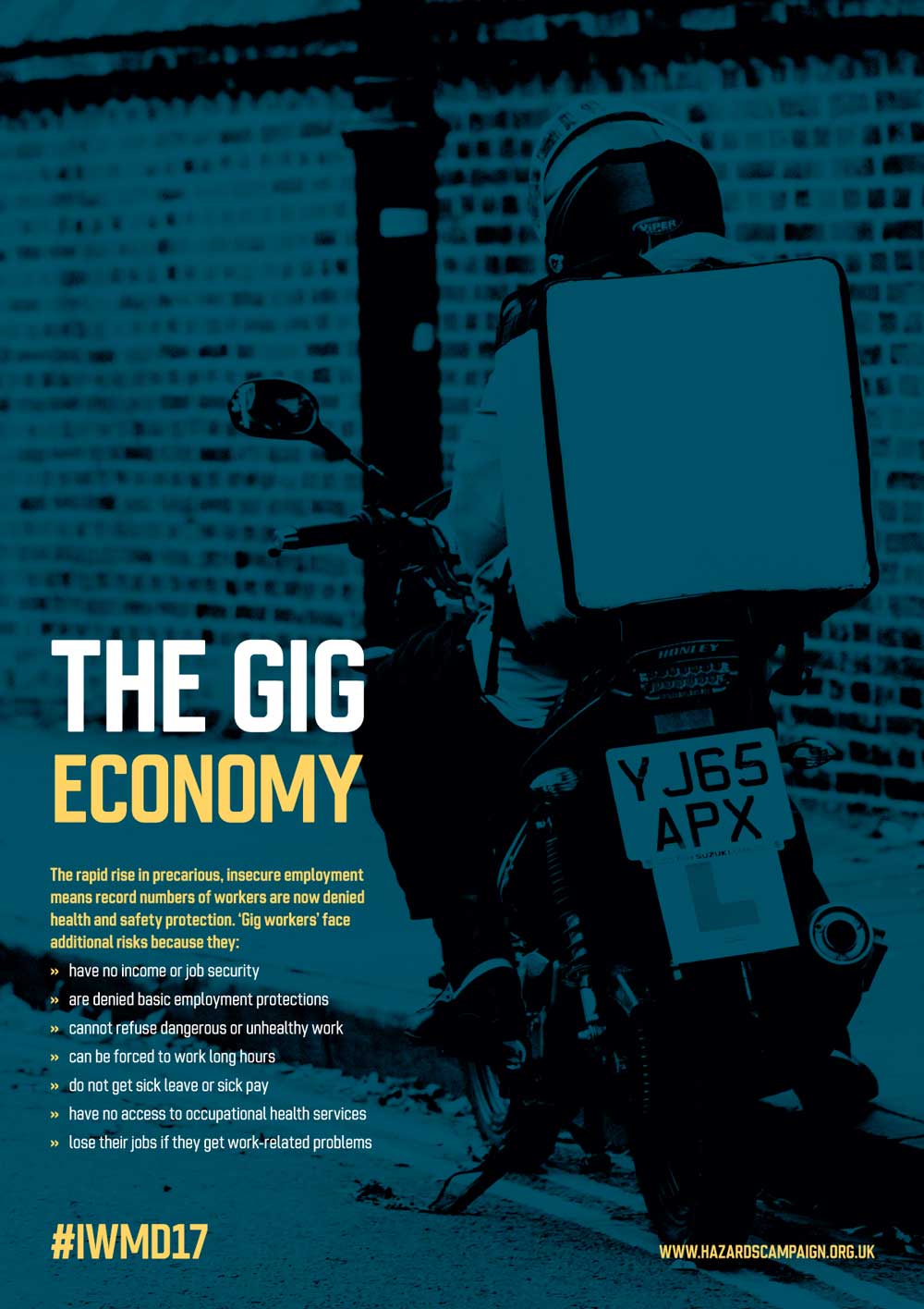
Australia: Unions prepare to take on Amazon
Around the world, Amazon is famous for its low prices, fast delivery, ruthless efficiency and antipathy towards unions, who say it treats workers like robots. Unions in Australia – where Amazon is about to expand its operations – are taking heed.
The Age. Sydney Morning Herald. Risks 797. 29 April 2017
Global: We are all sickened by inequality at work
Whether it is a gaping gulf in pay, job insecurity or job discrimination based on your class, gender or race, a divided workplace is bad for your health, a top union official has warned. In a commentary ahead of International Workers’ Memorial Day on 28 April, Sharan Burrow, general secretary of the global union body ITUC, said who lives and who dies at work is not an accident of chance.
Face it. We are all sickened by inequality at work, editorial by ITUC general secretary Sharan Burrow, Hazards online, April 2017.
Unsafe and unfair – discrimination on the job hurts us all, ITUC briefing for International Workers’ Memorial Day, 28 April 2017.
TUC Workers’ Memorial Day 2017 events listing. Risks 795. 8 April 2017
Canada: Insecure work hits mental and physical health
Precarious work is bad for both mental and physical health, according to a new survey of nearly 5,000 workers by the Ontario Federation of Labour (OFL). The union body, which represents workers in Canada’s most populous province, found almost one-third of survey respondents cite mental and physical health issues as impacts of precarious work.
OFL news release and Make it fair campaign. Toronto Star. More on job insecurity and health. Risks 794. 1 April 2017
Britain: Suicide is a workplace issue
The UK is turning a blind eye to a major workplace killer, work-related suicide, the TUC has warned. The union body points to a series of reports this week highlighting how work factors can put large sections of the workforce at a greatly increased suicide risk, but there the problem is off the radar of the safety regulator.
TUC Stronger Unions blog. TUC guidebook on mental health in the workplace (registration required).
Sarah Waters. Suicidal work: Work-related suicides go uncounted and unaccounted for in the UK, Hazards magazine, number 137, 2017. Hazards quick guide to work-related factors linked to suicide.
Suicide by Occupation 2011-2015, Office for National Statistics, March 2017.
Dying from inequality, Samaritans, March 2017. Reducing the risk of suicide: A toolkit for employers, Samaritans/Business in the Community, March 2017. Crisis management in the event of a suicide: A postvention toolkit for employers, Samaritans/Business in the Community, March 2017. Risks 793. 25 March 2017
Britain: Zero hours contracts treat workers like ‘disposable labour’
New official figures showing a sharp rise in the number of workers on zero hours contracts demonstrate the need for an urgent reform of employment law, the TUC has said. Commenting on new figures from the Office for National Statistics, which show that the number of people on zero hours contracts has increased by 13 per cent over the past year, TUC general secretary Frances O’Grady said: “Zero hours contracts allow bosses to treat workers like disposable labour.”
TUC news release. Are you an insecure worker? Complete the TUC survey. ONS figures, March 2017. Risks 792. 18 March 2017
Britain: Couriers told to find sick cover or face big fines
Parcel delivery firms DPD and Parcelforce Worldwide have been called before a committee of MPs to answer questions about the working conditions faced by their self-employed couriers. Frank Field, the Labour MP who chairs the work and pensions select committee, has written to the bosses of both companies asking them to provide evidence as part of an ongoing inquiry into the gig economy.
Work and Pensions Committee news release and letters to Parcelforce and DPD. HR Grapevine. The Guardian. Risks 791. 11 March 2017
Britain: DX couriers launch legal battle for work rights
The union GMB is to start legal action on behalf of couriers working for the delivery company, DX. The union says it wants to “secure rights on pay, holidays, health and safety, discipline and grievances on behalf of members who work as couriers and drivers for DX.”
GMB news release. Leigh Day news release.
House of Commons business, energy and industrial strategy committee’s Future world of work and rights of workers inquiry hearings. Risks 791. 11 March 2017
USA: ‘Diseases of distress’ linked to work
A 2015 study revealing a sharp spike in death rates among white working class Americans, bucking a long-term downward trend, has prompted research establishing that the ‘diseases of distress’ responsible – alcohol and drug-related diseases and suicides – are linked to work factors. This associations were established by a group of work environment doctoral students at the University of Massachusetts Lowell, Professor Laura Punnett explained in a posting in the public health blog The Pump Handle.
The Pump Handle. Anne Case and Angus Deaton. Rising morbidity and mortality in midlife among white non-Hispanic Americans in the 21st century, Proceedings of the National Academy of Science (PNAS), volume 112, number 49, December 2015.
TUC drugs and alcohol webpages. More on work-related suicide, drug and alcohol use and job insecurity. Risks 790. 4 March 2017
Britain: Agency worker trapped hand in plastic machine
A West Yorkshire polythene film manufacturer has been sentenced for criminal safety breaches after a worker trapped his hand in machinery. Huddersfield Magistrates’ Court heard how the injured agency worker broke the little finger on his right hand while operating machinery in March 2014 at Total Polyfilm Ltd’s Brighouse plant.
HSE news release. Risks 789. 23 February 2017
Britain: Suspended jail term after casual roof worker’s death
A self-employed businessman has been sentenced to nine months imprisonment, suspended for two years, and 200 hours of unpaid work after a casual worker fell from the flat roof of a building and died from his injuries. Manchester Crown Court heard how on 22 December 2013, father of two Jason Fogarty was working alongside company boss Roy Hardaker on a flat roof replacement project. to nine months imprisonment, suspended for two years, and 200 hours of unpaid work.
HSE news release and roofwork webpages. Risks 789. 23 February 2017
Britain: GMB disappointed with Uber’s ‘cosmetic’ changes
Taxi firm Uber has missed a ‘golden opportunity’ to start complying with the law, the union GMB has said. The union, which last year won a groundbreaking employment rights legal case on behalf of Uber drivers, said it was disappointed with the ‘cosmetic’ changes introduced for Uber drivers.
Lawyer Monthly. Risks 789. 23 February 2017
Britain: Heart attack plumber wins workers’ rights fight
A plumber has won a Court of Appeal employment rights battle in the latest significant court ruling over freelance operations in the modern workplace. Gary Smith wanted to reduce his working days at Pimlico Plumbers following a heart attack, but said he was dismissed as a result.
TUC news release. Court judgment. BBC News Online. The Guardian. Risks 788. 18 February 2017
Britain: Insecure work up by over a quarter since 2011
The number of people in insecure work – those working without guaranteed hours or baseline employment rights – has shot up by more than 660,000 (27 per cent) over the past five years, according to new research for the TUC. The trend toward more precarious work, has been linked to higher rates of occupational injuries, work-related ill-health and worker being far less likely to feel able to take sick leave.
TUC news release. Morning Star. The Independent. More on health and safety and insecure work. Risks 787. 11 February 2017
Britain: Hundreds flock to join Uber action
Hundreds of Uber drivers have joined GMB’s legal case against cab firm, with proceeding already issued in 50 cases, the union has said. Law firm Leigh Day, working with GMB to assess the claims, predicts thousands of drivers could potentially join the group action.
GMB news release. Leigh Day news release. Risks 781. 17 December 2016.
Britain: GMB slams Asos double standards
A ‘huge disparity’ in the employment conditions offered to staff at the London HQ of online retailer Asos and its Yorkshire warehouse staff has been criticised by the GMB. The union was commented after Asos announced plans to create 1,500 jobs in a London HQ “that fosters creativity” just days after GMB held a ‘catwalk of shame’ outside the Asos AGM in protest at conditions for warehouse workers in Yorkshire.
GMB news release. Asos news release. Risks 781. 17 December 2016
Britain: Worker suffered cement burns on first day Building products manufacturer Stressline Limited has been fined after an agency worker suffered serious cement burns on his first day of work. Leicester Magistrates’ Court heard how the inexperienced 21-year-old – on his first day of full-time employment – was exposed to alkaline cement slurry while standing in a drainage pit.
HSE news release and cement hazards factsheet. Risks 735. 23 January 2016
Spain: Less secure work equals more work injuries
Deregulatory labour market reforms in Spain in 2012 led to more job insecurity and higher staff turnover and a subsequent sharp rise in workplace injuries, unions have said. Pedro J Linares, safety secretary with the CC.OO trade union confederation, said the reforms had “made dismissals cheaper, weakened trade union bargaining power and slackened investment in occupational health and safety.”
Equal Times. TUC health and safety facebook page. More on the hazards of insecure work. Risks 729. 21 November 2015
Britain: Casual worker fatally injured falling through roof
A self-employed worker has been fined after a casual worker he employed to repair a shed roof fell, dying of his injuries several days later. Ayr Sheriff Court heard how on 26 August 2012, William Sproat, 63, had been employed by David William McVey to repair a storm damaged shed roof at Brunton Farm in New Crummnock.
HSE news release and working at height guide. Risks 727. 7 November 2015
Britain: Agency worker dragged into machine and killed
A company that manufactures and supplies high-strength bar and cable systems has been fined £200,000 after a worker was pulled into an inadequately guarded machine and killed. Alan Gerrard, 47, suffered fatal crush injuries while working at McCalls Special Products Limited when his clothing got caught in the machine, used to apply adhesive tape to bars to stop corrosion. HSE news release and work equipment webpages. Risks 726. 31 October 2015.
Britain: Ambulance count exposes Sports Direct work practices
Ambulances were called out to the warehouse headquarters of one of Europe's largest sports retailers 80 times in two years, an investigation found. Unite, which has launched a campaign for decent work at Sports Direct, says poor conditions are not limited to the company’s warehouses.
Sign up to the online petition to Sports Direct chief executive David Forsey: Sports Direct: Stop your shameful work practices. Unite Sports Direct campaign.
Investigating Sports Direct, BBC Inside Out, 5 October 2015. BBC News Online. Risks 723. 10 October 2015
Britain: The national disgrace of ‘disposable workers’
Insecure employment is creating an army of ‘disposable workers’ too scared to take sick leave and who are fired when they can no longer perform, according to the TUC. The union body was commenting after Health and Safety Executive (HSE) research found that “temporary and permanent employees have comparable rates for both injuries and ill health”, but also discovered “temporary employees have around half the average working days lost per employee of permanent employees.”
TUC health and safety facebook page. Self-reported work-related illness and workplace injury for permanent and temporary employees, HSE, 2015. More on health and safety and insecure work. Risks 711. 18 July 2015
Britain: Scottish inquiry into the quality of work
The social and health impact of work is to be investigated by a key committee of Scotland’s parliament. The “major inquiry” by the Economy, Energy and Tourism Committee will investigate how employment and job quality has changed since the 2008 recession.
Scottish parliament Economy, Energy and Tourism Committee news release and call for evidence. BBC News Online. Risks 708. 27 June 2015
Global: Temp agencies accused of ‘false advertising’
Ciett, the global lobbying body for temporary labour agencies, has been accused of ‘false advertising’ after claiming the International Labour Organisation (ILO) supports the expansion of agency work. Global union federation IUF, which represents unions in the food and farming sectors, dismissed Ciett’s assertion that the growth in business for temporary employment agencies advances the ILO's “decent work” agenda.
IUF news report. Ciett news release. Background report prepared by the ILO. More on the hazards of insecure work. Risks 706. 13 June 2015
Global: McJobs report documents global abuses
McDonald's fought a losing battle for years to keep 'McJobs' - generally defined as low-wage, insecure, dead-end work with no benefits - out of dictionaries. But global foodworkers’ union IUF and its North American affiliate SEIU says their new report, ‘McJobs: Low wages and low standards around the world’, should see “systematic rights abuses”, including safety abuses, added to the current definition.
IUF publication alert, and full publication: McJobs: Low wages and low standards around the world, IUF/SEIU, 2015. Risks 705. 6 June 2015
Global: Mineworkers confront Rio Tinto over casualisation
Mineworkers have confronted Rio Tinto over casualisation of coal mining jobs and its dangerous impact on mine safety. Speaking ahead of the global mining giant’s AGM in Perth, Australia, Andrew Vickers of the Australian mining and energy union CFMEU said that insecure work arrangements were a troubling feature of Rio Tinto’s mining operations worldwide and were “a disaster for mine safety.”
CFMEU news release. Mining Australia. More on the hazards of insecure work. Risks 702. 16 May 2015.
Britain: Unite to tackle ‘Victorian’ Sports Direct practices
Unite has launched a confidential advice and support line to help confront abusive ‘Victorian’ work practices at Sports Direct and a culture of fear at the retailer’s Shirebrook warehouse in Derbyshire. Working conditions are underpinned by a ‘six strikes and you’re out’ disciplinary procedure, where workers can get strikes for long toilet breaks, excessive chatting and even having time off for sickness.
Unite news release. Channel 4 Dispatches: The Secrets of Sports Direct. Risks 701. 9 May 2015
Global: Intermittent jobs are bad for your health
People moving in and out of temporary or insecure work are at a heightened risk of physical and mental health problems. New research has found an ‘accumulation’ of health effects linked to multiple spells of unemployment, adding to evidence showing a pronounced health impact of insecure work.
The Age. More on the hazards of insecure work. Risks 698. 18 April 2015
Britain: Going to work is more stressful than ever
Britons find their jobs more stressful, precarious and demanding than ever before, according to an extensive poll of experiences of the workplace conducted for the TUC. Two-thirds of employed people say that the amount of work they are expected to do has grown over the past few years, and more than a third are expected to do unpaid overtime, YouGov found.
Independent on Sunday • Risks 679 • 8 November 2014
Global: Precarious workers face higher risks
Three out of four workers killed last month at a mine in Indonesia part-owned by Rio Tinto were precarious workers, the global union IndustriALL has said. It says cases like this highlight the importance of its ‘Stop precarious work’ campaign, with studies linking precarious work to higher injury and sickness rates and poorer health overall.
IndustriALL news release • Wall Street Journal • More on the hazards of insecure work • Risks 675 • 11 October 2014
Britain: Agency worker loses arm at recycling firm
A waste recycling firm in Scotland has been fined for serious safety failings after an agency worker severed his left arm at the shoulder while clearing a conveyor belt blockage. Steven Dawson, then aged 28, was working as a line supervisor for Lowmac Alloys Ltd at its premises in Irvine, when the incident happened on 8 February 2011.
HSE news release • STV News • Risks 675 • 11 October 2014
Global: Union body steps up precarious work campaign
The global union IndustriALL is calling on its affiliates worldwide to mobilise their members to ‘STOP Precarious Work.’ It says regular, permanent and direct employment remains under constant attack from multinationals and other forces that are promoting precarious work, linked to higher rates of occupational injury and ill-health.”
IndustriALL news release and report, Negotiating security: Trade union bargaining strategies against precarious work • IndustriALL STOP Precarious Work campaign • More on health and safety and insecure work • World Day for Decent Work • Risks 670 • 7 September 2014
Britain: Company back in court for criminal failings
A Tyneside company has appeared in court for criminal safety breaches for the second time in less than a year after a forklift truck overturned at its factory in Burnopfield, injuring an agency worker. HSE inspector Cain Mitchell said: “The case is all the more serious as it is the second time in less than a year that Radford HMY Group Ltd has been prosecuted for safety failings.”
HSE news release and workplace transport webpages • Risks 658 • 14 June 2014
Britain: Zero hour contracts leave workers hard pressed
The majority of workers on zero hours contracts earn less than the living wage and are at risk of abuse, the TUC has said. The union body was commenting ahead of the publication of new official figures which indicated there are now well over 1 million zero hours contracts in the UK.
TUC news release • PCS news release • Usdaw news release • BBC News Online • The Independent • More on health and safety and insecure work • Risks 652 • 3 May 2014
Britain: Agency worker injured in poorly guarded machine
A Welwyn Garden City manufacturing firm has been prosecuted after an agency worker suffered a hand injury when clearing a blockage on a poorly-guarded palletiser machine. The 33-year-old worker, who does not wish to be named, was attempting to restart a machine at Sika Ltd’s factory after dealing with the blockage when his right hand was struck by a moving part.
HSE news release and manufacturing webpages • Risks 647 • 22 March 2014
Britain: UCATT welcomes false self-employment move
Treasury plans to clampdown on bogus self-employment have been welcomed by UCATT. The construction union has argued consistently that the widespread practice by employers of wrongly designating workers as self-employed has denied the Treasury millions and robbed workers of essential employment and safety protections.
UCATT news release. Government webpage on the false self-employment consultation • Risks 647 • 22 March 2014
Britain: Government sure to fail on zero hours
Proposals from ministers on zero hours contracts will fail to stem the widespread exploitation of workers, the TUC has said in its response to a government consultation. The TUC submission highlights how zero hours work is dogged by low pay, under-employment, and job and income insecurity.
TUC news release and consultation submission • The Guardian •
More on the health and safety risks of insecure employment •
The TUC is organising Fair Pay Fortnight from Monday 24 March to Sunday 6 April. It will be a series of events across England and Wales to raise awareness about falling living standards • Risks 646 • 15 March 2014
Britain: Safety concerns remain after track worker death
Rail staff are scared they will lose their jobs if they speak out about safety, a BBC investigation has found. BBC’s Inside Out programme examined the death of a contract worker who was hit by a train on the track; Scott Dobson, 26, died near Saxilby, Lincolnshire, in December 2012.
BBC News Online • Inside Out, 3 February 2014 • Risks 641 • 8 February 2014
USA: Injury risk increases with multiple jobs
People who hold down more than one job not only experience an increased risk of injury at work, but when they’re not at work as well, according to a new study. The research, published in the January 2014 issue of the American Journal of Public Health, found that multiple job holders had a “significantly” higher injury rate per 100 workers for work- and non work-related injuries when compared to single job holders.
The Pump Handle. Helen R Marucci-Wellman, Joanna L Willetts, Tin-Chi Lin, Melanye J Brennan, and Santosh K Verma. Work in Multiple Jobs and the Risk of Injury in the US Working Population, American Journal of Public Health, volume 104, number 1, pages 134-142, January 2014 [abstract] • Risks 637 • 11 January 2014
Britain: Legal challenge against zero hours contracts
Zero hours contracts are facing a legal challenge, after a part-time worker with SportsDirect.com decided to take her case to an employment tribunal. Elizabeth George, the barrister in the employment team of law firm Leigh Day who is acting for Zahera Gabriel-Abraham, said: “There was no practical difference between the obligations put on my client by the company and those placed on full-time staff,” adding: “The ‘casual’ part-time employees in this case are employees in the conventional sense and denying them their paid holidays, sick pay and bonuses is unlawful.”
Leigh Day news release • 38 Degrees blog • Risks 618 • 17 August 2013
Global: Job worries raise heart disease risks
There is a “modest association” between self-reported job insecurity and coronary heart disease (CHD), a major study has found. In a response welcoming the British Medical Journal paper, Paul Nicholson, chair of the British Medical Association’s Occupational Medicine Committee, noted job insecurity is also linked to increased sickness and raised cholesterol levels and blood pressure, adding the new study was important “because we are living in ‘VUCA times’, that is to say the world is: Volatile, Uncertain, Complex and Ambiguous.”
Marianna Virtanen and others. Perceived job insecurity as a risk factor for incident coronary heart disease: systematic review and meta-analysis, British Medical Journal, volume 347, f4746, 2013, published online 8 August. Response to the article from BMA OMC chair Paul Nicholson • TUC news release • The Mirror • More on job insecurity • Risks 618 • 17 August 2013
Britain: Government must act to halt zero hours culture
Urgent action is needed to stop the growth of the zero hours culture, unions have said. The call came after the Office for National Statistics (ONS) admitted it had dramatically underestimated the extent of zero hours work, and then research published by the human resources organisation CIPD suggested the problem could still be much more serious than the government accepts, with a possible one million zero hours workers in the UK – four times the revised government estimate.
TUC news release • CIPD news release • Unite news release • UNISON news release • UCU news release • Prospect news release • BECTU news release • TUC Touchstone blog • The Work Foundation news release • The Guardian • Risks 617 • 10 August 2013
Britain: Sports Direct faces flak over zero hours contracts
Pressure is mounting on Mike Ashley and his Sports Direct empire over its use of zero-hours contracts for part-time employees as Unite this week demanded a meeting with the billionaire businessman. Politicians, campaigners and charities called on the UK’s biggest sports retailer to change its policy after Unite revealed it was using the no-rights contracts for 90 per cent of its workforce.
Unite news release • The Guardian • The Independent • More on insecure work and safety • Risks 616 • 3 August 2013
Britain: Rail casualisation is a dangerous rip off
Contractors are using bogus self-employment on zero hours contracts to rip off rail workers and create a cut-price and dangerous railway system, according to a new report from the rail union RMT. The report was released on 23 July, to coincide with a meeting between the rail unions and the Office of Rail Regulation (ORR) where the union demanded that both the industry watchdog and Network Rail “take urgent and decisive action to stamp out casualisation in the rail industry which is hitting the workforce and compromising safety.”
RMT news release and report: The Great Rail Payroll Rip Off • Safety on the line, BBC Radio 4 Face the Facts • Risks 615 • 27 July 2013
Britain: Concern at ‘shocking’ rise in zero hours contracts
The government should look at regulating zero hours contracts, the TUC has said. The union was commenting after figures published by shadow health secretary Andy Burnham MP revealed over 300,000 workers in the care sector alone are employed on zero hours contracts.
TUC news release • The Guardian • BBC News Online • Resolution Foundation news release and report, A Matter of Time: the rise of zero-hours contracts, Matthew Pennycook, Giselle Cory and Vidhya Alakeson, Resolution Foundation, June 2013. More on the hazards of insecure work • Risks 612 • 6 July 2013
Britain: TUC wants tougher rules on zero hours contracts
The TUC is calling on Vince Cable to impose tough new regulations on zero hours contracts, after he announced that his officials are conducting a review. Frances O'Grady, the general secretary of the TUC, said: “With the tough times set to continue, now is the perfect time for the government to be reviewing – and hopefully regulating – the increasing use of these exploitative contracts.”
TUC news release • The Guardian • Personnel Today • More on insecure work and health and safety • Risks 610 • 22 June 2013
USA: OSHA initiative to protect temporary workers
Temporary employees in the US will be better protected from workplace hazards, the official safety enforcer has pledged. The Occupational Safety and Health Administration (OSHA) sent a memorandum to the agency’s regional administrators directing field inspectors to assess whether employers who use temporary workers are complying with their legal safety responsibilities and newly created code in their information system to denote when temporary workers are exposed to safety and health violations.
OSHA news release and OSHA temporary workers memo • More on temporary worker health and safety • Risks 603 • 4 May 2013
Britain: Deregulating agency work a mistake
Government plans to repeal regulations which control how employment agencies operate and replace them with a system of self-regulation will lead to more exploitation, the construction union UCATT has warned. Under the government’s proposals included in a consultation by the Department for Business, Innovation and Skills (BIS) which closed on 11 April, the Employment Agencies Act and the existing regulations covering employment agencies would be scrapped.
UCATT news release and full consultation response • Risks 601 • 20 April 2013
Britain: More firms using zero-hours contracts
Almost a quarter of Britain's major employers now recruit staff on zero-hours contracts that keep workers on standby and deny them regular hours. According to government estimates, 23 per cent of employers with more than 100 staff have adopted the flexible contract terms for at least some staff following a surge in the number of public sector services contracted out to private providers.
The Guardian article and related comment • More on the health impact of insecure work • Risks 600 • 13 April 2013
Brazil: McDonald’s gets $4m fine for zero hours contracts
In Brazil, fast food giant McDonald's was this year fined US$4 million for operating a zero-hours scheme under which workers sat in the "break rooms" without being paid, until the employer determined there were a sufficient number of customers for hours to be counted. The court ruling required McDonald’s to eliminate the working time scheme throughout Brazil and ordered it to provide healthy meals to its workers.
IUF news report • Equal Times • More on the health impact of insecure work • Risks 600 • 13 April 2013
Britain: Workman fined for friend's fall through roof
A self-employed maintenance worker has been fined after a casually-employed friend fell through the roof of a disused factory. The injured man, in his forties, suffered a broken elbow when he fell three metres through the asbestos cement roof at a disused rubber factory at Bullo Pill, Newnham, in the Forest of Dean on 4 September 2012.
HSE news release and falls webpages • Hazards insecure work webpages • Risks 598 • 23 March 2013
USA: ‘Expendable’ insecure workers need protection
A new report is urging the US government’s safety regulator to step up efforts to protect the soaring number of ‘contingent’ insecure workers. The report notes that contingent workers are disproportionately racial minorities and often come from vulnerable socioeconomic backgrounds.
At the company’s mercy: Protecting contingent workers from unsafe working conditions, CPR, 2013. AFL-CIO Now blog • The Pump Handle • Risks 590 • 26 January 2013
Britain: Horror death in a small firm
The dangers of informal work in small firms has been highlighted by a workplace tragedy. Welder Martyn Heal, who was paid £60 a day cash-in-hand for three days a week, died over four months after being badly burned when his shirt caught light while working on a gate, an inquest heard.
Western Daily Press • The Bristol Post • More on the dangers of precarious work • Risks 590 • 26 January 2013
Britain: Quick fire move leaves workers dangerously insecure
A government move that will make it easier to for firms to fire their staff will do nothing for the economy but will leave workers much more insecure, the TUC has said. The warning came after ministers announced the 90-day consultation period before large-scale redundancies can take place is to be cut to 45 days from April 2013.
TUC news release • BIS news release • BBC News Online • More on job insecurity and health • Risks 587 • 22 December 2012
Britain: Job fear is affecting the health of UK workers
The harsh economic climate, austerity-related job cuts and job loss fears in those still in work is having a real impact on the health and well-being of workers, according to the newly published findings of a TUC safety survey. TUC general secretary Brendan Barber commented: “Fears about how austerity is affecting peoples' jobs and their families is having a real impact on the health and well-being of UK workers.”
TUC new release and biennial survey of safety reps • More on insecure work and safety • Risks 581 • 10 November 2012
Britain: Agency worker regulations criticised by Unite
Unite has warned against complacency as many agency workers are being poorly treated, the current Agency regulations have too many loopholes and the enforcement of the legislation is not strong enough. An independent survey by Unite showed that in the vast majority of workplaces that employ agency workers (78 per cent of those surveyed) these workers are still second class and are not getting equal treatment.
Unite news release • Risks 580 • 3 November 2012
Canada: Union warning on ‘survivor syndrome’
An epidemic of ‘survivor syndrome’ is affecting overworked and demoralised workers in workplaces shedding staff as job fear grips the working population, a Canadian public sector union has warned.
PSAC news release • More on health and safety and insecure work • Risks 576 • 6 October 2012
Global: Unions challenge agency labour ‘explosion’
The ‘massive expansion’ of insecure agency work is undermining employment and safety standards and should be reversed, unions worldwide have warned. “Employment via agencies, labour brokers, dispatchers and contractors is being used to wholesale replace permanent, direct employment,” said Jyrki Raina, general secretary of body IndustriALL.
IndustriALL news release, Stop precarious work campaign and The Triangular Trap report. More on health and safety and insecure work • Risks 576 • 6 October 2012
USA: Work in a depression is depressing
Watching people lose their jobs all around you will make you sick, even if you hold onto your own job, new research has found. Researchers from the University of Michigan examined the impact of the current ‘Great Recession’ found perceived job insecurity “was associated with significantly higher odds of reporting fair or poor self-rated health at the time of interview, symptoms over the past 2 weeks suggesting major or minor depression, and an anxiety attack in the past 4 weeks, even after adjustment for workers' socio-demographic characteristics and previous health problems.”
Burgard, Sarah A; Kalousova, Lucie; Seefeldt, Kristin S. Perceived Job Insecurity and Health: The Michigan Recession and Recovery Study, Journal of Occupational and Environmental Medicine, volume 54, issue 9, pages 1101–1106, September 2012. The Pump Handle • More on health and safety and insecure work • Risks 576 • 6 October 2012
Britain: Women’s work gets more insecure
Falling numbers of women in full-time work and a rise in their self-employment and involuntary part-time and temporary employment has left women increasingly insecure at work, a TUC economic report reveals. TUC general secretary Brendan Barber said: “Replacing full-time jobs with low-paid, insecure work will drive down wages and keep this country mired in recession.”
TUC news release and Economic report: Women and work • Hazards insecure work webpages • Risks 574 • 22 September 2012
Global: Insecure work leaves workers ‘trashed’
A global epidemic of insecure work is leaving a trail of sick and injured workers in its wake, a new report had concluded. ‘Trashed!’, published in the workers’ health journal Hazards, says the “most reliable product of many modern workplaces is now insecurity, with those in permanent jobs fearing the axe in the name of automation or austerity, and a growing slice of the workforce already outsourced or semi-detached from employment, on zero hours contracts, temping or skirting around for scraps in the informal economy.”
Hazards magazine and insecure work webpages • Industriall news report, leaflet and details of the 7 October 2012 precarious work day of action • Sign up to the ‘Stop precarious work’ cause • Risks 573 • 15 September 2012
Britain: Job insecurity linked to soaring hospital admissions
Rising numbers of people are being admitted to hospital with stress caused by the recession, official figures have revealed. A total of 6,370 people were hospitalised with stress in the 12 months to May, a seven per cent rise on the previous year and 47 per cent up on 2007/8 when the economic crisis hit, according to the Health and Social Care Information Centre (HSCIS).
HSCIC news release and full report • The Independent • Morning Star • Risks 573 • 15 September 2012
Britain: Labour to review of bogus self-employment
The Labour Party is to launch a review into bogus self-employment. In his speech to the TUC Congress in Brighton, shadow chancellor Ed Balls said: “On the issue of bogus self-employment in the construction sector and more widely, I am determined that we look at this issue again.”
Ed Balls’ speech to TUC • UCATT news release • Daily Mirror • Risks 573 • 15 September 2012
Australia: Insecure work is making workplaces less safe
The rise of insecure work in Australia over the past few decades has made employees less able to speak up for their rights and workplaces less safe, Australia’s top union body has warned. ACTU president Ged Kearney, speaking on United Mineworkers Federation Memorial Day, said a constantly changing workforce often meant that safe systems of work were not fully-implemented, and casual, contract and labour hire workers were also less likely to speak up if they thought something was unsafe because they feared the sack.
ACTU news release and Ged Kearney’s speech • 13 September 2012
Britain: Labour to review of bogus self-employment
The Labour Party is to launch a review into bogus self-employment. In his speech this week to the TUC Congress in Brighton, shadow chancellor Ed Balls said: “Construction is one of the most important industries,” adding: “Let’s work together to make it stronger, safer and fairer for the future.”
Ed Balls’ speech to TUC • UCATT news release • Daily Mirror • 13 September 2012
Hong Kong: Nurses, cops and teachers at greater risk of suicide
Nurses, police officers and teachers are more prone to suicide than people in other work, figures released by Hong Kong University's Centre for Suicide Research and Prevention. Hong Kong's focus this year for World Suicide Prevention Day – 11 September - is employment as it found self-perceived job insecurity may further increase suicide risk.
Hong Kong Standard • 13 September 2012
USA: Lawsuit highlights warehouse subcontracting perils
The warehousing industry typically involves complicated layers of companies using, owning, operating and staffing warehouses, making the sector ripe for labour abuse. Warehouse worker groups, including the union-based Warehouse Workers Uniting (WWU), have long argued that unrealistic and escalating productivity quotas are among the things that lead to high chronic and acute injury rates in warehouses.
In These Times • Risks 572 • 8 September 2012
Britain: Bar blacklisters from official contracts – MP
Labour MP Jim Sheridan has called for construction firms guilty of blacklisting trade unionists to be barred from publicly funded projects. The MP, speaking at a 27 August Blacklist Support Group protest outside the Glasgow HQ of construction giant Balfour Beatty, said: “Any contracts from British taxpayers' money - don't give them to criminals like Balfour Beatty who are blacklisting people.”
Jim Sheridan MP news release • Morning Star • Blacklist blog • Risks 571 • 1 September 2012
Britain: Balfour Beatty boss accused of perjury
A blacklisted construction worker has accused a top executive of construction giant Balfour Beatty of perjury. Colin Trousdale, a blacklisted electrician and UNITE member from Manchester alleged the company’s human resources director, Gerry Harvey, had sent a letter to the court asserting “there is no blacklist, we are not blacklisting you, you are paranoid” – but his blacklisting file contained company documentation proving this wasn’t true.
Blacklist blog • Risks 571 • 1 September 2012
Canada: Alberta erases farm workers deaths
The Alberta provincial government in Canada has been condemned for removing farm fatalities from reports on occupational deaths. Alberta Federation of Labour says the move is an example of how ''agricultural workers are being erased in Alberta.'' The federation says the province announced its plans on a government website and offered no meaningful explanation for the change. Alberta is the only province in Canada where farm workers aren't covered by occupational health and safety laws.
OHS • Risks 570 • 25 August 2012
Australia: Study confirms insecure work is dangerous
New official Australian research showing casual workers are 50 per cent more likely to be injured at work is solid proof that insecure work leads to unsafe working environments, the country’s top union body has said. ‘Australian work-related injury experience by sex and age, 2009-2010’, published by national safety regulator Safe Work Australia, found that casual workers without leave entitlements reported 54 injuries per million hours worked compared with a rate of 35 for those with leave entitlements.
Safe Work Australia news release. Australian work-related injury experience by sex and age, 2009-2010, Safe Work Australia, 30 July 2012 [pdf] • ACTU news release. ABC News • Risks 567 • 4 August 2012
Canada: Temp workers are falling through cracks
Complex employment relationships, gaps in the regulatory system and job insecurity can leave low-wage temp agency workers more vulnerable to workplace injuries, according to new research from the Toronto-based Institute for Work and Health. Researcher Ellen MacEachen and colleagues found “that low-wage temp agency workers are less well protected because of the complex working relationship in which they find themselves.” At Work, Issue 69, IWH, Summer 2012 and related research presentation, The management of OHS and return-to-work issues in temporary work agencies [pdf] • Risks 567 • 4 August 2012
USA: Groundbreaking law to protect temporary workers
Temporary staffing agencies in Massachusetts will no longer be allowed to send temporary workers to jobs without informing workers of the name of their employer, the wages they will be paid, or the basic safety training they need to protect themselves from jobs that are often hazardous. The law, which will come into effect in January 2013, has been welcomed by safety campaigners, who say it shines a light on those temp agencies operating in the darkness of Massachusetts’ underground economy, where worker injuries are often unreported and millions of dollars in overtime and minimum wages are unpaid.
Governor of Massachusetts Office news release • MassCOSH news release • Temporary Worker Right to Know Act • Boston Globe • Risks 569 • 18 August 2012
Japan: Officials probe bogus radiation readings
Subcontracted workers at Japan’s earthquake wrecked Fukushima Dai-ichi nuclear power station may have been forced to submit bogus reports on their radiation exposures so they could remain on the job longer. An official investigation began last week after media reports of a cover-up at the plant, which suffered multiple meltdowns following the March 2011 earthquake and tsunami disasters.
Washington Post • The Guardian • Risks 566 • 28 July 2012
USA: Agency work can kill
Lax regulations, loose enforcement and employer resistance to union health and safety committees inflict a ghastly toll of illness, injury and death on the job, the global foodworkers’ union federation has warned. IUF was commenting after the grisly death of a contract worker at a US Nestlé plant, a tragedy it says provides further evidence that agency workers face even greater risks due to their precarious employment status.
IUF news release • MASSCOSH news report • Risks 566 • 28 July 2012
Britain: Teens ‘narrowly escaped death’ at work
A Derbyshire manufacturing firm and its director have been fined after two teenage agency workers ‘narrowly escaped death’ in a fall from a platform above a heap of supermarket trolleys. Derby Crown Court heard that the two 18-year-olds were helping to put scrapped trolleys into a skip using a makeshift lifting platform designed by Storetec Limited director Brian Crossan to fit a forklift truck.
HSE news release • Derby Telegraph • Risks 561 • 23 June 2012
Job insecurity -
the deadly hazards
of precarious work
Insecure work is not just unfair, it's downright unhealthy. Hazards challenges the dangerous shift to increasingly precarious work.

IndustriALL
precarious work campaign
Campaign webpage
RESOURCES

• ACTU secure jobs, better future website
• GURN portal on precarious work
• World Day for Decent Work, ITUC webpage
• International Labour Office (ILO) Decent Work Agenda and related presentation
• ILO global jobs pact webpages
• Stop precarious work campaign, IndustriALL
• Alliance for the American Temporary Workforce | Safe Workplaces
• Health and safety and gig economy: A guide for UNISON health and safety representatives, UNISON, 2018.
ON THIS WEBPAGE
Features • News
HAZARDS WEBPAGES
Vulnerable workers • Victimisation • Blacklisting • Suicide