
Food flavouring wrecked my lungs
Hazards 101 January-March 2008
 When
agency worker Martin Muir (right) was offered a full-time job by flavourings
firm Firmenich in 2003, he thought he was lucky. “It was alright.
I could see I could get further up if I put my head down and got on,”
he recalled.
When
agency worker Martin Muir (right) was offered a full-time job by flavourings
firm Firmenich in 2003, he thought he was lucky. “It was alright.
I could see I could get further up if I put my head down and got on,”
he recalled.
Within three years, exposure to an artificial butter flavouring used in thousands of products including frozen dinners, baked goods, home baking products, crisps, snacks, sweets, butter substitutes, sprays and oils and other processed foods, had cost the father of four his marriage, his health and his job. “When you do lung function tests it gives you a lung age. I come out about 80 years old,” Martin said. “If I run upstairs, I’m out of breath. I was fit as a butcher’s dog before, I’ve always been healthy. They reckon I’ve lost 25-30 per cent of my lung capacity. It doesn’t sound like a lot but when you try do anything you realise it is.”
In December 2005, the firm, based in Thirsk, North Yorkshire, referred him to a chest physician, who confirmed he had bronchiolitis obliterans, a normally rare but sometimes life-threatening condition. The work link was only spotted at all because he was by chance referred to one of the few UK specialists familiar with the US cases.
Diacetyl - the lung destroyer
In the US, hundreds of food workers have been affected by bronchiolitis obliterans, caused by exposure to diacetyl – a flavouring found in brand name products present in most UK kitchens. So far over 500 claims have been filed. Around 100 compensation claims totalling tens of millions of pounds have already been settled, one single claim agreed at around £10 million. At least three affected workers have died.
The disease scars the bronchioles, small airways in the lung, causing irreversible damage. Severe symptoms can surface suddenly or emerge gradually, resulting in shortness of breath, dry cough, wheezing and fatigue. For the worst affected a lung transplant is the only hope – but the operation is risky, and the majority of transplant patients are dead within 10 years.
The first cases were spotting in 2000 in workers on the production line in a popcorn factory in Jasper, Missouri, with the condition dubbed “popcorn workers’ lung”. Since then dozens of cases have emerged in workers in other parts of the food industry. Among them is flavouring factory worker Francisco Herrera, 34, who in 2003 – the year Martin started work with Firmenich – was diagnosed with bronchiolitis obliterans. He sleeps tethered to an oxygen tank. His job, like Martin’s, was mixing flavours, including diacetyl.
“My job as a production operative was running the plant, mixing powders, packing it,” explained Martin. “It produces high intensity food flavourings to go into stock cubes and the like. This was a vegetable flavouring – goes into anything, gives it a high intensity flavouring.”
Swiss multinational Firmenich, which describes itself as “the world’s largest company in the fragrance and favour industry” and which has a turnover in excess of £1bn, puts the flavour into brand name foods for major firms including Unilever, Knorr, Walkers Crisps, McDonald’s and Burger King.
And the evidence suggests Firmenich was aware of the seriousness of the diacetyl risk. In December 2003, two years before Martin’s diagnosis and over a year before he became sick, the US government’s National Institute for Safety and Health (NIOSH) sent an alert to 4,000 businesses that might make or use butter flavouring or diacetyl. The alert called for stringent controls, including “substitution of less hazardous flavouring ingredients or formulations where feasible.”

FEMA KNEW Firmenich is a member of flavouring trade group FEMA, the company’s Leslie L Blau serving as president in 2007. Diacetyl risks in flavouring factories were raised with FEMA and Firmenich before Martin Muir started with the company in 2003.
Firmenich operates from nine locations in the US. NIOSH confirmed it sent this alert direct to the company’s New Jersey plant. Firmenich was, anyway, on the inside track when it came to accessing the latest information. The Flavoring and Extract Manufacturers Association (FEMA), an influential US-based trade group, commented on the NIOSH alert at draft stage; Firmenich is a prominent FEMA member, and the company’s Leslie L Blau is a long-standing member of the FEMA board, serving as president in 2007.
Dr Richard Kanwal, of NIOSH’s Division of Respiratory Disease Studies commented: “Representatives of Firmenich attended a FEMA meeting in June 2002 at which I gave a presentation on flavouring-related occupational lung disease risk and described NIOSH's work in microwave popcorn plants as well as our knowledge of cases in flavouring plants. “Firmenich had also been doing spirometry [lung function] tests on its workers since at least the late 1990s.”
Information about the risks in flavouring factories was also in the public domain. On 26 April 2002, an article by scientists from NIOSH and the Missouri Department of Health in Morbidity and Mortality Weekly Report, published by the US government’s Centers for Disease Control (CDC), noted “recent reports to CDC document bronchiolitis obliterans cases in the settings of flavouring manufacture” and “preliminary animal studies at CDC suggest severe damage to airway epithelium after inhalation exposure to high air concentrations of a butter flavouring.”
What is “food flavourers’ lung”?
Inhaling diacetyl causes extensive and irreversible damage to the
lungs – workers do not recover when they are removed from
exposure. In the worst cases, workers may be left with just 25 per
cent of their lung capacity, requiring them to remain tethered to
an oxygen bottle.
The disease, bronchiolitis obliterans, can develop swiftly –
Martin Muir went in less than three months from a fit, active young
man to someone incapable of walking up the stairs without wearing
himself out – or more gradually. Symptoms include severe shortness
of breath, dry cough, wheezing and unexplained fatigue. If exposure
continues, further damage can occur to an extent where the only
medical option is lung transplant.
The disease is rare and the occupational link almost unknown in
the UK and few doctors anyway even ask for details of a person’s
job. For this reason, it is likely any cases that do occur will
be diagnosed as asthma, bronchitis, emphysema or pneumonia. The
treatments for these conditions are ineffective, however.
Bronchiolitis obliterans is commonly known as “popcorn workers’
lung” in the US, because the first clusters were recognised
in popcorn workers. Cases, however, have been spotted in workers
in other parts of the flavouring and food industry and there is
a concern kitchen staff heating diacetyl containing butter substitutes,
cooking oils and sprays could be at risk. “Food flavour lung”
would be a more accurate description. There is a suspicion one consumer,
a man who ate two packets of microwave popcorn a day, may have developed
the condition.
Martin’s experiences suggested in the UK at least Firmenich fell short of the NIOSH recommended safe procedures, including “use of closed production processes (ie. avoid handling of open containers of flavourings and ingredients)”.
Martin was using a stainless steel pot “with a little wooden lid on top, just sat there. There was nothing in place. I knew it made your eyes sore and I wore goggles and dust masks, but we made chillies so I assumed it was the same sort of thing. Even the dust masks weren’t right.” After his diagnosis “there was a massive song and dance – overhead ventilation and air supplied face masks appeared. They got 3M in to look at it and they said the particulates used on site were too small to be stopped by the dust masks.” He added: “They actually got rid of the product in 2006 after it all came out as they found a safer alternative, completely harmless.”
There is no compelling reason to suspect UK workers are significantly better protected than their US counterparts. The dearth of cases here could be explained not by their absence, but by UK doctors failing to recognise an unfamiliar condition with an unfamiliar cause.
What they don’t know
Finding out how many firms are using diacetyl in the UK is not easy. None of the major food, flavouring or snack trade organisations in the UK could or would provide a products list.
Food and Drink Federation spokesperson Christine Welberry commented: “We are unable to provide you a list of products that contain diacetyl, as we do not hold this type of information at FDF.” She was, however - like all the other trade bodies questioned - in a position to say wherever it was being used, it was being used safely. “Where diacetyl is used in food and drink manufacturing, employers will be controlling the ingredient through the existing health and safety precautions set out under the COSHH (Control of Substances Hazardous to Health) regulations, which would protect employees from this and other substances.”
The Margarine and Spreads Association shares the same building and, seemingly, the same viewpoint. “Where diacetyl is used in food and drink manufacturing, employers will be controlling the ingredient through the existing health and safety precautions set out under the COSHH regulations, which protect employees,” said spokesperson Juliet Bennett.“Spread manufacturers are constantly monitoring the safety of their employees and put the most stringent practices in place.”
And Steve Chandler, director general of the Snacks, Nuts and Crisps Manufacturers Association (SNACMA), also at the same London address, said because of the known respiratory risk from the “purest form” of the chemical “it is necessary for flavouring manufacturers who deal with diacetyl in this form to have safety guidelines in place, which they have.”
Nor is the unfolding scandal in the US causing Europe’s law makers to rush to action. In a statement, European Commission spokesperson Eva Kaluzynska said “for this specific substance, no EU Occupational Exposure Limit has been set nor has it been evaluated by the Scientific Committee on Occupational Exposure Limits. In addition, I can confirm that it is not on the priority list of substances for future scientific evaluation by this expert scientific committee.”
Information from the UK’s official safety watchdog, the Health and Safety Executive, is equally sketchy. Spokesperson René McTaggart said HSE had confirmed diacetyl is not used in popcorn production in the UK, but could not provide any details on where it is used, how many workers are exposed, or on numbers suffering related health problems.
He did confirm diacetyl is widely used in food products in the UK, but could not identify either the products or workplaces. McTaggart admitted “we were not able to find anyone willing to own up to using it as I suspect they feared bad publicity resulting in the public considering the substance a risk to food safety rather than a risk to workers.” Asked if HSE had identified any cases of bronchiolitis obliterans in diacetyl-exposed workers, he said: “They don’t have to notify us they are using diacetyl. You’re actively looking. We’re not.”
Short of doorstepping employers – and the cutback agency does not have the resources to do that, with workplace visits in rapid decline in recent years – it has no way of compelling firms to provide the information. This leaves both consumers and workers in the dark. Food labels do not identify diacetyl, just “flavourings”.
HM Revenue and Customs said they do not hold information on the volume of diacetyl imported into or exported from the UK. And European Food Safety Authority (EFSA) spokesperson Ewa Moncure confirmed: “We do not have data on diacetyl usage in the EU,” a message repeated by all the major European and international trade industry groupings.
The Food Standards Agency said the EU has a register of about 2,800 flavouring substances, with spokesperson Shaun Whelan adding: “Diacetyl is on this register and no further evaluation is required.”
Flavourings including diacetyl are rarely named on product labels, have not been assessed for occupational risks and do not have specific occupational exposure standards. Without this information, devising an effective safe system at work when a flavouring chemical enters a workplace will be, in most instances, a matter of guesswork.
Belated US action
While specific workplace health and safety guidance and exposure limits on diacetyl seem a long way off for Europe’s workers, there have been the first signs of progress in the USA. US companies, concerned at compensation costs, bad publicity and consumer concerns have started to drop diacetyl from their products. In December 2007, popcorn manufacturer ConAgra announced a 16 per cent drop in its consumer foods operating profits, with the company conceding – after initial stubborn resistance - it had now removed diacetyl from all its popcorn and was “confident it would win back sales in this category.”
In September 2007, the House of Representatives passed draft legislation to require the preparation of interim workplace standards to limit worker exposure, a move pre-empted by the official safety watchdog OSHA, which announced it was taking the first tentative steps on the standard-setting process. The OSHA action came only after a public drubbing from the US press, unions and health and safety advocates for its refusal to clampdown on diacetyl use despite clear evidence from its sister organisation, NIOSH, that it had a major occupational health risk on its hands.
 In
June 2007, Jackie Nowell (right), safety and health director of the foodworkers’
union UFCW, commented: “OSHA has been sitting on evidence that there
is a direct correlation between diacetyl and popcorn workers lung for
years. By not regulating this dangerous chemical, OSHA has neglected its
responsibility to food workers. The idea that it would take an act of
Congress to get OSHA to do its job and protect workers is appalling.”
In
June 2007, Jackie Nowell (right), safety and health director of the foodworkers’
union UFCW, commented: “OSHA has been sitting on evidence that there
is a direct correlation between diacetyl and popcorn workers lung for
years. By not regulating this dangerous chemical, OSHA has neglected its
responsibility to food workers. The idea that it would take an act of
Congress to get OSHA to do its job and protect workers is appalling.”
A 7 September 2007 letter to US Secretary of State of Labor, Elaine L Chao, said that OSHA “appears to be ‘missing in action’… it continues to ignore facilities where flavours are manufactured or mixed - the facilities where most new cases of bronchiolitis obliterans are appearing. It also makes no effort toward protecting diacetyl-exposed workers in other snack food factories. Most important, it fails to define the steps employers must take to protect employees, especially measures necessary to limit workers’ exposure to this hazardous chemical.”
 The
letter, signed by Jackie Nowell from UFCW, Teamsters’ health and
safety director LaMont Byrd (right), AFL-CIO safety director Peg Seminario
and over 40 of the USA’s top occupational health scientists, concluded:
“The nation needs OSHA to act. OSHA should not wait for or allow
more illnesses to occur… While some high-profile popcorn manufacturers
have vowed to eliminate diacetyl use, there are thousands of other plants
where workers are exposed to diacetyl. Exposure to this deadly chemical
must be controlled.”
The
letter, signed by Jackie Nowell from UFCW, Teamsters’ health and
safety director LaMont Byrd (right), AFL-CIO safety director Peg Seminario
and over 40 of the USA’s top occupational health scientists, concluded:
“The nation needs OSHA to act. OSHA should not wait for or allow
more illnesses to occur… While some high-profile popcorn manufacturers
have vowed to eliminate diacetyl use, there are thousands of other plants
where workers are exposed to diacetyl. Exposure to this deadly chemical
must be controlled.”
To date, though, OSHA would seem to be the only regulatory agency anywhere to have taken any steps towards closer regulation of diacetyl in any occupations. And other nations may be standing by, averting their gaze as an occupational disease outbreak simmers on their doorstep.
 A
2007 paper in the International Journal of Occupational and Environmental
Health (IJOEH) said the “avoidable tragedy” was “caused
by corporate and regulatory negligence.” Brown University’s
Dr David Egilman and colleagues noted: “Corporate responsibility,
professional vigilance, and proper federal and state regulations could
have prevented the epidemic of lung disease related to flavourings that
has already led to three deaths and countless illnesses.
A
2007 paper in the International Journal of Occupational and Environmental
Health (IJOEH) said the “avoidable tragedy” was “caused
by corporate and regulatory negligence.” Brown University’s
Dr David Egilman and colleagues noted: “Corporate responsibility,
professional vigilance, and proper federal and state regulations could
have prevented the epidemic of lung disease related to flavourings that
has already led to three deaths and countless illnesses.
“To prevent future outbreaks of disease in workers and consumers, it is recommended that the federal government regulate all potential hazards from food and substances added to food, including those currently considered to be GRAS or ‘generally regarded as safe’.”
The GRAS system, concerned solely with the risk from consumption of minute quantities in food, has been a particular bugbear for unions worldwide. Foodworkers are handling diacetyl in industrial quantities and are inhaling the potent lung irritant, not ingesting it. But they are being told GRAS, a system that takes no account at all of occupational risks, proves diacetyl is safe for them to handle.
Total inaction elsewhere
Regulated or not, there is a booming global trade in diacetyl. The Made-in-China website markets it online in 25kg drums. Closer to home, UK based flavouring supplier Treatt plc, a FEMA member with a £38 million turnover in 2007 and trading worldwide, includes diacetyl on its products list. Diacetyl is perfectly legal and EU-approved for use in food. It also has the potential to kill the workers handling it, something so far glossed over by Europe’s regulators.
Global foodworkers’ union federation IUF said its enquiries in Europe had uncovered “an alarming pattern of complacency and denial of responsibility in the face of this dangerous threat to worker health. “Regulatory, safety and trade bodies approached by the IUF have acknowledged extensive use of diacetyl in food processing but would not provide details on where or how the chemical is used, the size of the exposed population or any details of health surveillance or research into diacetyl exposure as an issue in EU workplaces.”
According to IUF: “No worker should be expected to work with a substance linked to a debilitating and potentially fatal occupational disease. In view of this threat to workers’ health and lives, the IUF is therefore calling on its member unions, on the wider labour movement, and on health care and medical organisations concerned with worker health and safety to immediately demand action by national and supranational health and safety regulatory agencies.”
 IUF
general secretary Ron Oswald (right) commented: “The Muir case indicates
that both the companies and the regulatory agencies responsible for workplace
health and safety have been, at worst, dissembling about known hazards
or, at best, dangerously complacent. Unions questioning food manufacturers
about possible diacetyl hazards are either told that there is no danger,
because exposure is within permissible levels – despite that fact
that no-one has seen or verified these measurements, and that no permissible
level has been set.”
IUF
general secretary Ron Oswald (right) commented: “The Muir case indicates
that both the companies and the regulatory agencies responsible for workplace
health and safety have been, at worst, dissembling about known hazards
or, at best, dangerously complacent. Unions questioning food manufacturers
about possible diacetyl hazards are either told that there is no danger,
because exposure is within permissible levels – despite that fact
that no-one has seen or verified these measurements, and that no permissible
level has been set.”
He added that there was a hat trick of excuses for inaction – exposure levels are not dangerous, or diacetyl is ‘Generally Regarded As Safe’, a system that in fact refers only to consumer risk, or that commercial secrecy prevents firms telling workers whether or not they are working with diacetyl. It’s a combination that can leave workers at increased risk of developing the condition and, when they do, with little or no chance of making the link to their job.
Oswald said national and international regulatory agencies “will have to move quickly” to head off potential lethal exposures from “products manufactured and commercially available around the world.” He concluded: “The Muir case is one more reason for unions to treat claims of product safety with the scepticism they deserve, and to press for decisive action.”
Cooking up trouble
Martin Muir was in the bronchiolitis obliterans front line. He used pure diacetyl in a factory setting and it was a hot process, increasing the potential for hazardous fumes. There is a generally accepted assumption once the flavouring has been added to the flavour mix and shipped out in diluted form to food firms and consumers, that’s the end of the risk. It’s a very convenient assumption too, as the market in products containing butter-flavourings is highly lucrative.
It could also be a wrong assumption. The findings of laboratory tests commissioned and published on 21 December 2007 by US newspaper the Seattle Post-Intelligencer found top selling butter substitutes, when heated, released significant levels of diacetyl vapour. This creates a whole new category of at risk worker: commercial kitchen staff.
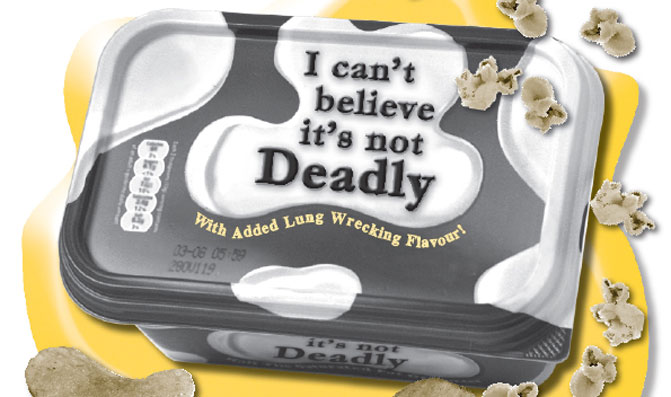
Among the products tested was Unilever’s ‘I can’t believe it’s not butter’. The best selling product was introduced in the US in 1986, and in the UK in 1991. When a dozen eggs were cooked in six tablespoons of the butter substitute, levels of diacetyl arising from the skillet were measured at 171.91 parts per million (ppm), joint second highest of the seven spreads tested - and higher than levels seen in some factories where bronchiolitis obliterans cases have occurred.
The lab tests did not mimic real-life working conditions, but they were a genuine warning sign, said NIOSH’s Dr Richard Kanwal. “Without a comprehensive evaluation it’s impossible to assess the actual risk, but there is no doubt that this group of workers should be studied,” he said. “It is possible that the amount of diacetyl being released in commercial kitchens where these butter-flavoured products are being used could equal or perhaps exceed what was found in the popcorn plants.”
Unlike many factory environments, restaurants and other food outlets typically have a rapid staff turnover. Sick workers with relatively little employment protection would quickly leave their jobs and perhaps the sector entirely, making the identification of a work link considerably more difficult.
Questioned about possible health risks in the manufacture or use of its market-leading product, Caspar Nixon, a UK spokesperson for Unilever, said: “We’ve not really got anything to say.” Dairy Crest, another market leader, did not respond to several requests for a comment. Kerry Foods said none of its products contained diacetyl.
NIOSH said at least one case of “terrible lung disease” has been linked to use of butter-flavoured cooking products by a US short-order cook – the sort that churns out hundreds of sunny-side-up and over-easy eggs every morning.
Hidden dangers
 Neil
Wilkinson, a solicitor with law firm Irwin Mitchell, is representing Martin
Muir. He says his client was never aware he regularly handled a chemical
which carried a life-threatening risk. “We got their safety datasheets
for diacetyl and these said there was clearly a significant risk, the
knowledge was there,” Wilkinson said. “It named diacetyl and
set out the dangers, saying occupational exposure has been ‘linked
to serious pulmonary disease’. They’d got to step 1 and identified
the problem, but not stopped the exposure of Martin and his colleagues.”
Neil
Wilkinson, a solicitor with law firm Irwin Mitchell, is representing Martin
Muir. He says his client was never aware he regularly handled a chemical
which carried a life-threatening risk. “We got their safety datasheets
for diacetyl and these said there was clearly a significant risk, the
knowledge was there,” Wilkinson said. “It named diacetyl and
set out the dangers, saying occupational exposure has been ‘linked
to serious pulmonary disease’. They’d got to step 1 and identified
the problem, but not stopped the exposure of Martin and his colleagues.”
On 5 December 2007, Wilkinson initiated compensation proceedings at Newcastle County Court. It was clear there was a problem in the work method – and the company has already admitted liability, he said. “When mixing in diacetyl oil it gave off a yellow haze. When the job was finished he then had the job of cleaning out the vat, with his head inside, using hot water.”
Martin was a safe worker. “If I was offered PPE (personal protective equipment), I took it. I’ve always, always worn my PPE, done health and safety courses, always done them when they have come up. It’s necessary to protect yourself and get on.”
But solicitor Neil Wilkinson says there are limits to what an individual worker can do. “He sometimes wore masks, but they didn’t fit securely. “He wasn’t familiar with the safety precautions to be taken, nothing specific to diacetyl.” He added that despite the serious health risk warning on the datasheet, no-one told Martin.
Wilkinson believes it “is extremely likely” there are other cases in the UK. “My first thought was ‘I eat this stuff’. I eat potato crisps and popcorn on a fairly regular basis. “Diacetyl is pretty commonplace. And studies in the US suggest small concentrations can cause the condition.”
Cases are being missed
How many other workers are affected in the UK is at this time impossible to assess. Martin Muir is the first case of flavouring related bronchiolitis obliterans recognised in the UK – and it may be down to luck that it was spotted at all.
 He
was referred by Firmenich to Dr Chris Stenton, an occupational respiratory
disease specialist and colleague of Professor David Hendrick (right),
at Newcastle’s Royal Victoria Hospital. Hendrick is a long-time
friend and work contact of Dr Kathleen Kreiss, a colleague of Richard
Kanwal at NIOSH, who together have been key players in identifying and
pressing for action on flavouring related bronchiolitis obliterans. Hendrick
and Kreiss had discussed the condition.
He
was referred by Firmenich to Dr Chris Stenton, an occupational respiratory
disease specialist and colleague of Professor David Hendrick (right),
at Newcastle’s Royal Victoria Hospital. Hendrick is a long-time
friend and work contact of Dr Kathleen Kreiss, a colleague of Richard
Kanwal at NIOSH, who together have been key players in identifying and
pressing for action on flavouring related bronchiolitis obliterans. Hendrick
and Kreiss had discussed the condition.
This personal contact proved crucial. “I think that is a fair point, because I and a colleague run the regional centre for occupational lung diseases, and he was aware of the problem when the case was referred to him, because I was involved,” Professor Hendrick said. “Had this been referred to other centres around the country it could have been missed. It would not probably have been picked up if referred to just the local chest consultant. There may be other cases that haven’t been recognised. Like all new diseases with occupational and environmental causes, it is only the cases with the highest exposure levels that are recognised first.”
Recognition “would be particularly difficult if the patient is elderly and smokes and shows fixed airways obstruction, hence a diagnosis of chronic obstructive pulmonary disease (COPD)” – a condition that is common in the general population and often linked to smoking. Cases could be missed for years, instead labelled as the more familiar conditions asthma, bronchitis, emphysema or pneumonia.
Martin’s case was unusually straightforward, said Hendrick. “He was young, never smoked and all symptoms came on within three months and by chance the first chap who saw him knew about this condition.”
Four severe cases of bronchiolitis obliterans at a Dutch factory – the only other cases so far identified in Europe – were neither recognised nor linked to the job but were labelled COPD, mirroring the experience in the US. The Dutch cases were only identified in a study after the factory had shut. The research team noted cases of bronchiolitis obliterans “were not previously detected or suspected by the occupational health service or otherwise.”
 It
often takes another accident of chance before the penny drops –
several workers developing similar problems in the same workplace around
the same time and seeking help from the same medics. NIOSH’s Dr
Kreiss (right) wrote last year: “Cases of flavouring related bronchiolitis
obliterans develop insidiously without a history of overexposure. Thus,
recognition of this new cause of a rare disease required the occurrence
of clusters of cases in occupational groups.” Some workplaces where
workers became ill had extremely low diacetyl levels, she added. Typical
workplace monitoring and controls would offer few clues and very limited
protection.
It
often takes another accident of chance before the penny drops –
several workers developing similar problems in the same workplace around
the same time and seeking help from the same medics. NIOSH’s Dr
Kreiss (right) wrote last year: “Cases of flavouring related bronchiolitis
obliterans develop insidiously without a history of overexposure. Thus,
recognition of this new cause of a rare disease required the occurrence
of clusters of cases in occupational groups.” Some workplaces where
workers became ill had extremely low diacetyl levels, she added. Typical
workplace monitoring and controls would offer few clues and very limited
protection.
Ron Oswald of global foodworkers’ union IUF commented: “Since bronchiolitis obliterans is frequently misdiagnosed as asthma or COPD, we won’t know the full extent until governments begin overriding claims of commercial secrecy and start demanding full disclosure of the use of diacetyl by the food and flavour manufacturing industry and organise systematic surveillance of all current and former food workers who may have been put at risk.”
It seems certain an unquantifiable but significant number of cases are being misdiagnosed, misattributed or just plain missed, and this has helped justify a regulatory paralysis on the issue. The human cost of this failure to act is high, even if the absolute numbers affected turn out to be low. In the worst affected workers, a lung transplant is the only option – but only half of lung transplant patients survive five years. Few are alive after 10 years. Some of those who don’t get a transplant die anyway, their damaged lungs unable to suck in sufficient air.
Martin’s case is not so severe. “I’m fortunate. I’m not going to get any worse. But I know I find my body is working twice as hard to keep up. When you’ve got 80 year old lungs, that’s bad enough.” His mental well-being has also been a concern. “I was sent to a psychotherapist in the end. “It was affecting my marriage horrendously. We’ve broken up now and this didn’t help. I was a nightmare to live with. I didn’t know what was wrong with me.”
According to Professor Hendrick: “Most of these guys simply don’t get any better and by the time the cases are recognised are suffering significantly.” He is dismayed that companies are refusing to admit to using diacetyl – and perhaps to brionchiolitis obliterans cases in their workforce. “It’s a very sad knee jerk reaction. By and large cooperating early is easier and better in the long-term.
“Just putting diacetyl into Google turns up a considerable amount of high quality, sensible advice. Once an employer knows, there is no excuse to be ignorant.”
In a forthcoming paper in the journal Thorax, he says the case illustrates how “popcorn lung” is a misnomer, with “food flavourers’ lung” a more appropriate diagnostic label. And he believes diacetyl might not be the only suspect. “The chances are there are other agents could cause it. When it comes to regulatory action, we are right at the start.”
A real human tragedy
Martin left the firm in March 2007, a move encouraged by the psychotherapist. “It was winding me up,” Martin admitted. “She really helped me. I realised I’m not going to get better so I can’t dwell on that.”
The December 2005 day he received his diagnosis was a low point. “It was a long drive home. I was always hoping I could get help and I’d be right again. I started to cry in the car. It was an empty feeling, knowing life was going to change altogether.” His relationship with his kids – Jessica, 10, Curtis, 12, Gemma, 18 and Paul, 19 – has been affected. “I can’t go out for a bike ride, can’t have a game of football, a game of cricket in the summer. “I can’t go in the sea – that bit of cold is too much, it just takes my breath. I used to enjoy going to the beach, playing about with the kids. All that’s over.”
There is no treatment. “They tried all sorts, a right string of stuff, and they did nothing – really strong steroids, inhalers. They tried the works and nothing worked.” Now nothing is easy. “I try to do something on my own and I get in a mess – lifting weights, moving stuff about. It’s very tiring and I get frustrated.”
He’s friends with his ex now, but has been unable to start a new relationship. “It knocks your self confidence, because the physical stuff you can do – everything physical – is reduced.” A new job in sales took “ages” to find, and he is now working for less money, his income topped up with industrial injuries benefit. And he’s still waiting for a compensation payout – “I’m fed up waiting” - that his solicitor Neil Wilkinson believes could be worth as much as £100,000.
“He’ll be disadvantaged on the open labour market and he has this condition for life and he’s never going to get any better,” he said.
For Martin, more important than the money is some admission he’s been wronged. “I’d like someone to be held accountable. I’d like an apology, someone to say ‘yup, we’re sorry, we did screw up’. It’s not as though it’s not their fault. They’ve admitted liability.”
The company only got a properly prepared work system after Martin had been affected. “I got to write the safe system of work when I was pulled off the production line,” he said.
Diacetyl timeline
March 12, 1985 NIOSH investigators visit
an Indiana facility that produces flavors for bakeries, where two young,
previously health, nonsmoking employees have been diagnosed with severe
fixed obstructive pulmonary disease (consistent with bronchiolitis obliterans).
Diacetyl is one of the chemicals commonly used at the facility.
February 16, 1993 Researchers for the
German company BASF finish conducting a study in rats underwent a single
4-hour exposure to diacetyl vapours; all of them died at diacetyl concentrations
> 23.9 mg/l.
May 19, 2000 Missouri Department of Health
notifies OSHA that ten workers from one popcorn plant have bronchiolitis
obliterans and asks OSHA to inspect the facility.
May 23, 2000 OSHA inspector visits the
plant, but samples cannot be analysed by OSHA’s laboratory.
August – November 2000 NIOSH investigates
Missouri microwave popcorn facility; findings indicate that workers exposed
to flavourings at the microwave popcorn plant are at risk for developing
fixed obstructive lung disease.
December 2000 NIOSH issues interim recommendations
to the Missouri microwave popcorn plant on ways to control workers’
exposure to the artificial butter flavouring.
September 2001 NIOSH investigators return
to the Missouri factory they studied to distribute materials describing
investigation results, ongoing activities, and worker precautions.
September and December 2001 Attorney representing
sick workers files complaints with OSHA, noting that worker health continued
to decline after plant took measures recommended by NIOSH.
April 26, 2002 Scientists from NIOSH and
the Missouri Department of Health publish an article in CDC’s Morbidity
and Mortality Weekly Report describing their investigation; the article
notes that “recent reports to CDC document bronchiolitis obliterans
cases in the settings of flavouring manufacture” and that “preliminary
animal studies at CDC suggest severe damage to airway epithelium after
inhalation exposure to high air concentrations of a butter flavouring.”
September 2002 OSHA’s Region VII
enters “an agreement establishing an alliance” with the Popcorn
Board trade association; the agreement includes a provision for the Board
to review a draft OSHA “Hazard Information Bulletin.”
2002 - 2003 NIOSH scientists conduct experiments
on laboratory animals and find significant adverse respiratory effects
from diacetyl vapour exposure.
March 2003 The alliance between OSHA and
the Popcorn Board concludes, evidently without the Hazard Information
Bulletin being issued.
Spring/Summer 2003 EPA’s Indoor
Air Quality Research Update reports that a project to identify and quantitatively
evaluate compounds emitted through popping and opening microwave popcorn
is expected to be completed in December 2003.
December 2003 NIOSH alert suggesting safeguards
and asking employers to caution workers goes out to 4,000 businesses that
might use or make butter flavoring.
July 26, 2006 Unions UFCW and the Teamsters
petition OSHA to issue an emergency temporary standard to protect workers
from diacetyl. Forty-two scientists and occupational health experts express
support for the petition.
July 26, 2006 SKAPP requests the EPA to
release the results of its study that had been slated for completion in
December 2003.
August 21, 2006 UFCW, Western States Council,
and the California Labor Federation petition Cal/OSHA to adopt an emergency
temporary standard for diacetyl in California.
March 2007 California Assemblywoman Sally
Lieber introduces a bill that would ban diacetyl in the workplace by 2010,
and Cal/OSHA drafts a standard on occupational exposure to food flavourings.
May 7, 2007 Congresswoman Rosa DeLauro
writes to US Food and Drug Administration (FDA) Commissioner Andrew von
Eschenbach requesting that the agency re-examine diacetyl's "Generally
Regarded as Safe" status.
May 31, 2007 Dutch researchers report
online there have been four cases of diacetyl related bronchiolitis obliterans
in flavouring factory workers in Holland. The researchers investigated
the health of former workers at the factory, which had already closed.
None of the cases had been correctly diagnosed or attributed to work when
the factory was open.
June 12, 2007 US FDA Commissioner Andrew
von Eschenbach responds to DeLauro's 7 May request, stating that “the
agency does not have evidence that would cause it to take immediate action
with respect to diacetyl” and that “FDA continues to monitor
the scientific literature for studies conducted to define and clarify
the dangers associated with exposure to diacetyl vapours.”
June 13, 2007 Congresswoman Lynn Woolsey
introduces legislation that would force OSHA to set an interim standard
for diacetyl exposure within six months and a final rule in two years.
August 28, 2007 Manufacturer Pop Weaver
announces that it has eliminated diacetyl from its microwave popcorn.
September 4, 2007 David Michaels breaks
the news, on The Pump Handle blog, that Dr Cecile Rose, chief occupational
and environmental medicine physician at National Jewish Medical and Research
Center, had diagnosed a case of bronchiolitis obliterans in a man who
did not have occupational exposure to diacetyl but was a regular, heavy
consumer of microwave popcorn. She had informed the FDA, EPA, CDC, and
OSHA about the case in July but got very little response. Newspapers and
TV shows across the country publicize the story, and ConAgra announces
that it will remove diacetyl from its Orville Redenbacher and Act II microwave
popcorn lines.
September 26, 2007 By a vote of 260 to
154, the US House of Representatives passes the Popcorn Workers Lung Disease
Prevention Act, which requires OSHA to set a standard to protect workers
from diacetyl.
November 6, 2007 An alert from global
food workers’ union federation IUF says because of the proven worker
health risk it was “calling on its member unions, on the wider labour
movement, and on health care and medical organisations concerned with
worker health and safety to immediately demand action by national and
supranational health and safety regulatory agencies…The current
state of knowledge warrants an immediate suspension of the use of diacetyl
pending a thorough appraisal of its workplace risks.”
December 21, 2007 Tests performed for
US newspaper the Seattle Post-Intelligencer reveal use in cooking of diacetyl
containing butter substitutes, cooking oils and sprays could create a
significant occupational risk to kitchen staff. NIOSH indicates earlier
cases could have been missed.
February, 2008 Hazards magazine
reveals a UK flavouring factory worker, Martin Muir, has developed diacetyl
related bronchiolitis obliterans, the first recognised case in the UK.
Other UK cases are likely – the occupational respiratory physicians
who spotted the case were by chance in contact with NIOSH respiratory
physicians, so acquainted with the problem. The warn GPs and general chest
consultants would be likely to misdiagnose, misattribute or miss entirely
work-related cases.
Sources Adapted and updated from DefendingScience.com and David
Egilman, Caroline Maillous and Claire Valentin. Popcorn-worker Lung Caused
by Corporate and Regulatory Negligence: An avoidable tragedy, International
Journal of Occupational and Environmental Health, volume 13, number 1,
pages 85-98, 2007 [pdf].
Key references
Preventing lung disease in workers who use or make flavorings, NIOSH Alert, December 2003.
Kathleen Kreiss. Flavoring-related bronchiolitis obliterans, Current Opinion in Allergy and Clinical Immunology, volume 7, pages 162–167, 2007 [abstract].
Frits GBGJ van Rooy, Jos M Rooyackers, Mathias Prokop, Remko Houba, Lidwien AM Smit and Dick JJ Heederik. Bronchiolitis Obliterans Syndrome in Chemical Workers Producing Diacetyl for Food Flavorings, American Journal of Respiratory and Critical Care Medicine, volume 176, pages 498-504, 2007 [abstract].
Kathleen Kreiss. Occupational Bronchiolitis Obliterans Masquerading as COPD, American Journal of Respiratory and Critical Care Medicine, volume 176, pages 427-429, 2007 [abstract].
David Egilman, Caroline Maillous and Claire Valentin. Popcorn-worker Lung Caused by Corporate and Regulatory Negligence: An avoidable tragedy, International Journal of Occupational and Environmental Health, volume 13, number 1, pages 85-98, 2007 [abstract].
New Study Highlights Potential Diacetyl Risk to Restaurant Workers, IUF, 3 January 2008.
Unions, members of Congress urge action on diacetyl, Seattle Post-Intelligencer, 22 December 2007.
Flavoring additive puts professional cooks at risk, Seattle Post-Intelligencer, 21 December 2007
Additive found in more than 6,000 products, Seattle Post-Intelligencer, 21 December 2007.
UNITE HERE response to new evidence of chemical hazard from cooking products, UNITE HERE, 20 December 2007.
IUF Calls for Urgent Global Action on Toxic Food Flavouring Ingredient Diacetyl, IUF, 6 November 2007.
Teamsters Applaud Passage of Legislation to Protect Workers From Diacetyl Exposure, IBT, 26 September 2007.
Federal Agencies
Knew of Diacetyl Dangers and Kept Silent, OMB Watch, 11 September
2007.
Unions & Scientists Renew Call for OSHA Action on Diacetyl, letter to US Secretary of Labor Elaine L Chao, 7 September 2007 [pdf].
Food and commercial workers applaud Congressional effort to force OSHA to do its job, UFCW, 13 June 2007.
Teamsters Support House Bill to Protect Workers From Diacetyl Exposure, IBT, 12 June 2007.
Emergency petition seeks immediate action on lethal popcorn flavorings. Unions, Supported by Scientific Community, Petition California Occupational Safety and Health Standards Board for Emergency Temporary Standard for the Chemical, UFCW, 28 August 2006.
Emergency Petition Assails OSHA'S Refusal to Take Action on Lethal Popcorn Flavoring, IBT, 26 July 2006.
Petition for an OSHA Emergency Temporary Standard for Diacetyl, IBT/UFCW, 26 July 2006 [pdf]
Obtaining bulk quantities of diacetyl online via Made-in-China.com
Resources
Diacetyl/Popcorn Workers Lung. DefendingScience.org, website of the Project
on Scientific Knowledge and Public Policy. Detailed
and extensively referenced briefing.
Diacetyl factsheet, DefendingScience.org
Flavorings-Related Lung Disease, NIOSH webpage, USA.
Flavorings-Related Lung Disease: Diacetyl, OSHA webpage, USA.
Hazard communication guidance for diacetyl and food flavorings containing diacetyl, OSHA, USA, September 2007
Factsheet: Diacetyl and popcorn lung, UFCW.
Diacetyl (butter flavour chemical) use in flavouring manufacturing companies. Health Hazard Alert, Hazard Evaluation System and Information Service (HESIS), California Department of Health Services/California Department of Industrial Relations, August 2006 [pdf]
David Egilman’s archive of legal and scientific documents on diacetyl butter flavouring and health
Washington State diacetyl warning to cooks [pdf]
Andrew Schneider’s Seattle Post-Intelligencer blog
Hazards Diacetyl news
Global: More concerns over health effects of popcorn flavouring
Concern has been expressed that a chemical used as a substitute for a food flavouring that causes lung disease is comparably toxic. Researchers claim the ingredient 2,3-pentanedione, used to impart the flavour and aroma of butter in microwave popcorn, is a respiratory hazard that can also alter gene expression in the brains of rats. Many companies switched to using pentanedione when the butter flavouring, diacetyl, was found to cause the serious and non-reversible lung disease bronchiolitis obliterans, also called 'popcorn lung'.
UPI.com • Hazards diacetyl webpages • Risks 570 • 25 August 2012
USA: Six figure payout for popcorn lung
A US factory worker has been awarded $814,500 (£496,000) by a court after his lawyers argued successfully he contracted potentially lethal ‘popcorn lung’ from breathing a chemical used to make food taste buttery. A jury had awarded Maryland-resident Brian Hallock $5.4 million (£3.3m) from Polarome International Inc, a New Jersey-based chemical manufacturer and distributor.
Baltimore Sun • More on diacetyl hazards and popcorn lung • Risks 515 • 11 June 2011
USA: Popcorn peril spreads to sweets
A recently identified outbreak of severe cases of popcorn lung among former sweet factory workers may prove what government and civilian occupational health experts have long feared - the sometimes-fatal disease can afflict those exposed to diacetyl butter flavouring regardless of where they work.
Andrew Schneider Investigates • More from Hazards on diacetyl risks • Risks 401
Hazards news,
11 April 2009
USA: Movement at last on popcorn lung
The US Occupational Safety and Health Administration (OSHA), reversing years of foot dragging while the agency was controlled by the Bush administration, is moving quickly to protect workers from a serious lung disease caused by diacetyl, the artificial butter flavouring added to popcorn and other food products.
OSHA news release • Lynn Woolsey statement • AFL-CIO Now • The Pump Handle • Andrew Schneider Investigates • Risks 398 • 21 March 2009
USA: Toxic firm wants to be left alone
A top journalist has attacked a major US flavouring firm for attempting to prevent federal health investigators from protecting workers. Seattle Post Intelligencer reporter Andrew Schneider, writing in his ‘Secret ingredients’ blog, was commenting on a year-long court battle between an Indianapolis flavour manufacturer and the government's top occupational health investigators regarding diacetyl, a flavouring know to cause potentially fatal lung disease.
Secret ingredients • Hazards website: www.hazards.org/diacetyl • Risks 393 • 14 February 2009
USA:
Second consumer popcorn lung case
A second US man may have developed ‘popcorn lung’ as a result
of microwave cooking and consuming bags of popcorn. Larry Newkirk has
been diagnosed with the sometimes fatal lung disease called bronchiolitis
obliterans.
Seattle
Post-Intelligencer • Hazards
diacetyl webpages • Risks
373 • Hazards, 13 September 2008
USA: Does
popcorn poison cause Parkinson’s?
A top expert on diacetyl, the chemical responsible for an outbreak of
the potentially fatal lung disease ‘popcorn lung’, now fears
it could also be linked to Parkinson’s disease. David Egilman, a
physician and clinical associate professor at Brown University in the
US, says he is aware of two cases of Parkinson’s disease in men
who were flavourists at Givaudan in Cincinnati, a large flavourings company.
The
Pump Handle • Seattle
Post-Intelligencer ‘Secret Ingredients’ blog • Hazards
diacetyl webpages • Risks
360 • Hazards news, 14 June 2008
USA: Watchdogs probe
diacetyl threat to cooks
A US federal investigation into the hazards facing cooks exposed to diacetyl,
a sometimes deadly artificial butter flavouring, is under way in New York
City restaurants. Meanwhile in Seattle, the state safety watchdog is starting
a similar inquiry.
Seattle
Post Intelligencer • Confectionery
News • Unite
Here December 2007 news release • Hazards
guide to diacetyl risks • Risks
348 • Hazards news, 22 March 2008
Britain: Government
busy doing nothing on diacetyl
In an 11 March written answer to a parliamentary question from Liberal
Democrat MP Mike Hancock on diacetyl risks in the UK, DWP parliamentary
under-secretary of state Anne McGuire replied: “No research has
been commissioned by the government or the Health and Safety Executive
(HSE). However, the Health and Safety Executive accepted the evidence
from the National Institute for Occupational Safety and Health in the
United States of America as the basis for alerting the food industry to
the potential inhalation risks to workers from diacetyl in 2004”
- a reported UK case resulted from workplace diacetyl exposures in 2005.
Food:
Industrial health and safety, Hansard written answer, 11 March
2008 • Hazards news, 15 March 2008
Britain: HSE issues
low key diacetyl warning
The Health and Safety Executive (HSE) has put out a low key, two-paragraph,
warning about the risk from diacetyl, a food flavouring that is widely
used in the UK and that has been linked to hundreds of cases of serious
occupational lung disease in the US.
HSE
diacetyl alert • I
can't believe it's not deadly: Food flavour wrecks lungs, Hazards
magazine diacetyl feature and resources • NIOSH
flavourings topic page • Risks
347 • Hazards news, 15 March 2008
Britain:
Lung destroying disease reaches the UK
A union organisation has repeated its call for global action on a lung-destroying
occupational disease which has affected hundreds in the USA, after it
was revealed the first case had been identified in the UK. Global foodworkers’
union federation IUF said regulatory action and medical surveillance of
food workers exposed to the flavouring ingredient diacetyl, the cause
of bronchiolitis obliterans, have so far elicited no response by health
and safety agencies in Europe.
IUF
news release • Irwin
Mitchell solicitors news release • I can’t
believe it’s not deadly: Food flavour wrecks lungs, Hazards magazine, Number 101, January-March 2008 • Risks
345 • Hazards news, 1 March 2008
Food flavouring wrecked my lungs
Contents
• Introduction
• Diacetyl - the lung destroyer
• FEMA knew
• What is food flavourers’ lung?
• What they don’t know
• Belated US action
• Total inaction elsewhere
• Cooking up trouble
• Hidden dangers
• Cases are being missed
• Key references
• Resources
Extra features
Diacetyl timeline more
Hazards webpages
Work and health • Deadly business