
There is no denying it is a big problem. The Workers Policy Project points to the government’s own data showing that 1 in 3 workers – 9.8 million people – experience workplace sexual harassment in a single year. This includes 680,000 subjected to rape or attempted rape.
The project wants the Health and Safety Executive (HSE) to treat sexual harassment as a genuine risk to health and safety.
Its push to close this ‘enforcement gap’ comes after both the HSE and the Equality and Human Rights Commission (EHRC) told Hazards in 2024 that they were unwilling – HSE – or not mandated – EHRC – to undertaken preventive inspections to protect workers from harassment (See: Stop it!, Hazards 167).
HSE’s ‘not me’ position is attracting growing criticism. The regulator has a right of entry to workplaces. It can undertake preventive inspections. And it can demand employers act to make workplaces safe before workers are harmed.
It just won’t exercise these rights on sexual harassment, which HSE’s critics say is undeniably a hazard at work.
End Not Defend
The Workers Policy Project leads End Not Defend, a national coalition of trade unions, survivor advocates, and legal and safety experts, all seeking to get sexual harassment recognised and regulated as a workplace hazard under health and safety law. The coalition includes partners such as Rights of Women, the Suzy Lamplugh Trust, the national Hazards Campaign and the TUC.
“If a machine is dangerous, the Health and Safety Executive (HSE) enforces the law,” Ian Hodson, president of the bakers’ union BFAWU, told an End Not Defend parliamentary meeting in November 2025. “If asbestos is found, HSE intervenes. If a worker suffers a preventable injury, HSE investigates. But when the hazard is sexual violence, predatory behaviour, coercion, stalking, or harassment, HSE does nothing.”
He added: “Sexual harassment at work often involves physical or psychological abuse and has been linked to depression and poor mental health. It is unquestionably an act of violence, and would fall clearly within the definition used by HSE.”
In a letter to the campaign dated 26 August 2025, HSE confirmed its refusal to regulate sexual harassment, stating: “It is our view, that HSE is not the appropriate organisation to regulate sexual harassment in the workplace.”
However, End Not Defend argues this refusal is unlawful and breaches the UK's obligations under UK workplace safety and equality law, and the International Labour Organisation’s Convention 190 on Violence and Harassment in the World of Work, which the UK ratified on 7 March 2022 and came into force on 7 March 2023.
Under the Worker Protection Act, which took effect in October 2024, workers have explicit legal protection from harassment at work. The new Employment Rights Act from April 2026 made sexual harassment at work a ‘protected disclosure’, giving whistleblowers additional protections.
 PRECARIOUS SITUATION The refusal by HSE to act on sexual harassment at work is a choice, says Jessie Hoskin of the Workers Policy Project, adding this “is leaving millions of workers, particularly women and those in precarious work, at risk.”
However, these workplace protections are only theoretical if unpoliced and unenforced.
HSE refuses to do it, EHRC can’t do it and the police won’t do it either, says Jessie Hoskin, the director of the Workers Right Project, as “there is no criminal category of 'sexual harassment', it is not recorded as 'in the workplace', and across all constabularies over the space of a year, only seven incidents of 'sexual harassment' were recorded in total. So, it is not being treated as criminal either.”
Voluntary fail
The existing approach, leaving responsibility with EHRC, means women can only complain after being harmed. There is no focus on prevention, enforcement or accountability for a criminal failure to put in place measures to protect workers.
The Workers Policy Project points to the case of McDonald’s, which was forced into a legally binding agreement with EHRC in February 2023 after widespread harassment was exposed. “Yet follow-up reports show harassment continues, because EHRC has no power to enforce prevention,” the project says.
At the time of the 2023 agreement, the bakers’ union BFAWU expressed scepticism, saying “we would encourage caution in celebrating such an agreement.”
Sarah Woolley, the union’s general secretary, commented: “This is not a few bad apples this is caused by a system of zero hours contracts, when crew members must depend on the goodwill of managers to be allocated hours, when low pay is endemic and working women are expected to live pay cheque to pay cheque, when there’s a culture of cover up with the use of NDAs and when McDonald’s continue to victimise members of trade unions when unions form anywhere in McDonald’s. When all that continues to happen I’m afraid sexual harassment will continue to be an issue in McDonald's.”
The union’s concerns were, as a slew of evidence suggests, well-founded.
In January 2025, three years after EHRC’s initial action, law firm Leigh Day said it had been instructed by more than 700 clients aged 19 or younger when working at McDonald’s to take legal action on their behalf, with over 450 McDonald's restaurants implicated in the harassment claims.
In November 2025 EHRC extended its original plan to protect staff at the fast-food chain from sexual harassment “in response to serious allegations raised.”
The situation remains so bad at McDonald’s that in January 2026, in response to a joint complaint from UK and international unions, the TUC and civil society organisations, the UK government offered to mediate.
The Workers Policy Project says similar concerns about ineffective EHRC action emerged at Lidl in 2024 and 2025, “proving that voluntary undertakings cannot change workplace culture without strong enforcement.”
Project director Jessie Hoskin commented: “HSE regulates stress, they regulate bullying, but they won’t regulate sexual harassment. This isn’t about what’s legally possible it’s about what’s politically convenient. The refusal to enforce is a choice, and it’s leaving millions of workers, particularly women and those in precarious work, at risk.”
An End Not Defender member, a survivor of workplace sexual harassment, commented: “We are failed twice over: Failed by employers who ignore us, and failed by regulators who refuse to act. The UK government signed up to protect us under Convention 190, but their promises are worthless if HSE won’t enforce the law.”
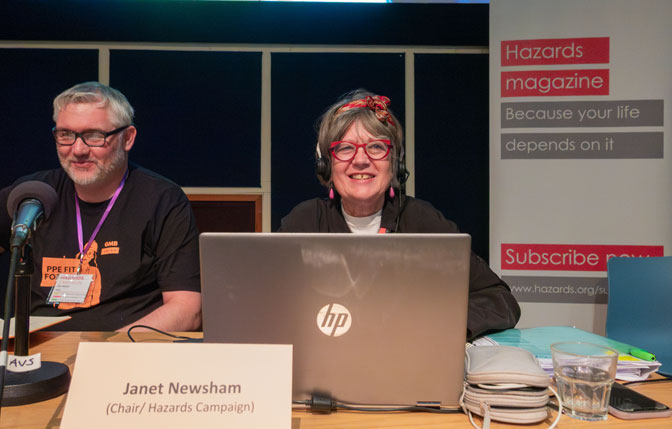 NON-ENFORCER The Hazards Campaign's Janet Newsham says HSE’s failure to protect workers from sexual harassment “is a failure of enforcement.”
Janet Newsham of the national Hazards Campaign said: “Sexual harassment is a serious health and safety risk, not just an equality issue.” She said HSE’s refusal to act “isn’t an oversight; it’s a failure of enforcement.”
In a statement, academics Ruth Beresford and Bob Jeffrey of Sheffield Hallam University, noted: “Workplace sexual harassment is an endemic problem in the UK, and it undeniably affects worker health and safety.” They added: “Bringing sexual harassment under the remit of the HSE would be a crucial step in strengthening workplace rights and holding employers who do not protect their workers to account.”
Pointing to their joint study, Ruth Beresford, said: “Our research highlights just how endemic workplace sexual harassment is, and the impacts it has on workers, who are disproportionately young, women, minoritised, LGBT and disabled. It also reveals how unsatisfactory outcomes are in the small proportion of cases that are actually reported.”
Bob Jeffery added “alongside issues of hiring practices, job allocation and contractual insecurity in certain industries, a key problem is the lack of regulatory action against workplace sexual harassment, with no systematic mechanism of recording or inspection.”
Plaid Cymru peer Carmen Smith is lending her support to the campaign. “The UK’s legal framework is failing to adequately protect workers from violence and harassment in the workplace. Making violence and harassment a health and safety issue, with a preventative duty placed on employers with Health and Safety Executive oversight, is a clearcut way to limit this harm and prioritise workers’ safety.”
The Baroness added: “It is deeply frustrating that the UK government rejected amendments I proposed to the Employment Rights Bill on this issue, despite having the means to bring about much-needed change.”
The amendments had been drafted with support from Workers Policy Project, the Suzy Lamplugh Trust and Rights of Women.
The End Not Defend campaign is calling on the government to recognise harassment as a workplace hazard under workplace safety law. It wants employers to include harassment and related psychosocial risks in risk assessments, to have explicit prevention duties and for there to be real consequences where employers fail to protect their workers.
It also wants the government to extend RIDDOR reporting rules, which are currently under review, to sexual harassment incidents. The HSE consultation ends on 30 June 2026.
And it says HSE must “empower” its inspectors to adopt a preventive inspection and enforcement role.
- Challenging Sexual Harassment in Low Paid & Precarious Hospitality Work. Jeffrey, Robert; Beresford, Ruth; Thomas, Peter; Etherington, David; and Jones, Martin (2024). Challenging Sexual Harassment in Low Paid & Precarious Hospitality Work. Project Report. Sheffield Hallam University. [Monograph]
- Workers Policy Project.
- End Not Defend.
- BFAWU.
- Hazards Campaign.
Heathrow Airport agrees sexual harassment policy
Civil aviation union Unite, has signed a landmark sexual harassment policy at London’s Heathrow Airport.
This policy covers all workers at Heathrow Airport Limited, including those who are employed by third party companies such as British Airways and OCS. It is the first such sexual harassment policy signed by Unite since the Worker Protection Act introduced new legal protections workplace sexual harassment in October 2024.
Key parts of the Heathrow policy, agreed in January 2026, include mandatory training on sexual harassment which all employees must do and sign off on, as well as regular risk assessments and a commitment to the employer taking swift and effective action when sexual harassment is reported. Unite says the policy also includes clear procedures in cases where an individual is disciplined or dismissed following a finding of sexual harassment.
Unite general secretary Sharon Graham said: “Unite has long been committed to taking a zero-tolerance approach to sexual harassment and this marks an excellent win for our members at Heathrow Airport.
“This new policy will go a long way to protecting our staff from sexual harassment and creating a safe workplace, where workers are being given the commitment that incidents will be dealt with effectively. Unite will fight every step of the way to ensure workplace harassment becomes a thing of the past.”
Next steps will include Unite carrying out polling at Heathrow Airport to see if members believe the policy is working, as well as a review of it. There will also be a campaign working with the employer focusing on sexual harassment.
Last year as part of a wider survey by Unite on sexual harassment, the union found the problem was endemic in the civil aviation sector. One in three women working in the industry had been sexually assaulted at work, while 55 per cent had been inappropriately touched and 40 per cent had been shown porn with the perpetrators including colleagues, managers and a third party such as a passenger.
However, the union found 80 per cent did not report these incidents, while those who did said it wasn't taken seriously by management with 76 per cent saying this was the case.
TUC Cymru finds almost half of workers sexually harassed
Nearly half of employees in Wales have experienced some form of sexual harassment in the workplace, according to a 2025 survey by TUC Cymru.
Almost half (46 per cent) of respondents to a Censuswide survey said they had been a victim of workplace sexual harassment. Nearly 1-in-10 (8 per cent) employees said they didn’t know how to report incidents when they occur. And more than 1-in-7 (13 per cent) workers said their workplace does not have a formal policy addressing sexual harassment, or they didn’t know if there was one.
TUC Cymru commissioned the survey in June/July 2025, run by Censuswide, of 2,000 employees across Wales. The survey found that 43 per cent of men and 48 per cent of women reported experiencing sexual harassment at work.
The survey found that young workers aged 25-34 were most likely to have experienced sexual harassment with just over half (53 per cent) of respondents in that age range saying they had experienced it. The number who have experienced it decreases with age but is still as high as 21 per cent in the over 55 age range.
The survey also found that women are less likely (17 per cent) to report an incident of sexual harassment than men (11 per cent). Men (21 per cent) are more likely than women (13 per cent) to turn to a union representative for help.
A third of women (30 per cent) who didn’t report said the reason was, “I didn’t think it was serious enough”.
And shockingly, said TUC Cymru, more than 1 in 10 respondents said their workplace either had no formal sexual harassment policy or they were not aware of a policy in place. Over a third (36 per cent) said they have not received any training on identifying or reporting sexual harassment in the workplace.
Shavanah Taj, TUC Cymru General Secretary said: “Everyone deserves to feel safe at work. It’s shocking that, in 2025, nearly half of all workers in Wales have experienced sexual harassment at work. This has to stop. And that’s why we’re launching our We’ll Support You campaign.
“Trade unions and reps are ideally placed to tackle sexual harassment in the workplace. Our We’ll Support you campaign will show all workers in Wales that, if they experience or witness sexual harassment, their trade union rep will be there, a visible ally by their side, every step of the way.
“This campaign will empower trade union reps to negotiate with their employer and make sure they’re complying with the new Worker Protection Act. Ultimately, this campaign will reduce the amount of sexual harassment taking place in workplaces in Wales.”
TUC Cymru’s We’ll Support You campaign aims to tackle sexual harassment in the workplace. Created to raise awareness around support available to workers from unions, the organisation has published a handbook to give union reps the information and resources they need to prevent sexual harassment in the workplace.
The evidence is all around you
Bus stop Arriva bus engineers in Luton voted for strike action in March 2026 over the company’s ‘despicable response’ to matters of incredibly serious sexual harassment and assault within the workplace. Instead of responding to the concerns, a Unite shop steward was suspended, with the union believing this was retaliation for holding the company to account. The union said multiple workers, including young apprentices, reported being subjected to unwanted touching, squeezing and striking, simulated sexual acts and gestures as well as offensive and sexually explicit remarks about close family members.
Health issue Two in five female medical students have been sexually assaulted or harassed, new research has found. A survey of nearly 1,000 medical students by doctors’ union the British Medical Association (BMA) warned that a “sexist and unsafe culture” experienced by medical students “risks becoming embedded in the NHS.” Some 67 per cent of those who experienced sexual assault or harassment chose not to report it, saying they believed “nothing would be done,” the survey found. Of those who did report, 75 per cent said they were not really or not at all satisfied with the outcome.
Off key Researchers at Glasgow University’s Scottish Centre for Crime and Justice Research report eight out of 10 (81 per cent) of the 409 women folk singers in Scotland it surveyed had experienced sexual violence and harassment, with 78 per cent saying it was not a single incident. The Musicians’ Union welcomed the January 2026 report, adding “Change is possible, but we need legislative reform, better pathways for justice, and better protections for all freelance workers.”
JUSTICE GAP
Victims of sexual harassment at work have been failed twice after the HSE refused again to take an enforcement role. Rory O’Neill reports that the safety regulator is now facing unprecedented flak for a stance that means there is no justice for the nearly 10 million women harassed at work each year.
| Contents | |
| • | Introduction |
| • | End Not Defend |
| • | Voluntary fail |
| Related stories | |
| • | Heathrow Airport agrees sexual harassment policy |
| • | TUC Cymru finds almost half of workers sexually harassed |
| • | The evidence is all around you |
| Hazards webpages | |
| • | Violence |