
“This means that train drivers will – finally – have access to toilets at work and will no longer have to go more than four hours on duty before they have access to a toilet,” said general secretary Dave Calfe.
“The industry has signed up to ASLEF’s Dignity for Drivers campaign.”
The move comes after ASLEF launched the campaign – on the back of the union’s 2024 Dignity for Drivers report revealing the shocking impact of a lack of toilet access and comfort breaks – at Westminster on 19 November 2025.
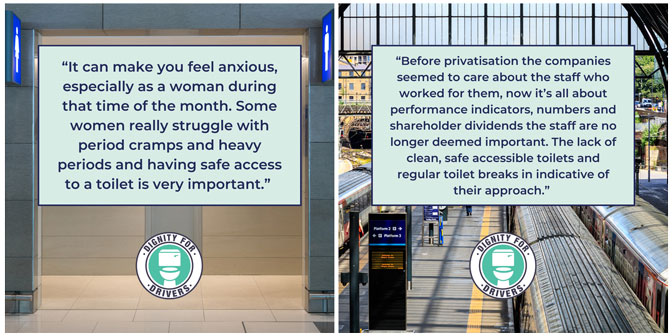
Drivers responding to an ASLEF survey and focal groups reported using inappropriate containers in the cab, having to leave trains to urinate on the tracks, and sometimes wetting themselves. Women drivers had additional problems with toilet access, periods and access to sanitary products.
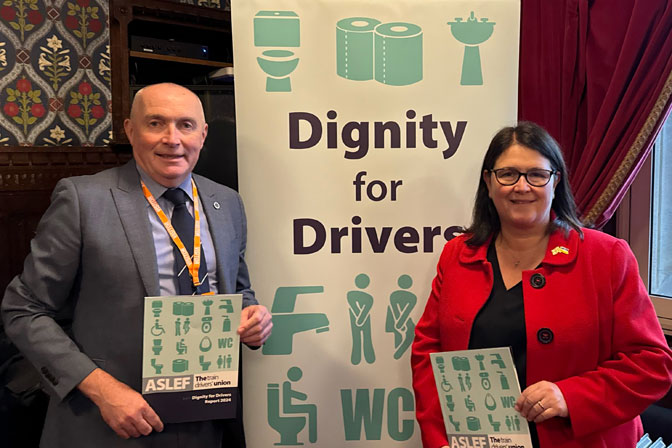 Dave Calfe, ASLEF’s executive committee president, and Labour MP Rachel Hopkins addressed the Westminster launch of the union’s Dignity for Drivers report. Hopkins hosted the meeting and chairs ASLEF’s parliamentary group. The report is based on a survey of more than 3,000 train drivers and focus groups where train drivers shared their sometimes harrowing experiences.
Dave Calfe said: “The industry is now on notice to make real change for train drivers to have access to toilet facilities across all parts of Britain’s railway network.
“Our campaign started after a Women’s Committee item was adopted at ASLEF’s annual assembly of delegates (AAD) which concerned the health benefits of cutting maximum continuous driving hours, and diagramming more frequent personal needs breaks (PNBs), easing and preventing conditions that include decreased risk of toxic shock, DVT, bladder issues, colorectal cancer, and prostate cancer.
“After being told by many companies that we had to pay for any changes, we made it clear that Dignity for Drivers is not a productivity issue – we are not paying through negotiation for our health and wellbeing or for access to toilet facilities – it’s the employer’s responsibility.”
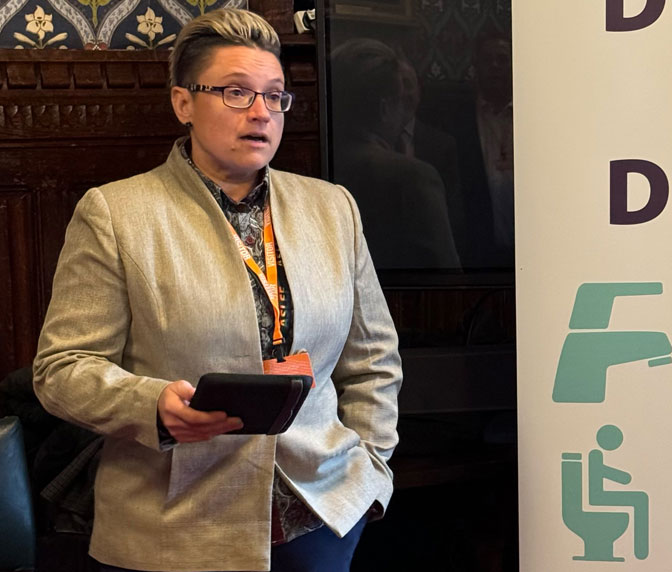 Train driver Julie Clegg, a member of ASLEF’s women’s committee – which kicked off the campaign – told MPs about her personal experience driving a train and facing the indignity of a lack of access to toilets at work. Clegg said all operators want to attract more female drivers, but the lack of toilets was a barrier.
The union demanded a maximum of four hours without access to a toilet and raised this with the safety regulator, and government, following the results of its survey of members.
“As a result of our campaign an industry roundtable was convened by the HM Chief Inspector of Railways, in June 2025, attended by the general secretary and me,” at which the regulator agreed to the four key principles in ASLEF’s 2024 report:
- A maximum period of four hours without access to toilet facilities as standard across the industry.
- The provision of safe, clean, accessible, and dignified toilet and welfare facilities across the network.
- Drivers must be able to go to the toilet based on their individual and personal needs, without being subjected to management interference, discrimination, or disciplinary action.
- All operators to provide free sanitary products in the workplace and for them to be made available across the network for drivers who want to use them.
“HM Chief Inspector of Railways has now told the industry that ‘access to clean, safe, and reliable welfare facilities is not a luxury – it is a basic requirement in any civilised society,” Calfe said.
“The current situation, where some railway workers still lack adequate facilities or the time to use them, is unacceptable. This is a matter of human dignity, health, safety and respect to our people.”
The ASLEF leader added: “We made it clear at the meeting that the current arrangements are unacceptable.
“The meeting agreed to develop and promote a charter of principles, supported by all duty holders, based on our four key demands, with a commitment to shared access to facilities, expanding the Network Rail welfare facilities app to include freight and on-track machine operators and third party suppliers, building on its existing map to identify gaps.
“The industry has also been urged to identify and provide universal access arrangements across operators; adopt simple interim solutions such as pop-up units; and make rostering adjustments to allow for breaks, especially in freight.”
He said the union welcomed the leadership shown by HM Chief Inspector of Railways and looked forward to the industry implementing, in full, the welfare charter by the end of 2026.
“Change is the only option and we will play our part in encouraging that change,” said Calfe. “Finally, I’d like to thank all those members who completed the survey – that gave us the ammunition for change in our industry.”
FLUSHED WITH SUCCESS
Train drivers will finally have access to toilets at work, in a big win for their union ASLEF.
| Hazards webpages | |
| • | Toilets at work |