

In 2024 the national union body for Wales, TUC Cymru, commissioned a report on health and safety regulation in Wales.
The purpose was to inform its Health, Safety and Workplace Regulation Committee on how best to represent the views of trade unionists to the Workplace Rights and Responsibilities Forum (WRRF) set up by the Welsh government.
Changes in the structure, organisation and control of work and employment pose significant problems for the enforcement of regulatory standards.
Two particular features stand out. One is the health effects reflected in statistics showing mental health and musculoskeletal disorders are responsible for a substantial part of the burden of work-related Ill-health in the UK. They show little sign of responding to regulation.
Latest statistics released by the Health and Safety Executive (HSE) in November 2025 show in Great Britain “mental health conditions remain the primary driver of work-related ill health, with 964,000 workers reporting stress, depression or anxiety caused or made worse by work in 2024/25.” This is the highest ever figure, up 24 per cent on the previous year (see: HSE is broke).
Overall, 1.9 million working people were suffering from a work-related illness in 2024/25, again a record high. HSE estimates the annual cost of workplace injuries and new cases of work-related ill-health at £22.9 billion.
Changing jobs
The second obvious feature is that changes continue to create forms of work and employment which themselves are hard to reach and challenging to regulate.
Growth in employment in micro and small firms, self-employment, agency work, platform work and other non-standard forms of employment all contribute to regulatory scenarios in which protecting workers’ health and safety is harder for regulators, whose own resources have been reducing in parallel.
A further feature of this scenario is the blurring of boundaries between traditional safety and health issues and those associated with poor conditions of work and employment more generally – the connections between mental health issues and low pay, job insecurity, high demand and low control etc are obvious features of work, as are the strain injuries associated with prolonged repetitive tasks.
Equally obvious, is that for many of the non-standard forms of work in which these conditions arise, scant attention is paid to preventive health and safety management.
Even where there are safety management systems in place, they seldom address the organisation and control of work and employment leading to these poor health outcomes. In such situations, there is an ‘enforcement gap’ in the regulation of labour standards.
In Wales, the British enforcement regime covering gangmasters, employment agencies and the minimum wage – since 7 April 2026 merged into the Fair Work Agency - operates alongside devolved Welsh government jurisdiction over health matters. Regulatory responsibilities overlap to an extent.
During the Covid 19 pandemic, when its policies on work related control of exposures differed from those of the UK government, the Wales government set up a Health and Safety Forum bringing all these regulators together with unions, employers and other interested parties.
In 2022 this Committee was transformed into the Workplace Rights and Responsibilities Forum (WRRF). It is supported by the Fair Work Directorate of the Welsh government.
Union study
TUC Cymru wished to explore experiences and perceptions among trade unionists and regulatory actors in Wales of the role of sharing and using information, and collaborative actions to secure compliance with health and safety standards. In particular, it wanted to consider the potential role of the WRRF in supporting this.
The study commissioned by the union body began with a review of published sources of information relevant to work health and safety in Wales.
It moved on, first to talk with trade union representatives and staff at TUC Cymru, and then to interview informants among regulatory agencies and other labour market organisations with membership of the WRRF, about their experiences of sharing information and undertaking joint activities, and of WRRF support for this.
It found work-related fatality and ill-health rates were worse in Wales, including levels of work-related stress, depression and anxiety and musculoskeletal injuries.
Comparison of health and safety outcomes between Wales and the UK
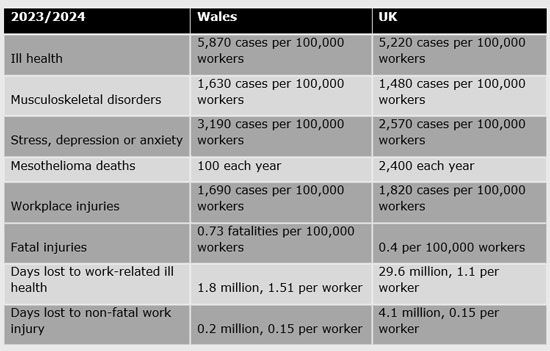 Source: Adapted from Health and Safety Executive 2024 Workplace health and safety statistics for Wales, 2024.
Patterns of enforcement were also broadly the same as for the UK more widely, with declining levels of enforcement associated with reduced resourcing over recent decades.
Prominent among the concerns of trade unionists, were health issues arising as consequences of the organisation and control of work and employment – which they felt were not addressed by conventional occupational safety management systems or their enforcement – even where these systems were present (which was seldom, and only in larger work organisations).
They expressed further concern about the lack of an obvious presence of enforcement activity directed at employment standards, including in relation to health and safety.
 NAILING IT Effective enforcement on occupational health and safety in Wales requires cooperation between HSE and environmental health and other regulators covering gangmasters, employment agencies and minimum wage which since 7 April 2026 have formed part of the Fair Work Agency, which has offices in England and Wales.
The informants from the regulatory enforcement bodies that were members of the WRRF, all recognised a labour market ‘enforcement gap’ in Wales, such as identified in the research literature in relation to labour standards and precarious and insecure work.
But it was perceived in different ways and to differing degrees. They all conveyed a strong sense of ‘doing the best they could with the resources available to them’ in a changing labour market whose size and complexity was not matched by their resources for securing compliance with regulatory standards.
Work health and safety matters were among the abuses encountered by all the enforcement agencies, not only by the HSE and the Environmental Health Departments.
They also recognised the widespread presence of psychosocial risks and their health consequences, but several indicated the problematic nature of establishing regulatory breaches in relation to these matters in comparison to more straightforward occupational safety issues.
In terms of sharing information and working together to help to close the perceived ‘enforcement gap’, they all acknowledged the important role of good information and especially of sharing this information in securing compliance with employment standards.
They also acknowledged that when serious breaches of one element of labour standards were discovered, further investigation revealed breaches in other areas too.
Joint regulatory actions were seen as potentially helpful for addressing overlapping concerns with work health and safety issues and in supporting compliance. However, informants drew attention to institutional, legal, procedural and personal constraints that limited capacities to share information and undertake these actions.
Nevertheless, they gave examples of how they had overcome constraints, including drawing work health and safety abuses to the attention of the HSE, strategic liaison and using Memoranda of Understandings between agencies to clarify what kind of information could be shared and what was confidential.
Several gave examples of joint actions between enforcement agencies, targeting abuses in particular sectors or locations (although few were located in Wales). Others talked about higher levels of strategic liaison between themselves and the HSE on platforms set up for such purposes.
However, informants gave few examples of systematic, proactive or prolonged institutional liaison beyond that already existing between the HSE and Environmental Health Departments on the one hand, and those coordinated by the Office of the Director of Labour Market Enforcement on the other.
All the informants indicated they found the WRRF useful for the exchange of information but there was little sign of its use more strategically.
Indeed, a key finding of the study was that the examples of information sharing and joint regulatory activities discussed by informants had all taken place without the direct involvement of the WRRF.
Nevertheless, some informants saw ‘a role for it to play… to go that bit further than to just share information’.
Regulation problem
Overall, the report found that the platform created by the WRRF afforded opportunities to develop ways of improving the existing employment rights enforcement in Wales.
This could occur through cooperation between regulatory actors and between them and other stakeholder membership of the Forum.
TUC Cymru’s Health and Safety Regulation Committee has recommended the report to its General Council.
This included backing a call on the Welsh government to “increase funding so that environmental health officers can undertake more proactive health and safety inspections for local authorities”, and for “work with the UK government and its agencies, through the Workplace Rights and Responsibilities Forum to encourage innovative and strategic joint operations and data sharing between regulators in Wales.”
But the report concludes that to take advantage of these opportunities, several constraints need to be addressed, including questions of leadership in the complicated jurisdictional responsibility framework resulting from the mix of devolved authority of the Welsh government, and the UK wide responsibilities for work health and safety regulation held by UK government agencies.
Underlying these constraints is resourcing. A significant factor in the seeming unwillingness to grasp opportunities for more joined up enforcement is fear that they will create more work for the actors and institutions involved without bringing commensurate resources.
Given the lamentable history of UK governmental support for improving compliance with employment and health and safety standards in recent decades, their reluctance is understandable.
Unless this is addressed, it seems unlikely that the potential of the WRRF as a platform for better practice will be fully realised.
- David Walters and Eva Makri. Regulating Work Health and Safety in Wales, TUC Cymru, 2025. www.tuc.org.uk/wales
SAVING WALES
The government in Wales is promising action on workplace health and safety. Labour standards experts David Walters and Eva Makri outline how unions set out to examine the plan and ensure it is properly informed by engaged trade unions and look at lessons for Wales and beyond.
| Contents | |
| • | Introduction |
| • | Changing jobs |
| • | Union study |
| • | Regulation problem |
| Hazards webpages | |
| • | Organising at work |