
I recently worked with a group of midwives, who due to NHS funding cuts were forced to use a small space next to the labour ward in order to discuss medical issues and update patients’ notes.
Their cramped ‘office’ was damp, poorly ventilated and the walls were covered in mould. The room wasn’t only a health hazard to the midwives, but also to the pregnant women and newborn babies under their care.
Senior management made sympathetic noises but argued that they didn’t have the budget to do anything about it.
That was until a newly trained Royal College of Midwives (RCM) safety rep brought her co-workers together to challenge the employer. The midwives refused collectively to work in the room. Within a week, a much more hygienic room miraculously became available.
This is just one of countless examples from the past 50 years of how trained safety reps have protected the health of their members. Members of the public too.
Ever since the late 1970s when the Safety Representatives and Safety Committees Regulations (SRSC Regs) were introduced, governments of all political shades recognised the tangible benefits of well-trained safety reps; not just for workers but for employers and to society in general.
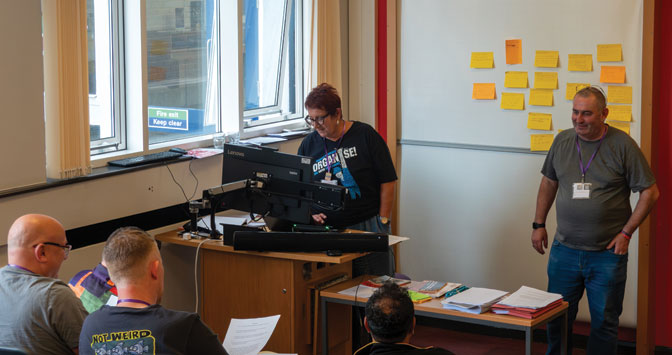
 EYE SORE Trade union funding is in a serious mess, leaving union safety rep training in jeopardy. The numbers harmed by work is already at record levels and going up – so Dave Smith is warning unions and unions reps need to act now to rescue this livesaving service.
Proactive union safety reps have a positive impact on public health, which saves the public purse a lot of money. Unsurprisingly therefore, for many years training for safety reps has received financial support from central government, with nationally agreed funding levels set for each course. Trade union education (TU Ed) centres based in Further Education colleges were able to draw down full funding to deliver high quality accredited qualifications for safety reps.
That consensus stopped in 2014, when George Osborne changed the funding mechanism, meaning that colleges could only claim half of the course cost.
The impact of the 50 per cent funding cut for safety reps training has been dramatic. Today there are only 13 TU Ed centres across the whole of the UK. There were 64 pre-2014. Some centres now only deliver courses online, meaning in large swathes of the country there is no classroom-based union training provision. This has an obvious impact on trade unions’ ability to organise effectively to improve workplace health and safety.
Postcode lottery
An additional funding problem arises due to an unintended consequence of education funding being devolved to Scotland, Wales and Northern Ireland, and to local authorities in England with an elected mayor.
Devolved funding ensures that money for adult education stays within the devolved authority to train people locally. That is fine for an A-Level English Literature course or an NVQ in bricklaying, which have similar provision in colleges across the UK.
It is a disaster for training for union safety reps, which is much more specialist, as many devolved authorities do not have a TU Ed centre.
 URGENT LESSON Trained safety reps make workplaces safer, but funding cuts and reorganisation of college funding is putting trade union education in mortal danger. www.hazards.org/unioneffect
It is now a postcode lottery, with reps in some locations able to attend fully funded courses locally, while other reps have literally no local provision, and if they attend courses delivered by a college outside of their devolved area – including online courses – no funding is available.
Colleges are now being forced to invoice unions for the safety reps who cannot access training where they live.
For example, Bristol City College is the only trade union education centre in the whole of the South West. Until recently it was able to draw down the 50 per cent funding for all safety reps they trained irrespective of where in the region they lived. Not any more.
Cornwall has now became a devolved funding authority. Without a Cornish TU Ed centre, funding for all safety reps from that county is now uncertain. It’s not just Cornwall.
The authorities that already have devolved authority for trade union education funding are Scotland, Wales, Northern Ireland, Greater London, North East, Tees Valley, York and North Yorkshire, South Yorkshire, East Midlands, Greater Manchester, Liverpool City Region, Bristol/West of England, Cambridgeshire and Peterborough, and Cornwall.
East Anglia, Essex, Kent and Devon could soon follow.
The fees are not insignificant. The TUC’s flagship 10-day Safety Reps Stage 1 course will be charged at £540 per rep. The TUC Diploma in Occupational Health and Safety will cost a whopping £1,728.
Fees even apply when a safety rep attends training provided by their own union. A short 3-day accredited risk assessment course would cost £216 per rep.
These imposed funding changes affect any safety rep from any devolved authority who attends training outside their own authority. This will have a significant financial impact on any union currently running their own national education programme.
Financial pressures could create a situation where some union safety reps get training and some reps don’t, purely based on where they live. This in turn will affect the ability of trade unions to organise effectively in some areas.
Pay per go
The funding crisis is compounded even further as some colleges are starting to apply course fees to all safety reps attending training - even those living within the college’s own funding authority.
For example, from 1 September 2025, senior management at Capital City College (CCC, formerly CONEL) decided to charge fees for all reps attending TUC and affiliated union training courses. This means whenever safety reps living in London earning over the London Living Wage are trained by the college, their unions will now be charged between £90 and £720 for each attendee, depending on the course.
These new fees apply to all union courses delivered by Capital City College. This change will impact on the viability of the TU Ed centre, as these fees are likely to be untenable for unions in the long run.
This particularly affects unions with large membership in London & South East. Given the financial restraints across the Further Education sector, it’s likely that other colleges will follow suit.
Change course
TU Ed needs to be classified as a specialist subject within adult education provision, allowing colleges to claim full funding for any training as set out in the SCRC Regulations Brown Book, irrespective of where the training takes place or which college delivers the course.
This is not pie in the sky, it would merely restore funding to how it was before the George Osbourne cuts.
There may be differences of opinion about the long-term future direction of trade union education, but this immediate funding crisis needs to be urgently resolved.
At the 2025 TUC Congress delegates even debated a composite motion on “the ongoing issues regarding the funding of in-person TUC Education training” and called on the TUC General Council to “seek discussions with the government and combined authorities to ensure the continued provision of TUC Education”.
Linda Littler from UCU, the union representing tutors who teach safety reps, spoke in the debate, arguing that: “Without training we lose organising power. “I’m certain that many employers will not be too perturbed if pesky reps could no longer call them out on health and safety and discrimination. With the previous government, you could be forgiven to think it would not be a priority for them. But surely the Labour government should support funding reform that ends the postcode lottery that there is for members’ training.”
This issue is too important to be left to the TUC General Council. Every safety rep who has ever attended a training course needs to pass motions and apply pressure within their own unions to sort out the funding crisis. Or else the free training provision of accredited training for safety reps could rapidly cease to exist – under a Labour government.
The cost of funding safety reps training is a pittance in the national education budget.
But not funding safety reps training will inevitably result in more avoidable accidents, more occupational diseases, more workplace fatalities, more family tragedies.
It will be workers and the public that end up paying the price.
CLASS ACT
Safety reps save lives. Training them is a critical component of any coherent national safety policy. But, warns organising expert Dave Smith, the dangerous impact of a dramatic long-term reduction in government support for union safety courses is now being amplified by funding devolution.
| Contents | |
| • | Introduction |
| • | Postcode lottery |
| • | Pay per go |
| • | Change course |
| Hazards webpages | |
| • | Organising |
| • | Organising 101 |