

The approach a company takes to occupational health and safety can have profound consequences for its workforce. In an era in which businesses make increasingly bold claims about their role in society, it’s reasonable to expect that they take health and safety seriously.
There are also increasing expectations of investors to hold companies to account for their policies and practices, as a result of the growing focus on environmental, social and governance (ESG) factors. So how can investors and others tell how companies are performing? One of the interfaces between companies and investors is company reporting.
Companies produce annual reports, primarily aimed at investors and their advisers. Where once these focused almost exclusively on financial metrics in recent years they have expanded to cover a range of ESG issues.
In addition, companies are required to set out the principal risks to the business, whether financial or otherwise. Therefore, annual reports are an obvious place to look to what companies are telling their investors about their approach to health and safety, and this has been the focus of recent research undertaken by PIRC.
To get a full picture of company disclosures on health and safety, we focused on three areas. We reviewed fines and notices issued by the Health and Safety Executive (HSE) and sought to link these back to companies in the FTSE350 – one of the main indexes of companies listed on the London stock market. We also drew data from the annual reports of the FTSE350 constituents. And we looked specifically for information on contingent workers.
Regrettably we found significant deficiencies in reporting in all the information we reviewed.
Half-hearted
Starting with the Health and Safety Executive (HSE) enforcement activity, we were able to link fines or improvement or prohibition notices to around a third of companies in the FTSE350.
Since 2011, 12 PLCs have been served convictions for breaches, with total combined fines amounting to £8,603,670. Just seven (58 per cent) listed occupational safety as a ‘principal risk’ in recent reporting. Of the 57 companies that received enforcement notices since 2019, only 30 (53 per cent) did this.
Whilst it is a decision for a company to determine what is a principal risk, being subject to enforcement activity, even under a regulatory regime that has been significantly weakened by cuts in funding, would seem to be significant.
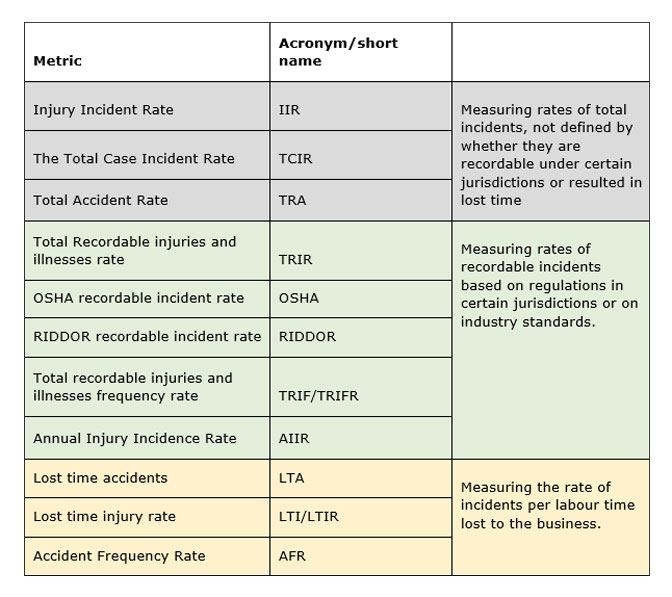
In fact this first finding was indicative of a much wider problem of patchy and inconsistent reporting by companies. We found that whilst 60 per cent of the FTSE350 disclose information in their annual report on employee safety incidents, there is no standardisation of reporting. In some cases, companies switch metrics from year to year, impeding analysis of safety practices over time.
Overall our review uncovered 40 distinct safety metrics being used within FTSE350 corporate reporting. Many metrics measure similar things but use different calculations – for example, some use hours worked as a measure of full-time equivalent workers and others count incidents per employees.
Written off
It is also worth noting here what – if anything – large public companies disclosed in their annual reports on Covid-19 cases and fatalities. In a separate piece of research in 2021 we looked at how FTSE100 companies dealt with this issue. Whilst all provided lengthy narrative about how Covid-19 impacted their business, among the FTSE100 only eight provided data on workforce cases or fatalities.
This is despite a number of other companies in the index acknowledging privately that workers have died from Covid-19.
The final issue we sought to explore was reporting in relation to contingent workers. It has been estimated that around 20 per cent of the workforces of large companies in both the UK and North America are contingent.
 BACK TURNED ‘Contingent’ or ‘platform’ workers like delivery riders are effectively invisible in some companies’ reporting, PIRC found, even where businesses are heavily reliant on their labour.
This means that they are kept off the payroll either as self-employed contractors, or through recruitment agencies or outsourced or franchised services.
Very few companies define what they mean when they report on contingent workers. Among the 12 per cent of the FTSE350 that define the size of their indirect workforce, language varies significantly. Our review uncovered companies describing “contractors”, “freelancers”, “riders” and “associates” – all used to denote those working for the company under self-employed contracts.
Forgotten contingent
Overall we found that in 2020/21 only 12 per cent of FTSE350 companies disclosed data about their contingent workforce. Even in high-risk sectors disclosures were lacking. Only 19 of the 57 PLCs that were served HSE enforcement notices since 2019 disclosed data on safety incidents among contingent workers.
Disclosures on contingent workers are most common in industries that have historically relied heavily on contractors, such as mining, construction, and manufacturing. However, within these industries disclosure levels are still mixed and metrics are self-selected.
Among companies in newer industries relying on high numbers of contingent workers, namely gig economy delivery platforms, there is a stark absence of workforce safety data. Here we looked wider than the FTSE350 to include some of the major platform employers.
There was no safety data provided for the 800,000 self-employed couriers delivering food for Deliveroo, Just Eat and Grubhub, three of the biggest platforms operating in the UK. For Uber Eats, there was no data provided for either the number of couriers, or the number of safety incidents. At present, investors and others are provided with a very partial picture on safety performance. The three key issues identified in our analysis intersect.
First, the lack of reporting of violations by companies means that safety risks are not being picked up by shareholders and other stakeholders. As a result, scrutiny of the governance and compliance of companies is inhibited.
This lack of scrutiny permits companies to cherry pick which safety metrics they disclose. Their self-selection is influenced by limited regulatory pressure, industry norms and an interest to portray the most favourable picture of their operations. The linking of workforce safety metrics such as fatality rates to executive remuneration, as PIRC’s previous research has explored, can produce perverse incentives to present favourable results and even underreport incidents.
Making it better
In total this poses a significant problem for any stakeholders who are serious about seeking to assess company performance on safety. So what can we do to improve reporting?

GET SHIRTY You too can be dressed-not-to-kill in the Hazards Campaign’s ‘Organise!’ t-shirt. £10 including p&p. Details from Janet Newsham, GHMC.
Email: janet@gmhazards.org.uk. Phone: 07734 317158.
Online: www.gmhazards.org.uk
PIRC supports recommendations for both increasing disclosures relating to contingent work via public policy and elevating the significance of occupational safety.
The overall lack of disclosures on contingent workers among UK listed companies is in part a result of the fact that Section 172 of the Companies Act 2006 uses the term “employees”. The TUC has advocated for this to be amended and replaced with “workforce” which would mandate enrichened corporate disclosures that includes contingent workers across a range of issues such as pay and safety.
Similarly, the 2017 Taylor Review of modern employment practices made a recommendation that large companies be required to “make public their model of employment and use of agency services beyond a certain threshold”.
In absence of these advancements, we support voluntary initiatives such as the Workforce Disclosure Initiative in the UK and the Human Capital Management Coalition in the US. We’re also pushing on both individual companies and sectors to provide more information. For example, we have contacted gig companies requesting they begin disclosing safety data for their large contingent workforces.
No shirking
Looking wider, we believe it may be helpful to develop new frameworks for improved workforce reporting that build on successes in other areas. It is no secret that corporate disclosures on social risk lag behind those on environmental risk, and there are lessons that can be learned from the latter.
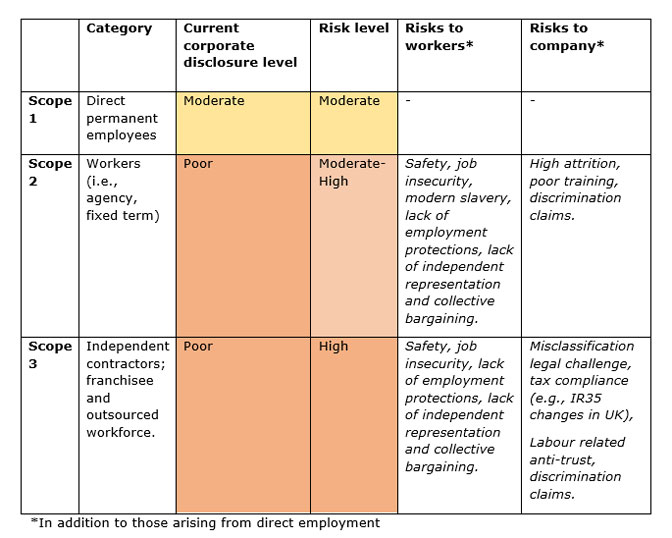
The Greenhouse Gas Protocol has ensured that those with significant capacity to reduce their climate impact do not shirk their responsibilities and has led to more standardised reporting, in turn providing accountability over corporate decisions. Its framework for categorising the various types of carbon emissions that organisations are responsible for – Scope 1, Scope 2 and Scope 3 – has been valuable for companies and their investors.
With some adaption, we believe that this framework could be utilised to assess social risks posed by a company in relation to the composition and treatment of their workforce. As a prompt for further discussion the table below outlines how the Scope framework could be used for categorising employment relationships and the risks posed by forms of contingent work.
PIRC believes that safeguarding and improving conditions of workers – whatever the nature of the employment relationship – is both one of their most important duties and one of the most significant positive impacts companies can have.
Current reporting has both huge gaps and lacks comparability – and disclosures are lacking in the areas where risks are most acute. Contingent workers are invisible to all intents and purposes in some companies’ reporting, even where businesses are heavily reliant on their labour.
Taking a structured approach of this type would ensure that the safety of delivery drivers working for platform companies, or subcontracted builders on sites run by major construction firms, becomes a reporting responsibility for those firms that benefit directly from their labour. It would seek to enable investors to understand where the risks are and to better support improved practices for the workforce as a whole.
Make them count
Injuries and fatalities amongst the workforces of Britain’s biggest listed companies – and the regulatory penalties that result – are routinely unreported to investors, a new study has revealed. Tom Powdrill of responsible investment thinktank PIRC explains the serious implications of the organisation’s research.
| Contents | |
| • | Introduction |
| • | Half-hearted |
| • | Written off |
| • | Making it better |
| • | No shirking |
| Hazards webpages | |
| • | Hazards news |
| • | Deadly business |